7 Min Read
A close look at the findings of the 2026–2027 Asia Design Trend Report shows that light is no longer a supplementary finishing element. The descriptions and keywords of many winning entries show that light has become a primary design material. It now works as a core element in shaping space, atmosphere, and brand identity. The report names this broad current “LUMINSCAPE,” a combination of Luminous, the sensation of shining, and Landscape, the built environment.
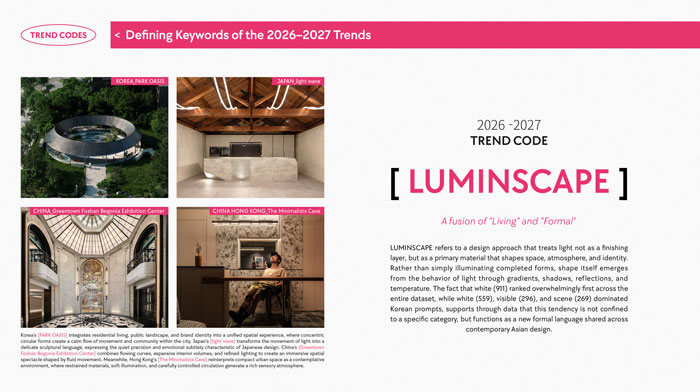
LUMINSCAPE is more than a new word that joins two terms. It marks the arrival of a new design material at the point where the sensation of light meets space. It reflects an approach that treats light itself as a formative element, and the outlook of designers who use light as a core material of architecture and space. The text analysis offers telling evidence. The word “white,” which is closely tied to space, had the highest frequency, appearing 911 times among the 142,290 words analyzed. It appeared 559 times in Korean winning entries, 119 in China, 62 in Japan, 40 in Hong Kong, and 98 in Taiwan. When a single word appears at the top across all major regions, it can hardly be a coincidence. Here, white is not simply a color choice. It is the most basic canvas for receiving, reflecting, and revealing light. On white walls, white ceilings, and white furniture, light becomes a tool for evoking intended sensations in the user. From this analysis we concluded that the “white” that recurs in the data is not an empty, colorless void but the most precise medium for holding light.
Why, then, has design begun to use light as a primary material now? The surface reason is technological progress. With the spread of LEDs and OLEDs, precise light control, integrated systems of natural and artificial light, and devices that adjust color temperature over time, designers can finally control light from the earliest planning stages rather than at the finishing stage. But technology is only half the reason. The more fundamental shift is that the central subject of design is moving from objects to atmospheres. An object is defined by its form, while an atmosphere is defined by light.
In an era of design that shapes atmosphere, the rise of light as a primary material is a natural progression. Another key factor is the more varied gaze of users. Today we rarely stay still within a single scene for long. Movement through the city is constant, and the eye, rather than fixing on a single object, drifts from scene to scene. In this context, composing a scene means using light to set spatial coordinates where a moving gaze can pause for a moment. The fact that words such as “visible,” “scene,” and “side” rank near the top of the data for Korean winning entries suggests that designers treat the user’s line of sight and movement as core variables of spatial design. Light becomes the most precise tool for shaping that intangible flow.
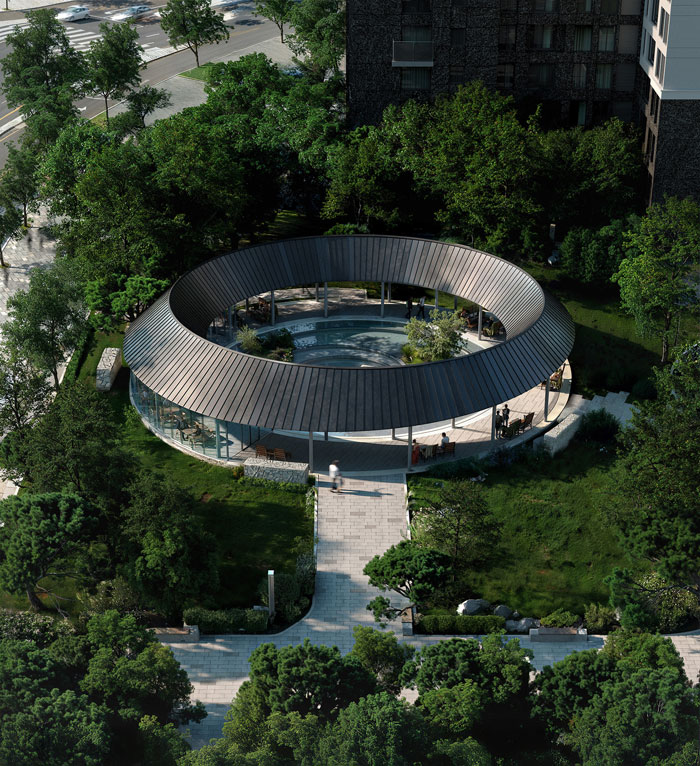
< PARK OASIS, ASIA DESIGN PRIZE 2026 Design of the Year >
The regional cases make this trend clearer. Korea’s PARK OASIS, selected as this year’s ADP Design of the Year, is the clearest expression of LUMINSCAPE. The project brings together elements of different kinds, a residential complex, a public park, and a corporate brand, within a structure of two concentric circles. The circles are not decorative devices but core structures that organize spatial flow, field of vision, and the experience of staying. During the day, natural light spreads along the curved surfaces, emphasizing the openness and continuity of the space. In the evening, artificial lighting forms layers of shadow along the inner surfaces, creating a calmer, denser atmosphere. Here, light is not a decorative element that supplements form but a structural element through which people perceive direction, depth, and the passage of time. By treating light as a core material from the initial design stage, PARK OASIS shows how LUMINSCAPE can be realized in contemporary spatial design and brand experience.
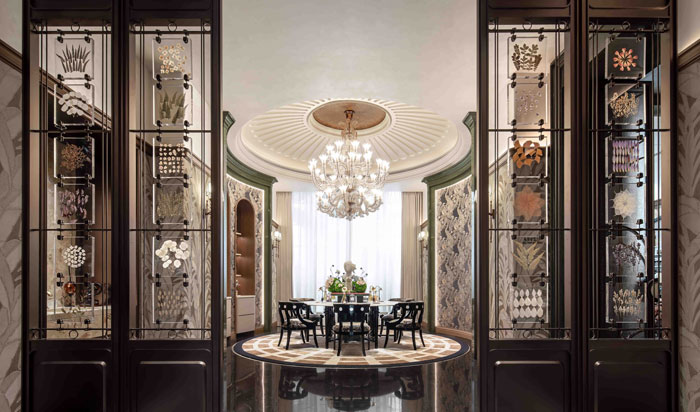
< Greentown Foshan Begonia Exhibition Center, ASIA DESIGN PRIZE 2026 Winner >
China’s Greentown Foshan Begonia Exhibition Center shows how LUMINSCAPE works at a very large scale. It combines a vast interior, elegant curved structures, and restrained lighting into a single integrated environment. The simultaneous rise of words such as “large,” “wall,” and “scene” in the data for Chinese winning entries shows that designing light around large walls and expansive interiors has become an important strategy. Where the Korean case centers on a refined experience of staying and quiet immersion, the Chinese case takes a different path, building a more dramatic and active immersive environment through sheer spatial scale and lighting. Gradual shifts in light heighten the viewer’s senses in stages.
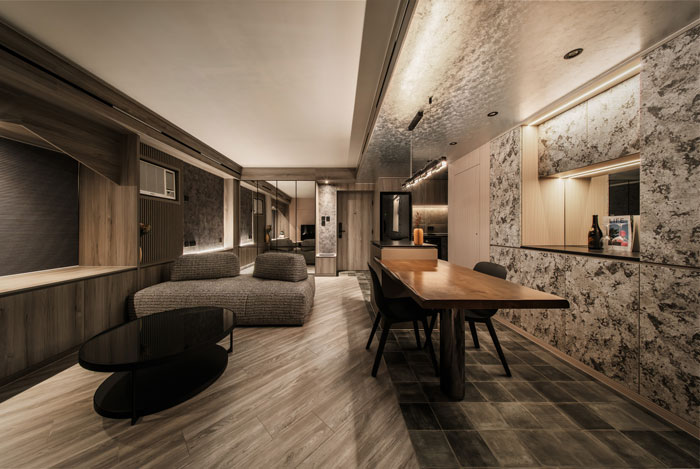
< The Minimalists Cave, ASIA DESIGN PRIZE 2026 Winner >
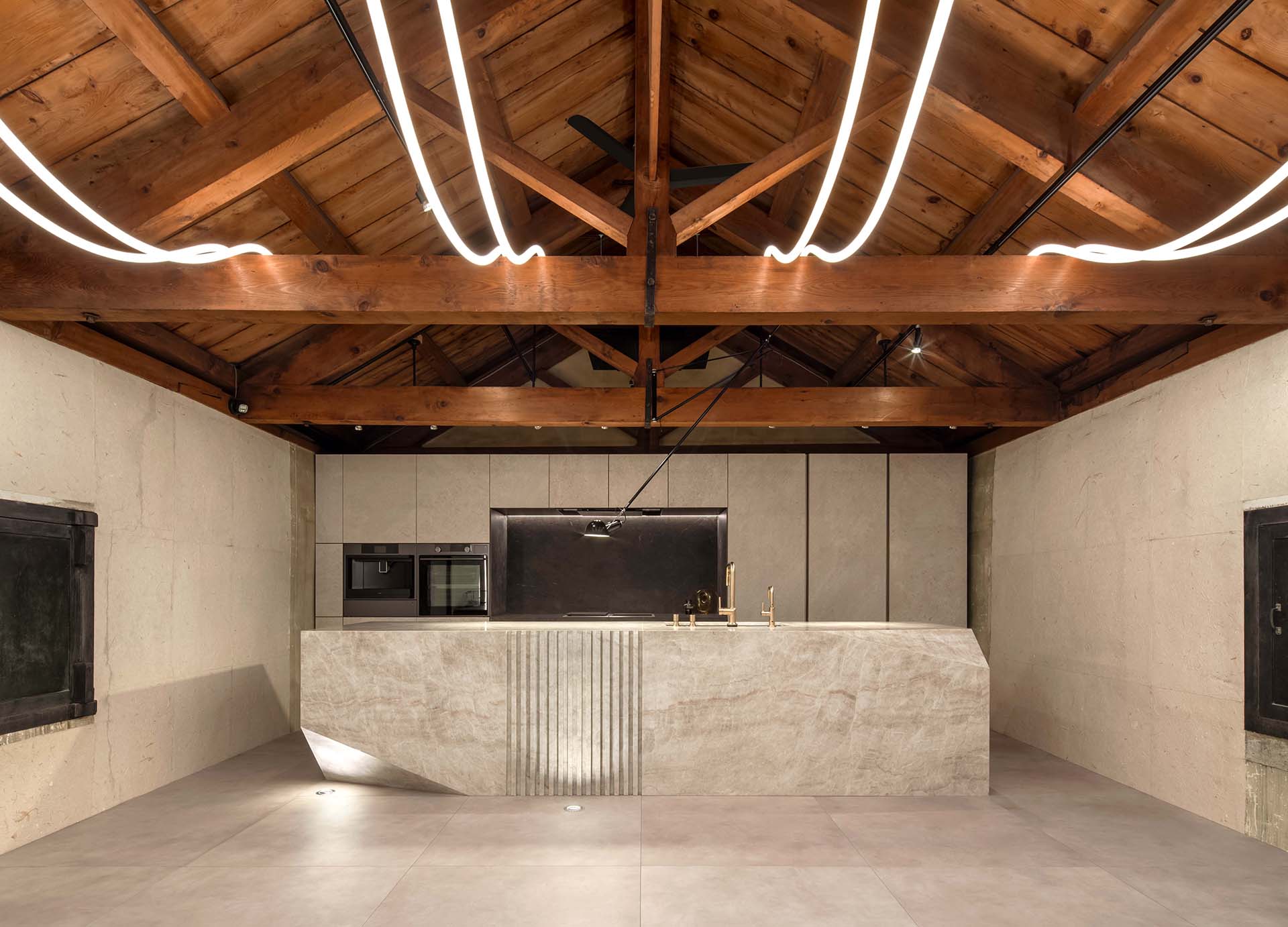
Hong Kong’s winning entry The Minimalists Cave points in another direction. In the text analysis of Hong Kong’s winning entries, “room” appears more often than “space,” and “interior” ranks highly. This suggests that Hong Kong design focuses not on filling wide spaces but on using light to extend the physical limits of a confined room. Restrained illumination leads the user toward quiet contemplation, and the narrow space is reinterpreted as a dense, concentrated experience shaped by light. The project shows how a cramped area, combined with light as a primary material, can become a deeper and broader experience.
Taken together, these regional cases show that LUMINSCAPE is not a uniform, surface-level trend. Korea’s LUMINSCAPE is light that composes a scene, China’s is light that induces immersion, and Hong Kong’s is light that condenses. Although “white” emerged as the top keyword in all major regions, what light produces on that white canvas differs greatly depending on local context. More notable still, this current is not limited to spatial design. As Japan’s light wave shows, light is rapidly extending its influence into product and interface design. light wave translates the physical phenomenon of light waves into a formal language, making light the basic material that shapes the product’s form and emotional character. Home appliances whose surface textures change in response to ambient light, and devices that synchronize with the user’s biorhythms, all stem from a shift that treats light as an active, formative material.
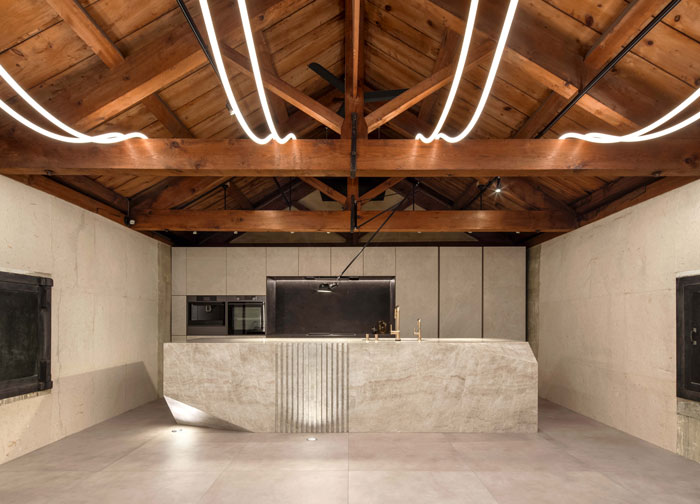
< light wave, ASIA DESIGN PRIZE 2026 Gold Winner >
One development we cannot overlook is that LUMINSCAPE is gradually absorbing the separate field of lighting design. Traditionally, lighting was an independent specialty within spatial design, and spatial designers often simply took over the lighting plan and made fine adjustments. In the era of LUMINSCAPE, these boundaries are breaking down. Spatial designers must treat light as a structural axis from their first sketches, and graphic designers must work out how typography on a white surface will read under specific lighting. Where the once rigid borders between design disciplines dissolve, LUMINSCAPE is likely to establish itself as a new common language. Finally, a shift is required of designers themselves. In the era of LUMINSCAPE, designers need two new sensibilities. First, they must design space together with light from the very beginning, rather than add light as an afterthought. Second, they must not simply see light as surface brightness but read the spatial context behind it.
The core competence now asked of designers goes far beyond controlling the amount of light. They must be able to read the subtle color temperatures and textures of light, the depth carved out by shadow, and even the negative space and silence left where light has passed. We no longer ask merely, “What form shall we place on a white canvas?” We must ask, “With what quality of light shall we bring the white canvas itself to life?” LUMINSCAPE begins where that question begins. The answers of contemporary designers who have thought hardest about this defining question unfold quietly but deeply throughout the winning entries of ADP 2026.












#14057, 905 49, Beolmal-ro 102beon-gil,
Dongan-gu, Anyang-si, Gyeonggi-do, Korea
Business Registration Number: 454-86-01044
Online Sales License No.: 2021-Anyang Dongan-1081
Copyright © DESIGNSORI Co., Ltd.