Recently, while reviewing students’ portfolios, I had many thoughts. Each project showed a high level of visual completion and contained intriguing ideas. Yet there was a strangely familiar atmosphere running through them. The themes of the works were different, but the underlying tone did not feel unfamiliar. I wondered if perhaps students, while referencing platforms like Behance or Pinterest, were beginning to resemble each other in their visual language. Design, in essence, is less about creating something entirely new out of nothing, and more about refining the existing, stripping away the unnecessary, and shaping it into a better form. In that sense, it is natural for students to imitate the work of seniors, peers, or publicly available designs and, through that process, find their own direction. However, now that AI has firmly established itself as a pillar of creation, the situation is shifting. Generative AI produces thousands or tens of thousands of images before a designer has even thought them through, functioning as a vast reference archive. This leads to a pressing question: if AI can generate every possible idea, is the designer’s unique sensibility truly safe?
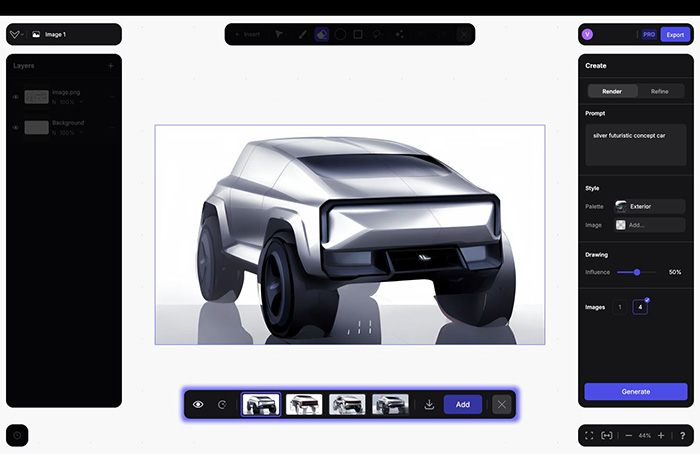
< Viscom AI: A sketch generated from a text prompt >
One freshman once asked, “If generative AI can easily create high-quality sketches, is it still necessary to practice sketching?” This question goes beyond the matter of practice methods and touches upon the very essence of design education. In industrial design, sketching is not just a means of expression but a tool for exploring ideas and expanding thought through the hand. Yet if AI quickly replaces this process, designers may skip the moments of reflection and jump straight to the outcome. Speed increases, but the internal assets built through deliberate contemplation may fade. Today, we are growing accustomed to receiving optimal answers instantly from AI. But the true value of design lies not in quickly finding the right answer but in refining one’s own sensibility through countless trials and errors.

A recent study conducted at MIT Media Lab supports this concern. Researchers divided students into three groups: one without any tools, one using search engines, and one using generative AI, then asked them to write essays. The group that used ChatGPT showed significantly lower brain activity. Their work was produced more quickly and easily, but the mental connections and memory involved in thinking, as well as their sense of ownership over the text, diminished. This study suggests that AI does not steal our sensibility itself, but rather reduces opportunities for us to think and struggle on our own. Ultimately, what matters is not speed but the inner assets gained through the process—and the same applies to design.
A great chef is not merely someone who follows recipes. They touch ingredients to test their freshness, adjust the heat with subtle precision, and craft depth of flavor. Likewise, an excellent designer possesses intuitive judgment beyond data. Texture, weight, and the way light reflects on material are elements no static image can fully capture. Yet AI offers refined images with disarming ease. In doing so, the time spent sketching with pencil on paper or shaping clay by hand gradually diminishes. This may lead to the fading of sensorial intuition. What designers lose is not technique but depth. Students accustomed to digital environments increasingly avoid hands-on making, and older design practices are fading into obscurity. This trend could signal that deep reflection in design is dwindling—a tendency likely to accelerate in the age of AI.
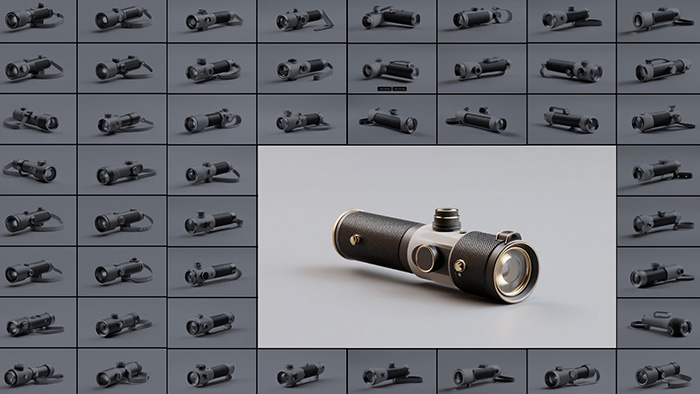
< Midjourney-generated design draft >
Still, we cannot simply conclude that AI hinders creativity. On the contrary, AI compels us to reconsider the essence of sensibility. Generative AI offers infinite possibilities through keywords, but the choice of which to embrace, why it is appropriate, and how to refine and implement it remains a human responsibility. AI does not replace sensibility; rather, it highlights its importance. Faced with countless AI-generated drafts, designers can question themselves more rigorously: “What image do I truly seek? Why is this choice more appropriate than another? How can I infuse a sense of humanity into this?” Such questions are not merely about selecting results but serve as exercises in honing a designer’s sensibility.
Thus, designers in the AI era must treat AI not merely as a tool but as a collaborative partner. Even if AI presents thousands of designs, blindly accepting them is dangerous. Instead, designers should analyze them, ask “why this design,” and accumulate experiences that build their own judgment criteria. Leaving everything to AI is risky. At times, it is essential to sketch by hand, build prototypes, and feel materials directly. The delicate nuances discovered only through such experiences—the so-called handcraft instinct—are values AI can never provide. While AI can elevate designers to a higher dimension, the leadership of the process must remain with the designer.
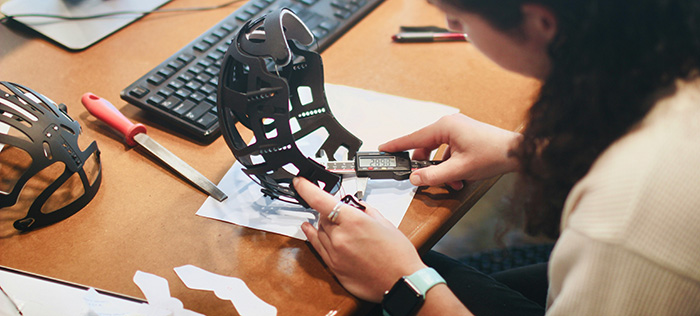
< Photo by Tool., Inc on Unsplash >
Today’s design process is constantly evolving, with new tools and technologies emerging endlessly. Yet amid this change, what must never be lost is fundamental sensibility. AI is not just a tool, but an assistant that allows designers to act as conductors and curators. Future designers must navigate the infinite possibilities AI provides without losing their compass. The true compass is not derived from flashy tools or cutting-edge technologies, but from instinctive sensibility and experiential knowledge. Creativity blooms when a pencil touches paper, when subtle differences are discovered by feeling materials with one’s fingertips, when vivid resonance emerges from heated exchanges of ideas with peers. The ability to discern the “real” among AI’s countless answers comes from precisely these experiences. Therefore, instead of fearing AI, we must actively embrace the technology while choosing a path that preserves sensibility. This is the unwavering identity of designers in the AI era and the condition for creative leaders who will guide the next generation.




















#14057, 905 49, Beolmal-ro 102beon-gil,
Dongan-gu, Anyang-si, Gyeonggi-do, Korea
Business Registration Number: 454-86-01044
Online Sales License No.: 2021-Anyang Dongan-1081
Copyright © DESIGNSORI Co., Ltd.