
Who creates a brand? Is it the founder who first started the business? The team members who develop its products and services? Or the customers who have chosen and supported the brand over time? In the early stages of a business, the answer to this question is relatively clear. The founder gives the brand its name, establishes its direction, and invests personal time and capital. However, as the brand grows, the situation becomes more complex. The team expands, external experts become involved, and customers and business partners begin to exert greater influence. At some point, the brand becomes something that can no longer be explained solely by the efforts of its founder. A brand undoubtedly grows through the contributions of many people. Talented team members improve the quality of its products, while the insights of experts can create important turning points. Without the trust and choices of customers, even the most outstanding brand cannot sustain itself.
Yet there is an important distinction to be made. Contributing to a brand’s growth and having the authority to determine its direction are two different matters. Contributions deserve proper recognition and compensation, but they do not automatically confer rights over the brand as a whole. These boundaries can become particularly blurred as a small brand grows. Collaborations that initially begin with mutual belief in each other’s potential may develop into complicated relationships of competing interests over time. Some individuals may come to equate their personal roles with the brand’s overall success, while others may expect continued influence based on their past contributions. Conversely, conflicts may also arise when founders fail to adequately recognize the efforts of those who have worked alongside them. It is difficult to attribute such situations entirely to one side. What is clear, however, is that the less clearly roles, authority, and responsibilities are defined, the more energy a brand is likely to waste on unnecessary conflicts.

I founded DESIGNSORI Media in 2008, driven by a desire to document stories about design and introduce outstanding designs and designers to the world. In 2012, I launched the K-Design Award, followed by the Asia Design Prize ten years ago. Over the years, DESIGNSORI has evolved into a media platform that documents ideas, perspectives, and experiences in design. The K-Design Award has established itself as a premium international design award, while the Asia Design Prize has grown into a platform dedicated to discovering and recognizing the achievements of designers. Countless people have contributed to shaping these three brands into what they are today. Jury members, partners, organizers, and designers have all played important roles in their respective fields. Without their expertise and participation, none of these achievements would have been possible.
Through years of experience, I have learned that building a brand is not about a founder accomplishing everything alone. It is a process in which people with different backgrounds and capabilities come together to pursue a shared direction. However, that journey has not always been smooth. As the brands grew in scale and influence, there were moments when expectations surrounding roles and authority began to diverge. Perspectives on the scope of collaboration and compensation differed, and at times, individual interests took precedence over the long-term direction of the brand. Initially, I believed that maintaining relationships was the best way to resolve these challenges. Over time, however, I came to realize that preserving every relationship is not always the right decision for the long-term health of a brand.
What mattered was not determining whose contribution had been greater. It was about clearly defining the direction the brand should pursue and establishing who would bear ultimate responsibility for that direction. The opinions of external experts deserve respect, but not every suggestion can be followed. The contributions of collaborators must be fairly recognized, but individual interests cannot take precedence over the brand’s principles. Above all, when important decisions affect the future of a brand, there must be someone clearly accountable for their consequences. Where, then, does a founder’s authority come from? Can every decision be justified simply because the founder was the first to create the brand? Certainly not. A founder may be the person who started the brand, but that alone does not mean their judgment is always correct.
The authority to determine a brand’s direction must be accompanied by the responsibility to accept the consequences of those decisions. If a founder shares the rewards of success with others but shifts the blame for failure onto them, that authority will inevitably lose credibility. I believe that when determining who truly owns a brand, the weight of responsibility matters just as much as legal ownership. Who spends the most time thinking about the brand’s future? Who is willing to accept personal losses to uphold its principles, even during difficult times? And when problems arise, who remains until the very end to resolve them? Owning a brand is not merely about having the right to enjoy its success. It is about taking responsibility for the decisions made in its name.
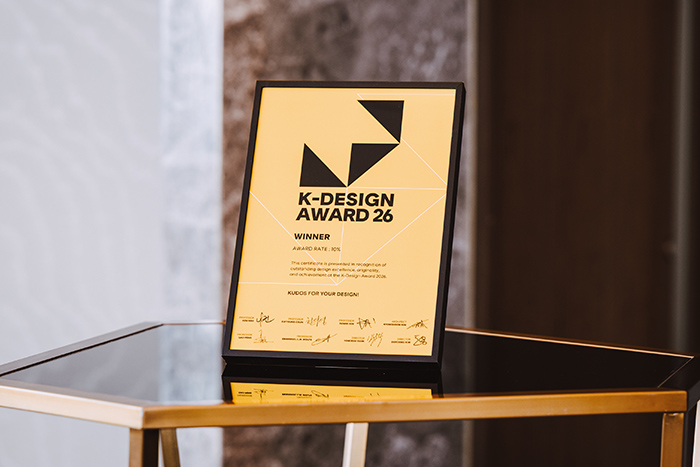
< Image source: K-Design Award >
The role of customers is equally important. A founder may determine how a brand is managed, but cannot unilaterally determine what that brand ultimately means to people. Whether a brand’s promises hold genuine value is ultimately determined through customer experience. No matter how compelling a founder’s philosophy may be, a brand cannot endure if customers fail to experience that value. Conversely, when customers recognize a brand’s value and repeatedly choose it, the founder’s vision finally acquires meaning in the marketplace. In this sense, a brand has different kinds of owners. There are those who hold legal rights and management responsibilities, and there are those who experience and evaluate the brand’s value firsthand. These roles are not inherently in conflict. A brand grows when its founder operates it with clear principles and accountability, while customers trust and choose the value it offers. Establishing clear authority over brand management and listening carefully to customers are entirely compatible.
This balance becomes even more important for microbrands, where the founder’s thinking and judgment directly shape the brand’s identity. In a small organization, a single decision by the founder can change the direction of the business, while one poor judgment can undermine trust built over many years. The greater a founder’s authority becomes, the more rigorous the standards they must apply to themselves. They must listen to different perspectives without avoiding responsibility, collaborate without compromising their principles, and accept the consequences of the decisions they make. As I prepare for the next decade, this is precisely what I consider most important: establishing a strong foundation for managing all three brands so that each can grow with a clearer direction while preserving its own philosophy. I believe this requires not the exercise of greater authority, but clearer standards for decision-making and a greater willingness to accept responsibility. Collaboration with talented people will certainly continue. However, for those partnerships to endure, they must be built on mutual respect for each other’s roles and a shared commitment to the brand’s principles.
As a brand grows, its founder must acknowledge that not everything can remain under their control. At the same time, they must never lose sight of what they are ultimately responsible for. A brand’s achievements are the result of many people’s efforts, but its direction and the ultimate responsibility for its management must remain clearly defined. When accountability is clear, collaboration becomes healthier, and the values a brand seeks to uphold remain firmly grounded. Who, then, truly owns a brand? I do not want to answer this question simply by saying it is the founder. A brand begins with the founder’s determination, but it grows through the contributions of countless people and the trust of its customers. Nevertheless, whoever holds the authority to determine a brand’s future must also be prepared to take full responsibility for the consequences of those decisions.
“To own a brand should not mean claiming greater rights. It should mean accepting the responsibility to remain accountable until the very end.”




















#14057, 905 49, Beolmal-ro 102beon-gil,
Dongan-gu, Anyang-si, Gyeonggi-do, Korea
Business Registration Number: 454-86-01044
Online Sales License No.: 2021-Anyang Dongan-1081
Copyright © DESIGNSORI Co., Ltd.