
One of the most notable shifts in Chinese design in 2026 is the movement from structure and function toward user experience. China has long been recognized for large scale spaces, highly developed production systems, and rapid execution. More recently, another strength has become increasingly visible: designers are considering not only what they make, but also how users move through a space, experience a brand, and interact with technology. The Chinese award winning projects featured in the 2026–2027 Asia Design Trend Report clearly demonstrate this transition.
The ten most frequently used words in the prompts of Chinese award winning projects are room (122), white (119), space (114), large (101), modern (100), wall (91), side (88), black (69), visible (65), and scene (64). The similar frequencies of room, white, and space indicate that large interior environments and contemporary spatial expression form an important foundation of Chinese design. The frequent appearance of large, wall, and scene also suggests that designers are paying more attention to the composition of an entire space than to an individual object. It is also notable that black is the only color related word to appear in the top ten. White often establishes the basic order of a space, while black is used to create contrast and direct attention toward specific areas or products. This shows how actively Chinese designers use visual contrast and focus within large environments.
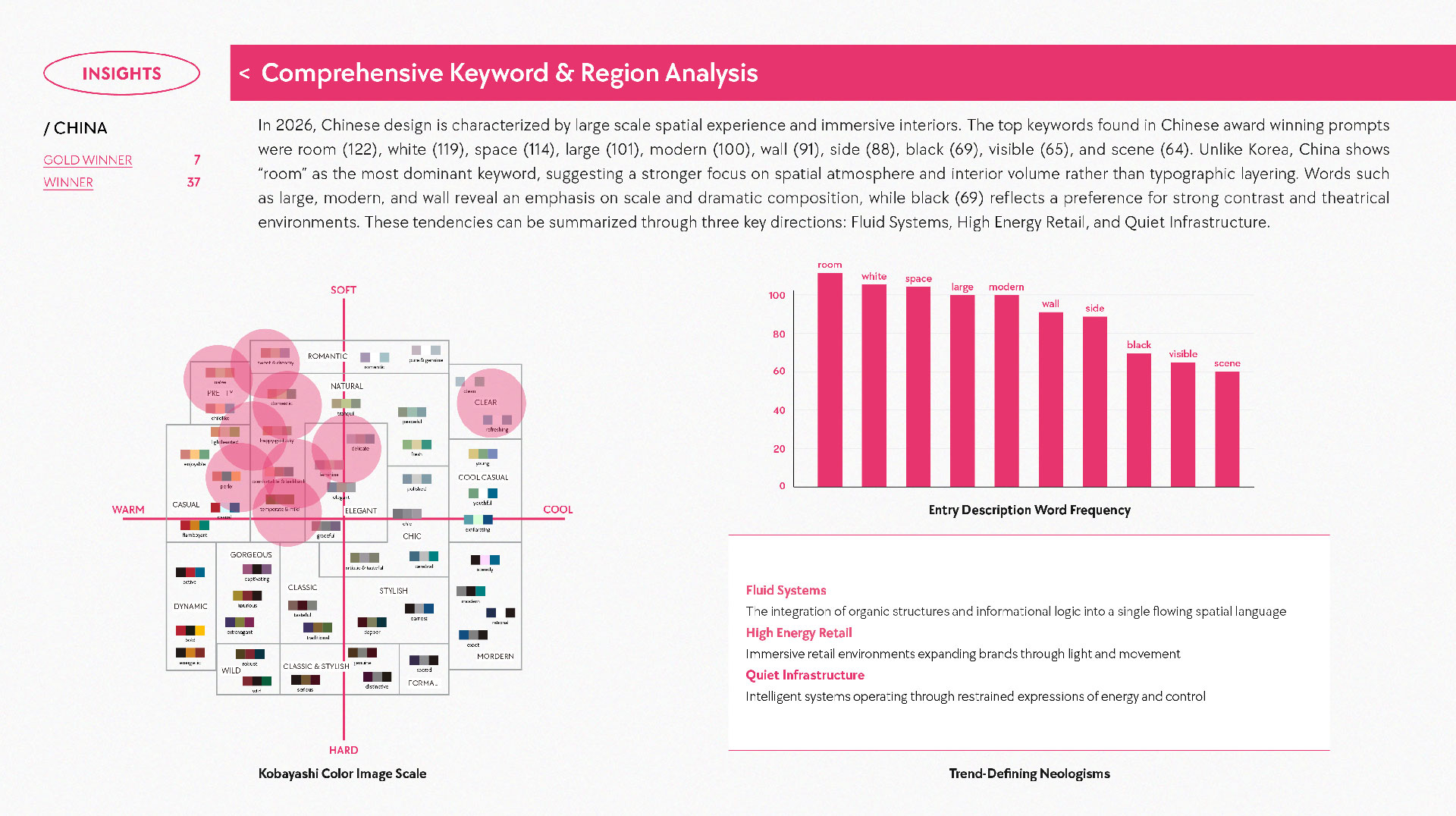
The report identifies three major trends: Fluid Systems, High Energy Retail, and Quiet Infrastructure. Although they appear to belong to different categories, they share one important principle. The value of design is increasingly defined not by structure itself, but by how users move, stay, interact, and complete tasks within it.
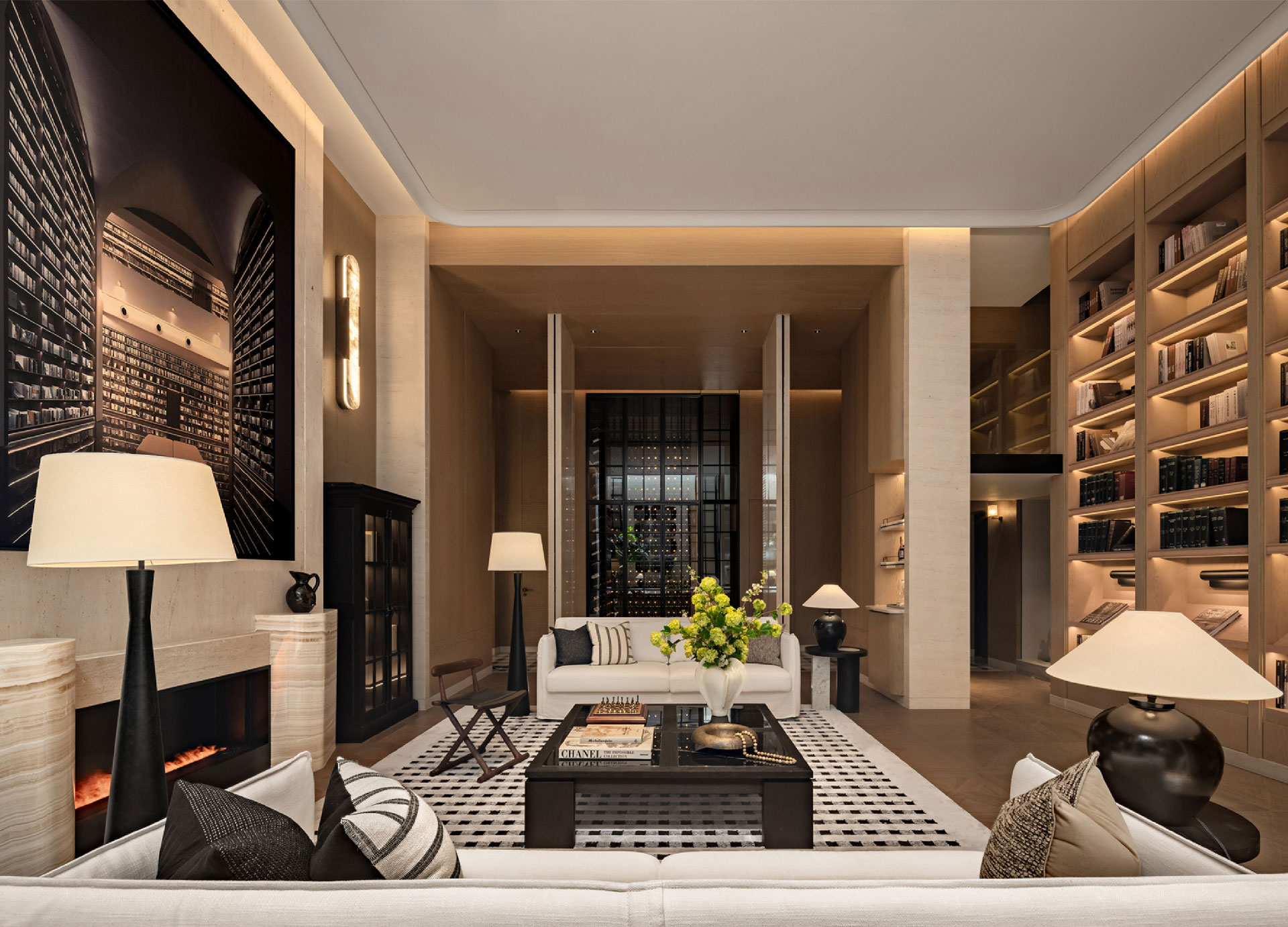
< ISLE MAISON, ASIA DESIGN PRIZE 2026 WINNER >
The first trend, Fluid Systems, approaches space not as a fixed form but as a continuous user experience. This tendency is clearly visible among Chinese award winning projects. ISLE MAISON connects a tea room with a 270 degree view to the surrounding garden, reducing the boundary between interior and exterior. The Prism Shanghai extends sightlines through a sunken courtyard, large curtain walls, and diagonal relationships between walls and ceilings. Secluded Dwelling also uses spatial division, materials, light, and shadow to guide users through a sequence of scenes. The important point is not the use of curves itself. What matters is whether users can naturally understand where to enter, where to move, and where to pause. The evaluation of spatial design is therefore expanding from formal completeness to the quality of the movement experience.
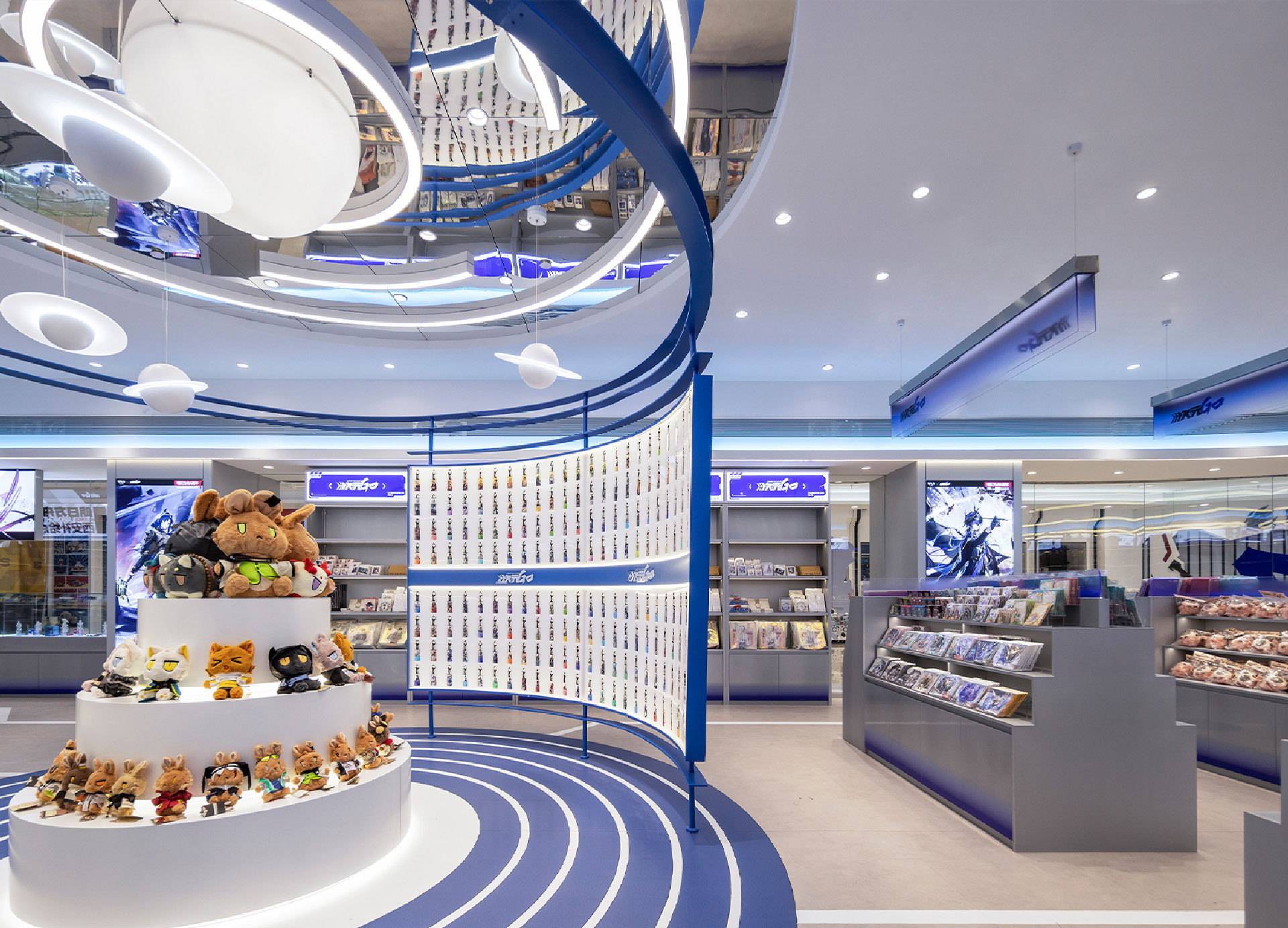
< Dimension Go Anime Retail Flagship Store, ASIA DESIGN PRIZE 2026 WINNER >
The second trend, High Energy Retail, transforms retail spaces from places of purchase into places where customers directly experience a brand. DIMENSION GO ANIME RETAIL FLAGSHIP STORE is a representative example. Rather than simply displaying animation characters and merchandise, the store combines large scale lighting, graphics, digital media, and circulation to create a complete content experience. Customers do not simply look at products. They move through a world created by the brand. The design also considers which scene customers encounter first, where they are likely to take photographs, and at which points they focus on products. Retail spaces in China are therefore developing beyond sales functions to include content creation, brand experience, and social sharing.
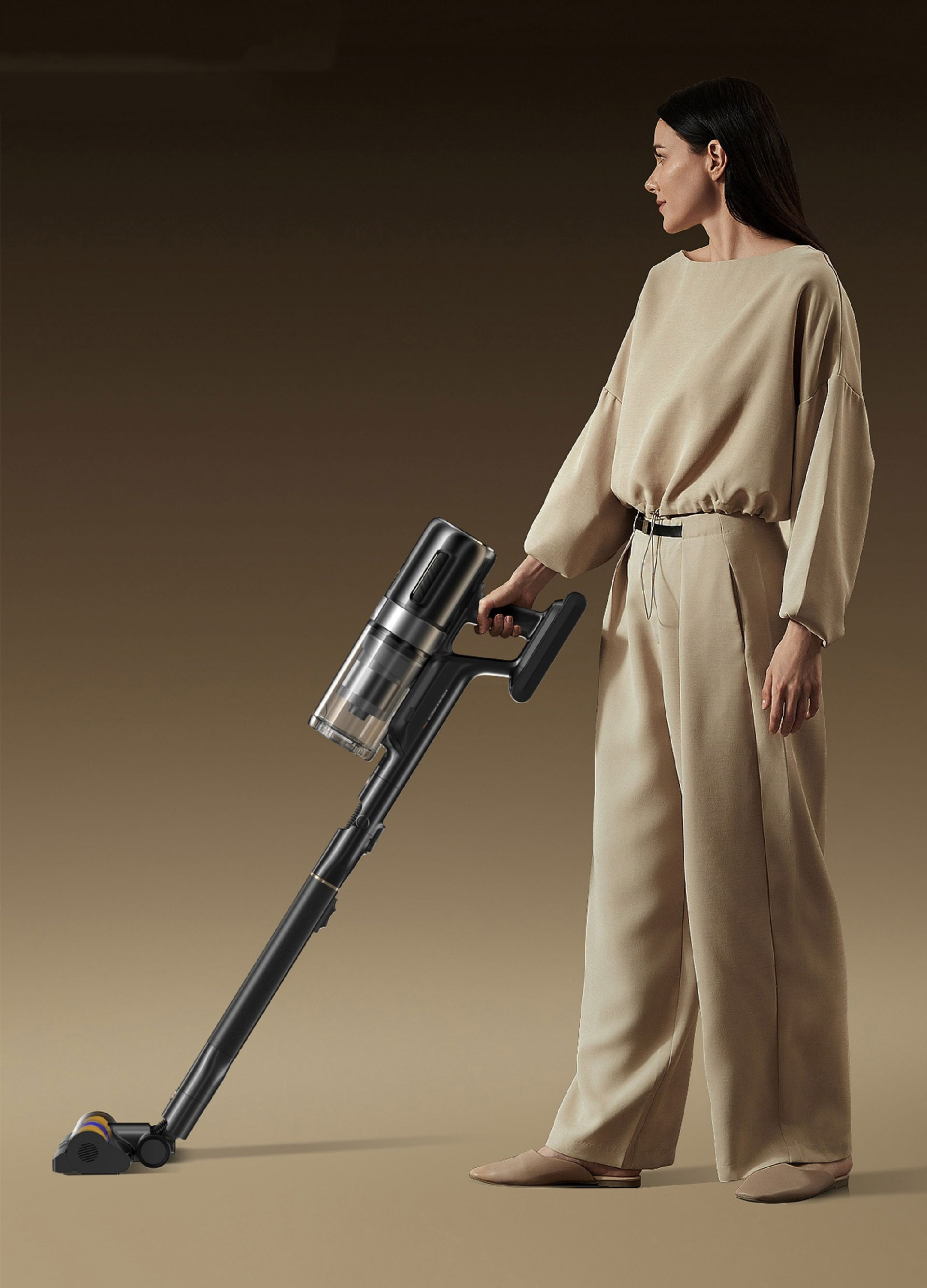
< Dreame Z50 Station Vacuum Cleaner, ASIA DESIGN PRIZE 2026 GOLD WINNER >
The third trend, Quiet Infrastructure, focuses on making technology more convenient and safer without making it overly visible. The Dreame Z50 Station Vacuum Cleaner integrates AI dust detection, automatic dust collection, and long term dust storage into a simple cleaning experience rather than presenting each technology separately. The P50 needlefree injector reduces user anxiety and the risk of misuse through a needle free injection system and a dual safety lock. MagiCenter minimizes visual interference by displaying only the information needed in different situations such as work, gaming, and meetings. What these products share is a clear design priority: technology should help users achieve their goals without requiring constant attention.
These three trends show that Chinese design is beginning to manage not only large spaces and complex systems, but also small details of everyday use. One reason for this shift is the rising expectations of Chinese consumers. Products and spaces are no longer judged only by function and price. Consumers also consider atmosphere, tactile quality, connections between digital services and physical environments, and the overall experience a brand provides. Especially in major cities, a brand is increasingly understood as the sum of multiple touchpoints rather than as a single product.
A second reason is the growing confidence of Chinese brands. In the past, it was important to quickly learn from global brands and adapt their spatial and product strategies to the Chinese market. Today, more Chinese brands are proposing their own retail formats and product experiences. Stores such as Dimension Go do not simply reproduce the format of a global flagship store. They combine animation, games, digital content, and physical retail to create experiences that are specific to contemporary Chinese consumers. Chinese brands are moving from adopting external standards to proposing their own.
A third reason is the growth of technology infrastructure and digital content industries. Large LED systems, sensors, digital displays, real time interaction, and precise lighting and sound control are now practical tools for commercial environments. At the same time, experience models familiar from games, animation, livestream commerce, and short form content are influencing physical space. Photo zones are designed with content creation in mind, while lighting and graphics are planned to remain visually effective on screens. One of China’s key strengths lies in its ability to apply these technologies and content systems quickly to real spaces and products.
This development also makes it difficult to describe Chinese design simply as visually extravagant. Spaces such as DIMENSION GO ANIME RETAIL FLAGSHIP STORE create powerful immersion and strong visual impact, while products such as the Dreame Z50 Station Vacuum Cleaner and P50 needlefree injector reduce the visibility of technology and prioritize convenience and safety. The important point is that Chinese design is not converging on a single style. Its strength lies in adjusting the intensity of an experience according to purpose and context. Retail environments may use lighting, graphics, and digital media aggressively, while home appliances and medical devices reduce visual expression in favor of usability and stability. In the same market, both highly expressive design and intentionally restrained design are developing at the same time.
This diversity also shows that Chinese design is not moving toward one visual language. Retail design places greater emphasis on brand immersion and content experience. Residential and commercial spaces increasingly focus on circulation and spatial continuity. Home appliances and medical devices prioritize intuitive usability and ease of maintenance. Chinese design is therefore expanding not by repeating a specific form or color palette, but by creating different experiences for different industries and user situations. Its competitiveness lies less in establishing one recognizable style and more in its ability to generate multiple design responses for a wide range of markets and contexts.
To summarize, Chinese design in 2026 does not treat immersion and convenience as opposing values. When users need to focus on a brand or space, the experience becomes stronger. When products and technology need to blend naturally into everyday life, design intervention becomes quieter. Fluid Systems organizes movement, High Energy Retail strengthens immersion, and Quiet Infrastructure reduces the burden of use. These three trends are connected by the same principle: adjusting the intensity of experience according to the user’s situation. Chinese design can no longer be evaluated only by scale and production capability. Its new strength lies in designing both how strongly something should be experienced and how naturally it should disappear into use. This balance explains why Chinese design is increasingly able to deliver both immersion and convenience at the same time.












#14057, 905 49, Beolmal-ro 102beon-gil,
Dongan-gu, Anyang-si, Gyeonggi-do, Korea
Business Registration Number: 454-86-01044
Online Sales License No.: 2021-Anyang Dongan-1081
Copyright © DESIGNSORI Co., Ltd.