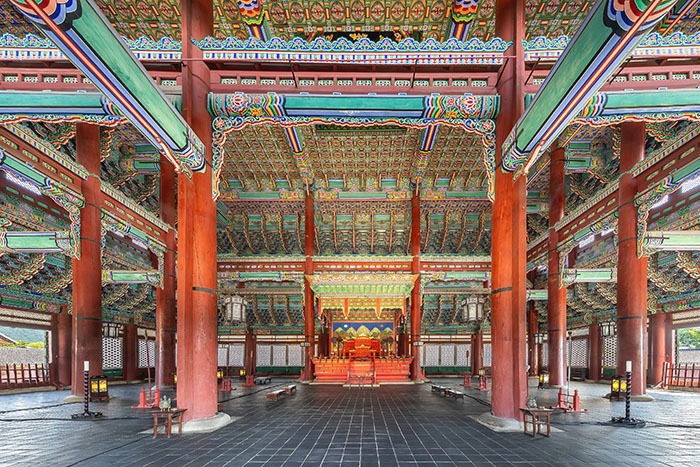
If we consider Geunjeongjeon Hall in Gyeongbokgung Palace, we can most clearly see how the concept of “kan” organizes space in wooden architecture. Geunjeongjeon is structured with five kan across the front and four kan along the side, and this simple numerical order determines the building’s hierarchy and authority. More importantly, however, is the spatial experience inside. The columns, repeated at regular intervals, draw the gaze deep into the space, and as the kan continue in sequence, the interior is perceived not as a single unified room, but as a series of layered spatial depths. As one’s gaze moves along the columns, the space does not end at a wall, but seems to extend continuously through the repetition of the structural frame. In this way, kan moves beyond being a mere unit of distance and becomes a device that generates spatial depth and rhythm. It is the moment when the repetition of structure becomes the experience of space itself.
This principle is not limited to palace architecture. In traditional hanok, the concept of kan operates more flexibly. The daecheong maru forms an open space by connecting multiple kan, while ondol rooms are divided into smaller kan to create more intimate, dense spaces. Within the same structural system, the character of space shifts depending on how kan are combined. Space is not partitioned by walls, but arranged through structural units. The same principle applies in temple architecture. Buildings such as Daeungjeon Hall at Bulguksa achieve both structural stability and symbolic centrality through the repetition of columns and kan. Ultimately, in Korean wooden architecture, kan functions both as the “minimum unit of space” and as the “unit that creates order.”
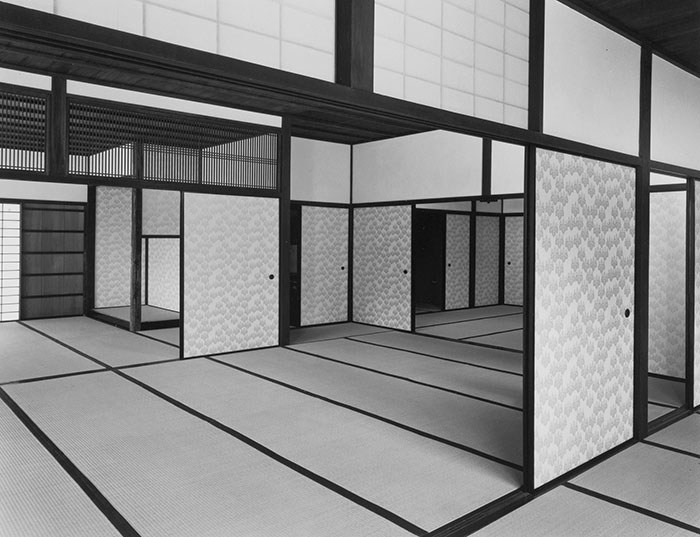
A similar structural way of thinking can also be found in Japan, though it unfolds differently. In Kyoto’s Katsura Imperial Villa, space is organized not by expanding outward, but through internal density and relationships. Here, the key concept is ma. Ma is not simply an interval, but a notion that encompasses tension, emptiness, and the flow of time between spaces. Developed through ancient Japanese rituals and architecture, this concept treats emptiness as an active element. The space between columns is not merely void, but a field where relationships and movement take shape. Tatami modules further refine this organization. While identical units repeat, their arrangement alters the depth and direction of space. If Korean architecture extends space through continuity with the outside, Japanese architecture modulates it through internal density and void.
In wooden architecture, columns are vertical elements, yet they also serve as the basis for horizontal expansion. As columns repeat, space gains continuity, and the horizontal line of the eaves extends that flow outward. Structure is not merely a system for bearing loads, but a mechanism that allows space to flow. In this sense, wooden architecture takes a fundamentally different direction from modern architecture. Reinforced concrete structures enable the free placement of walls, but in doing so, the relationship between structure and space becomes increasingly ambiguous. In contrast, in wooden architecture, the position of the structure itself defines the rhythm of space. The spacing of columns directly relates to the human body, naturally calibrating both the length of a step and the height of one’s gaze.
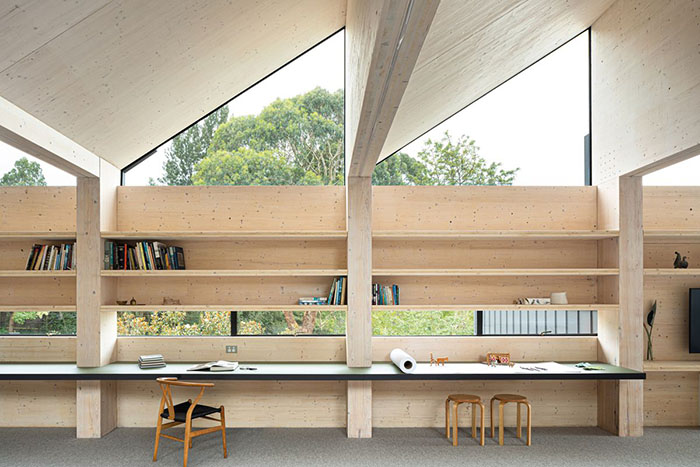
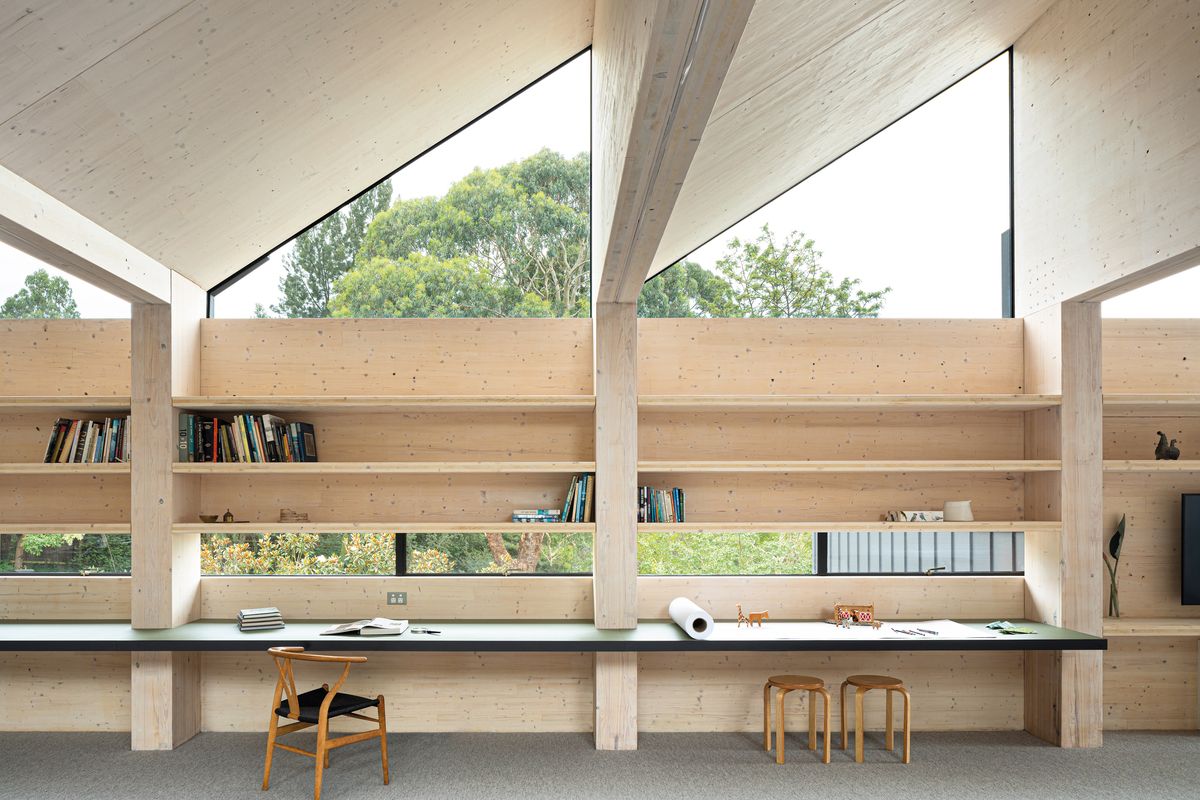
Even in contemporary wooden architecture, this order has not completely disappeared. Although engineered wood such as CLT emphasizes surface based structures, the logic of structure still functions as a key framework for organizing space. In particular, in heavy timber construction, columns and beams re emerge as central elements, and structure becomes legible once again. Columns and kan are not merely technical components. They are ways of understanding, connecting, and expanding space, and devices that calibrate proportion in relation to the human body. Structure remains fixed, yet within it, space continuously transforms. Perhaps the renewed interest in wooden architecture stems from this very reason, that the simple order of columns and kan has long shaped our sense of living and spatial perception, and is now returning to the fundamentals of architecture. Not an architecture where structure recedes into the background, but one where structure reveals the order of space.
“What organizes architecture?”
The oldest answer to that question remains the same: columns, kan, and the space between them. Through this simple principle, wooden architecture creates its deepest spatial experiences.