
How are the lattice structures of shoes and the folds of concrete columns created? We often understand design through its finished appearance. Yet a closer look reveals that form is determined by more than its outer contours. The direction and thickness of material layers, the structures that transfer forces, and even the textures produced during fabrication all become integral parts of design. As digital fabrication technologies advance, these relationships are becoming increasingly important. The way materials are processed and assembled is becoming a design language in its own right.
Generative AI can produce complex curved surfaces and intricate patterns at remarkable speed. However, the actual functions of the folds, openings, and lattice structures depicted in these images are another matter entirely. Beautiful forms do not necessarily imply structurally sound solutions, nor do sophisticated images guarantee that a design can actually be manufactured. This is why recent digital fabrication projects deserve to be examined not simply in terms of how novel or distinctive their forms appear, but through the materials, structures, and fabrication methods that make those forms possible.
The 3D-printed concrete pedestrian bridge Striatus, installed in Venice, Italy, in 2021, offers a compelling example of this transformation. Developed through a collaboration involving the Block Research Group at ETH Zurich and the Computation and Design Group at Zaha Hadid Architects, among others, the project reinterprets the principles of traditional arch structures through digital design and robotic fabrication technologies.
Striatus was constructed by assembling 3D-printed concrete blocks into an arch structure. What makes the project particularly interesting is that even the printing orientation of each block was treated as an integral part of the structural design. The concrete layers were oriented perpendicular to the principal compressive forces, while the geometry of the arches and the contact between blocks were designed to transfer loads through the structure. The bridge’s arch structure was assembled without steel reinforcement or bonding mortar, and the blocks were designed to be disassembled and reassembled.
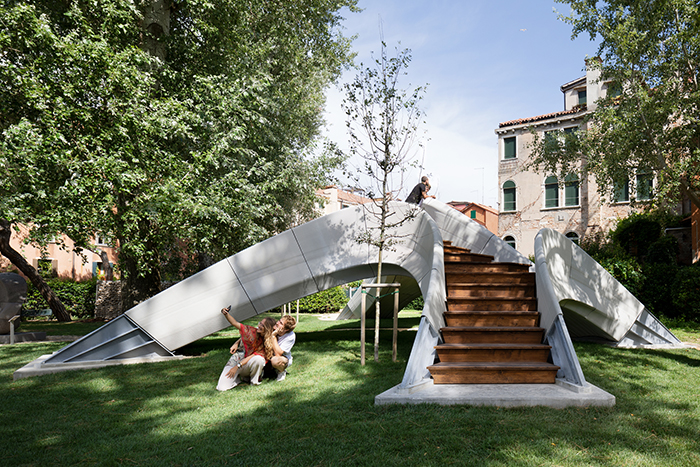
< Striatus 3D-Printed Concrete Bridge, Venice, 2021 >
Here, design does not end with creating the bridge’s elegant curves. Decisions about where to divide the blocks, which direction to print them, and how they should fit together all become essential elements in shaping the final form. The visible layers of concrete, seen up close, are not merely decorative surface details. They are traces that reveal the direction in which the material was deposited and the process through which it was fabricated. Structural logic becomes part of the visible form, while the fabrication process itself generates a new mode of sculptural expression.
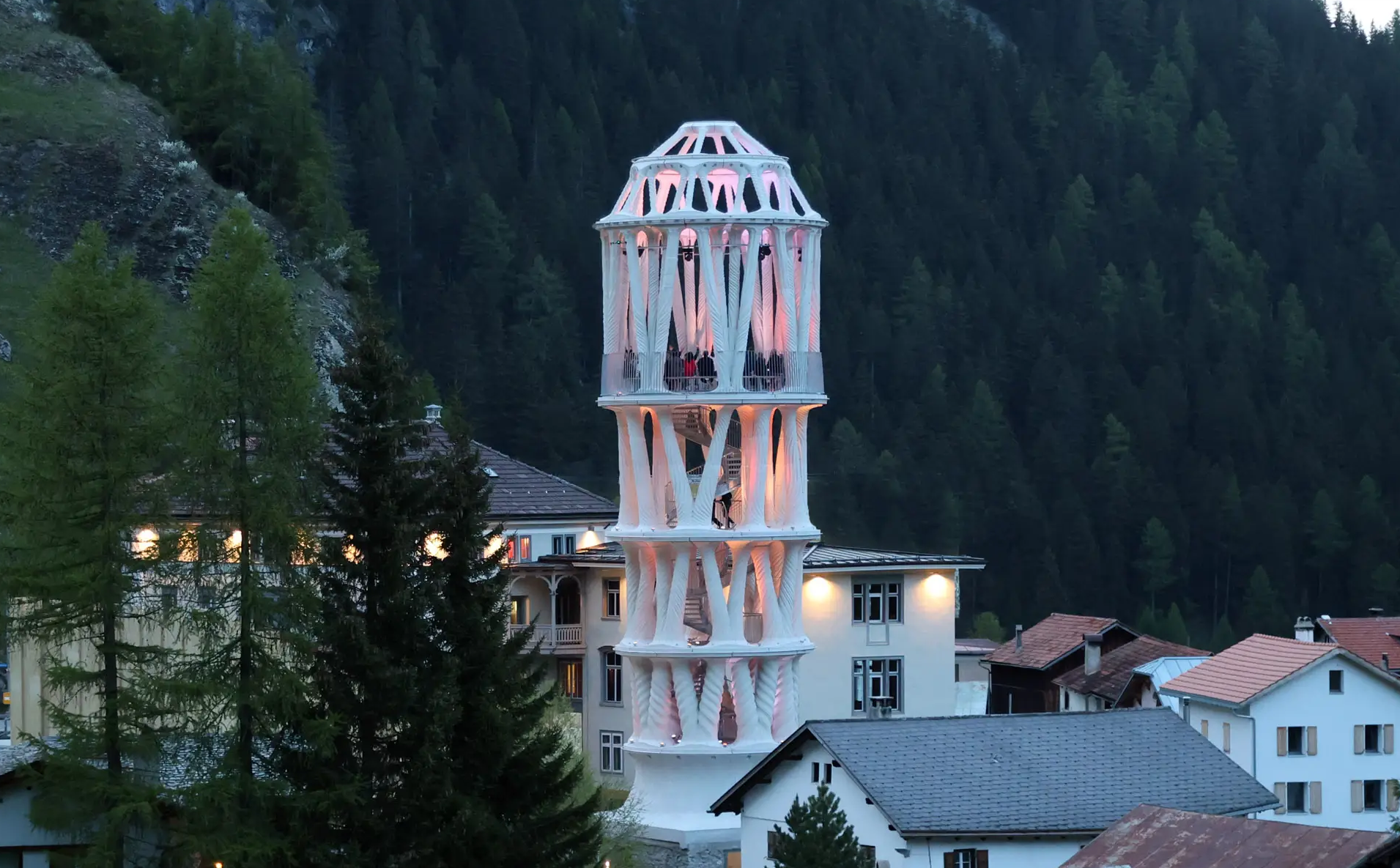
These possibilities have recently expanded into architecture on a much larger scale. Tor Alva, unveiled in Mulegns, Switzerland, in 2025, is a 3D-printed concrete tower standing approximately 30 meters tall. Developed through a collaboration between the Origen Cultural Foundation and ETH Zurich, and designed by architects Michael Hansmeyer and Benjamin Dillenburger, the project consists of 32 distinctive concrete columns. Becoming progressively more slender and intricately branched toward the upper levels, the columns define the tower’s exterior while simultaneously organizing its interior spaces.
What makes Tor Alva particularly noteworthy is the way concrete is handled. The main bodies of the columns were fabricated by directly depositing concrete using industrial robots, while their upper and lower sections were cast using 3D-printed formwork. Necessary steel reinforcement was incorporated into the printed components to ensure structural performance. In other words, different fabrication techniques were applied within a single column according to the specific function of each part.
Particularly fascinating are the delicate folds and textures that emerge across the surfaces of the columns. By controlling the speed and direction at which the robots extrude material, along with the conditions of each deposited layer, designers can alter the resulting formations of concrete. The forms planned in a digital model interact with the actual flow of material to create new surfaces. These outcomes are difficult to predict entirely on a computer screen. They require an iterative process of observing how the material accumulates and hardens, then repeatedly adjusting the fabrication conditions.
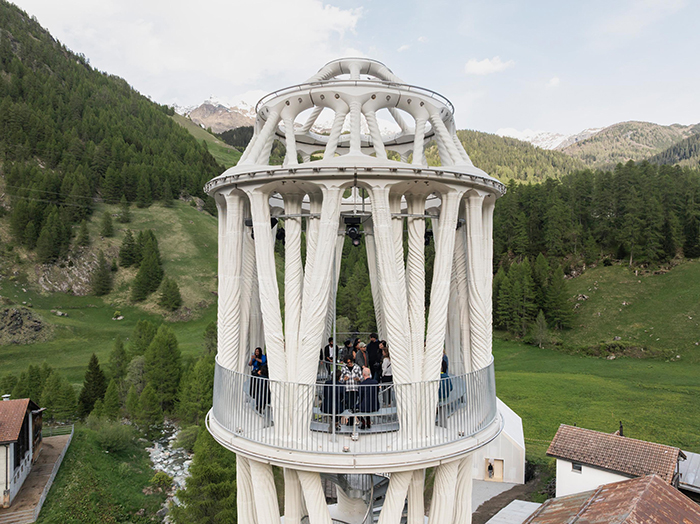
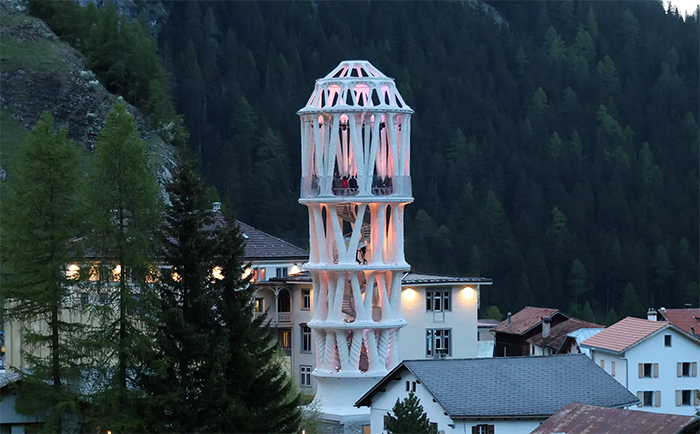
< Tor Alva, The White Tower, Switzerland, 2025 >
This kind of work brings to mind a new form of craftsmanship in the digital age. Where traditional artisans once shaped materials by hand to achieve their desired forms, today’s designers explore the properties of materials through digital data and robotic movements. The tools have changed, but understanding materials and discovering how to achieve the intended results remain just as important. The curves and surface textures of Tor Alva’s columns create patterns of light and shadow, allowing visitors to experience not only the structure itself but also the many expressive qualities of the material. It is a moment when fabrication technology becomes a sensory experience of space.
This transformation is taking place not only in architecture but also in the design of products we use every day. Futurecool, unveiled by adidas in 2026, demonstrates how 3D printing technology can redefine both the form and function of footwear. While conventional shoes are manufactured by cutting and assembling various materials and components, Futurecool creates the body of the shoe through a single, seamless three-dimensional lattice structure.
In this product, the lattice is far more than a decorative element. It serves as a structure that wraps around the foot, a network of channels that allows air to circulate, and a flexible surface that adapts to movement. The spacing and connections within the lattice influence not only the shoe’s visual appearance but also its breathability and comfort. Rather than simply defining the outer shape, the designer must consider the internal voids and the distribution of material throughout the entire structure.
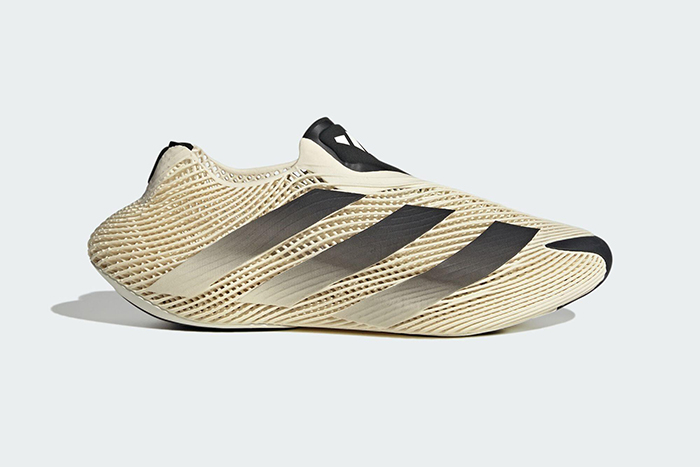
< adidas Futurecool, 2026 >
This is where Futurecool reveals a fundamental shift in design. In the past, designers typically developed a product’s form first and then searched for a suitable manufacturing method. Today, however, exploring the possibilities of fabrication technology can lead to entirely new forms and functions. Decisions about where to place material and where to leave empty space, which areas should be rigid and which should remain flexible, ultimately shape the design itself.
Although these three projects differ in scale and purpose, they share an important characteristic. In Striatus, the direction of material deposition is directly connected to the principles of structural engineering. In Tor Alva, the flow of concrete and the movements of robots create new surfaces and spatial experiences. In Futurecool, the connections and voids within the lattice determine both the product’s appearance and its functionality. Ultimately, fabrication technology is no longer merely a means of reproducing a completed design. It is becoming an integral part of the creative process through which form and function are developed together.
This transformation also invites us to reconsider the role of the designer. As AI generates a wide range of visual possibilities and digital fabrication technologies make increasingly complex forms achievable, designers have gained greater freedom to experiment. Yet not every form is necessary or meaningful. Designers must also evaluate what functions complex structures actually perform, how much material and energy they consume, and whether they present challenges in use or maintenance. After all, new fabrication technologies do not automatically guarantee sustainable or economically viable outcomes.
This perspective is equally important in design education and professional practice. Today’s designers need more than the ability to visualize a finished concept. They must understand material properties, experiment with fabrication processes, and incorporate the results of physical production back into their designs. Even when the overall form remains unchanged, adjusting material thickness or the direction of deposition can alter structural performance and surface texture. Changing the spacing of a lattice can likewise affect a product’s flexibility and user experience. By directly observing and evaluating these differences, designers can develop a deeper understanding of the relationship between form, material, and production.
The significance of digital fabrication lies not simply in its ability to produce more complex and unconventional forms. What matters is how materials, structures, and fabrication processes interact with one another to expand the possibilities of design. Designers must now consider not only what they want to create, but also how it should be made. Through this process, they must discover why a particular form should exist in the first place.
Good design is not revealed solely through its finished appearance. Its value also emerges from the direction and thickness of material layers, the ways individual components connect, and the functions of the spaces left empty. Beyond mastering the technologies that create form, designers must learn to design the logic that gives form its reason for being. It is here that we can discover the new language and possibilities of design emerging through digital fabrication.


















#14057, 905 49, Beolmal-ro 102beon-gil,
Dongan-gu, Anyang-si, Gyeonggi-do, Korea
Business Registration Number: 454-86-01044
Online Sales License No.: 2021-Anyang Dongan-1081
Copyright © DESIGNSORI Co., Ltd.