
Picture the moment you move finely chopped vegetables from a chopping board into a pot. You tilt the board to one side and push the ingredients in with the back of a knife or your hand, but a few pieces scatter over the edge. You gather them up and wipe away whatever has fallen onto the worktop. We repeat this routine, assuming that this is simply how chopping boards are. Yet someone thought to fold the sides of that flat board so the ingredients could be gathered and guided into the pot. Why did the chopping board need to fold? Within that question lies the reason I am fond of a brand called Joseph Joseph.
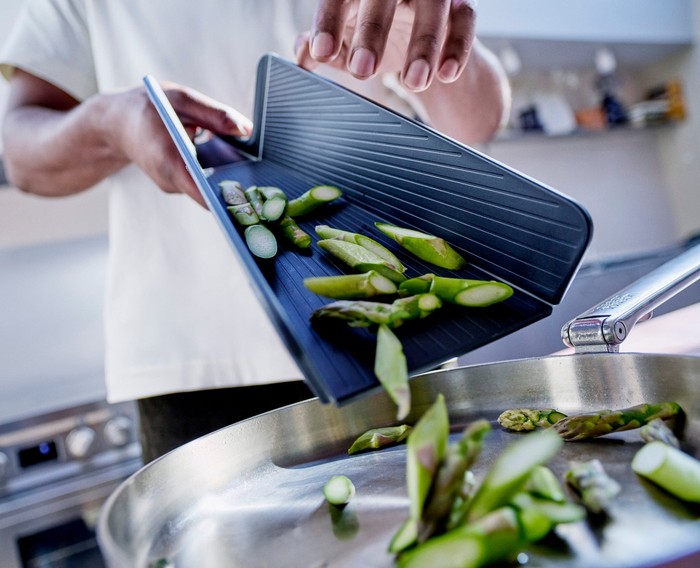
Chop2Pot. Its sides fold to gather chopped ingredients and guide them into the pot.
< Design: Mark Sanders / Image: Joseph Joseph >
Looking at Joseph Joseph, I am reminded that a small idea can bring people joy. Some products make sense the moment you see how they work. A slight change to the structure of a familiar object makes a daily task noticeably easier. At such moments, I feel something beyond the satisfaction of buying something new: the pleasure of realising that someone noticed an inconvenience I had always shrugged off, and solved it.
Joseph Joseph has its roots in a glass factory run by the Joseph family. The business, founded by Antony and Richard Joseph’s grandfather and carried on by their father, was already producing glass chopping boards. The brothers redesigned and sold those boards, and building on that experience, launched their own brand in 2003. Their range has grown considerably since then, but their focus on finding and solving everyday problems has remained the same. To understand their products, think of moving ingredients into a pot or setting down a spoon you have been using. These are actions we repeat every day, which is precisely why we rarely look at them closely.
Chop2Pot, the folding chopping board designed by Mark Sanders, captures this perspective well. Laid flat, it is a board for chopping. Squeeze the handle, and its sides fold up to form a channel that guides the chopped ingredients into the pot. A single board handles two tasks: cutting and transferring. What is interesting here is not so much the folding mechanism itself as how far the designer thought through the role of a chopping board. Rather than stopping at improving the surface the knife touches, the design considers what happens after the ingredients are cut.
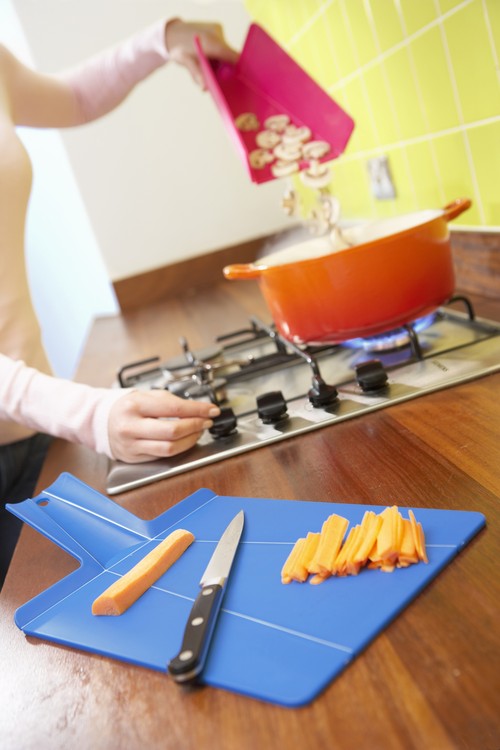
An early model of Chop2Pot. Lay it flat to chop, then fold the sides to transfer ingredients into the pot.
< Photo: Mark Sanders / Wikimedia Commons >
When we come across products like these, we often wonder why no one made them this way sooner. Once a problem has been solved, the solution looks obvious. Yet spotting what could be changed in a familiar action is not easy. As long as we believe we simply need to be more careful not to spill, we never question the shape of the chopping board. A designer observes that hand movement and asks whether the care people have to take each time could instead be built into the structure of the product.
A similar idea can be found in the Elevate kitchen tools. When you put down a spoon you have been stirring with, sauce ends up on the worktop. Using a separate spoon rest means one more thing to wash. Elevate uses a weighted handle and an integrated rest so that the head of the utensil stays off the worktop. It takes into account not only the moment of stirring but also the brief moment when the utensil is out of your hand. Once you understand why the small protrusion on the handle is there, a form that first seemed awkward begins to make sense.
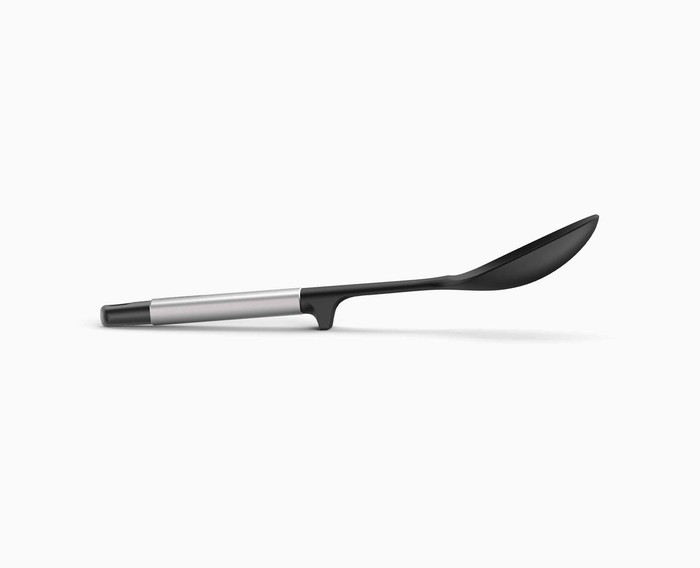
Elevate. A weighted handle and integrated rest keep the head of the spoon off the worktop.
With products like these, even working out how they function is enjoyable. As users fold the board to tip in ingredients and set the spoon down, they discover what each part of the structure does. Details that seemed insignificant at first glance reveal their purpose once you actually use them. I believe this sense of discovery is part of the pleasure Joseph Joseph offers. Rather than merely admiring a clever idea, you can immediately picture how it might fit into your own life.
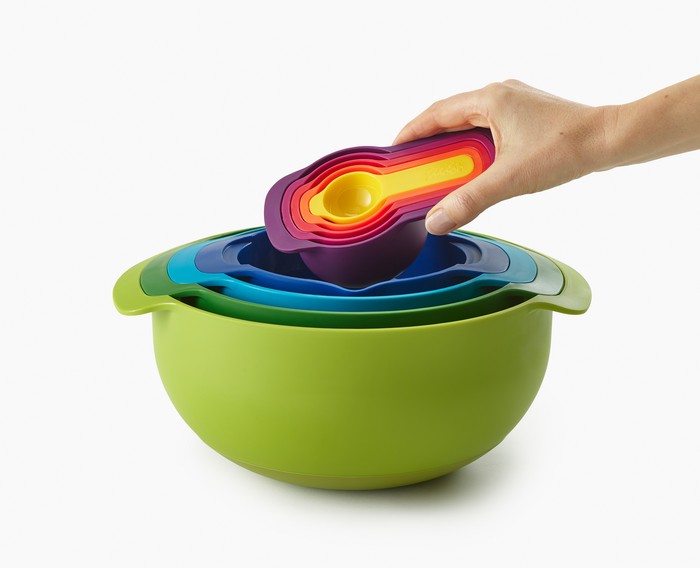
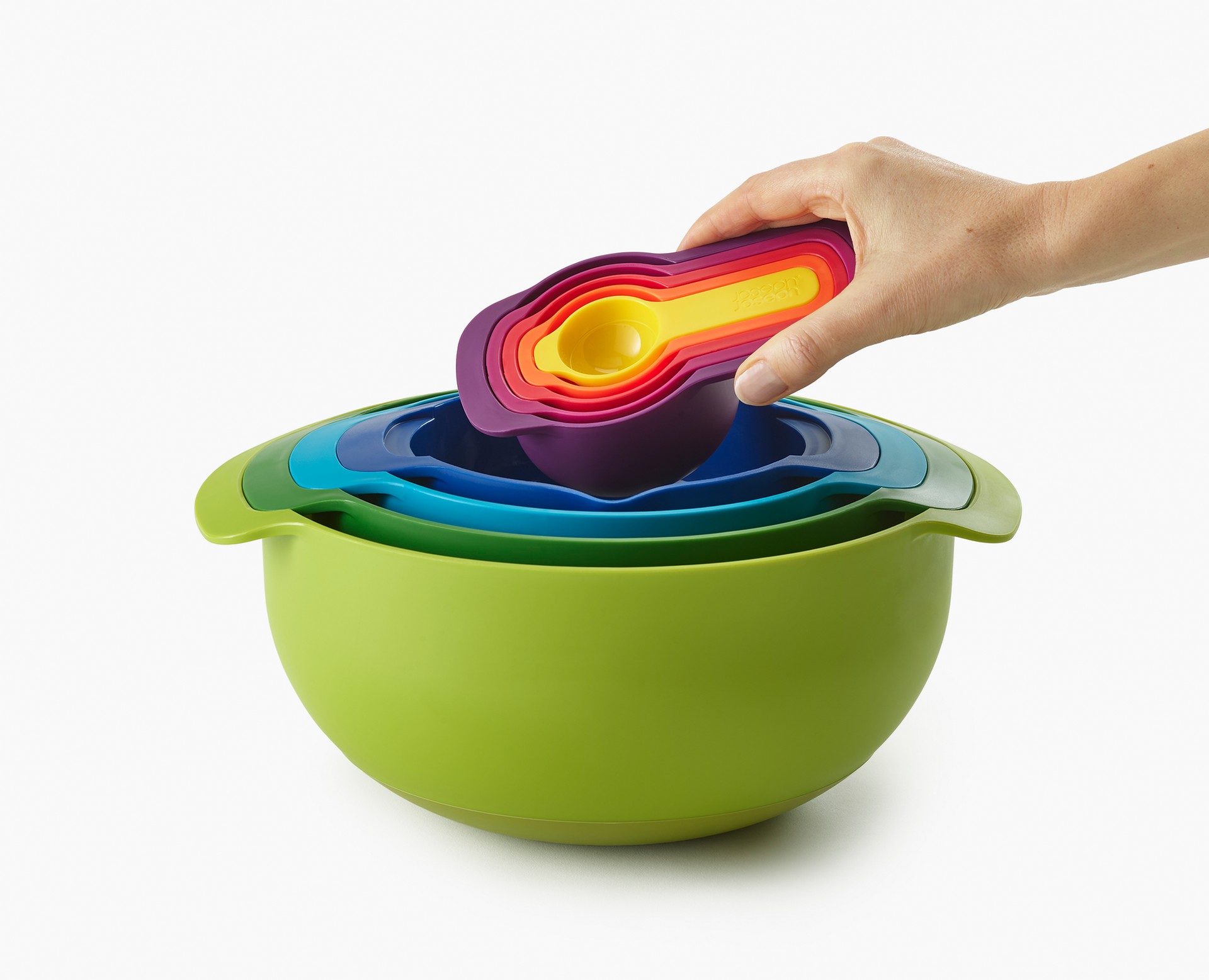
Nest 9 Plus. Bowls, sieves and measuring cups nest inside one another for compact storage.
< Design: Morph / Image: Joseph Joseph >
Designed by Morph, Nest 9 Plus is a product conceived around storage. Mixing bowls, a colander, a sieve and even measuring cups nest inside one another to form a single compact set. It takes up less space than storing each tool separately. The way pieces of different sizes fit together in sequence is also pleasing to look at, and the range of colours helps tell the components apart. The satisfaction this set brings probably does not come from its bright colours alone. Being able to keep items that were always a hassle to organise in one place also makes the product appealing.
If we think of function and aesthetic appeal as separate, this kind of pleasure is hard to explain. Function seems to take care of convenience, while appeal feels like something added afterwards through colour or decoration. In these products, however, the way a problem is solved becomes an enjoyable experience in itself. You have one less mess to wipe up, and you can store several tools in a small space. As you notice that difference each time you use them, an idea that first seemed merely fun becomes a genuine advantage. I believe the value design adds to a product comes from exactly these concrete uses.
Of course, cleverness alone does not make a good product. Folding parts must withstand repeated use, and nesting tools must still be easy to take out when you need just one. If cleaning becomes harder or a new structure becomes a chore to manage, the initial admiration will not last long. There is a difference between a feature that impresses in a shop and one that works well every day. The value of an idea cannot be judged by first impressions alone; it must still be convenient after repeated use.
The same standard applies to Joseph Joseph’s products. We need to ask whether a structure added to solve a small inconvenience creates new work elsewhere. Whether a chopping board folds well and whether it is easy to wash and store are questions to be considered together. Tools that must be stacked in a set order may even feel like a nuisance to some people. No single product can suit everyone. That is why what matters is not how novel a product is, but whether it genuinely reduces effort once it becomes part of daily life. For the pleasure to last, a product must also be good to use every day.
Designers often feel pressure to come up with new forms. Yet changes as modest as a chopping board that folds or a spoon whose head sits just above the worktop are meaningful enough. Through such differences, users come to understand what the designer was thinking about. When I realise that someone has solved an inconvenience I also experienced, I see that product in a new light. Part of my affection for Joseph Joseph lies in the pleasure of discovering ideas like these, all the more so because even people who have never studied design can understand what has changed and enjoy it too.
A chopping board does not have to fold. But someone believed that moving ingredients into a pot could be made as easy as cutting them. If the structure born from that question genuinely saves effort, even an ordinary chopping board takes on new value. Perhaps the pleasure that design brings can be explained in the same way: noticing small inconveniences and offering solutions that anyone can use with ease.
These days, when I supervise students’ projects, I often come across work dealing with new technologies such as AI-driven design or humanoid robots. Yet in many cases, whether the form takes shape A or shape B makes little difference to usability. I find myself asking whether they have thought hard enough about why it has to be this particular form. Sometimes I want to see design that refines its form to the very end in order to solve a single small inconvenience: products that bring joy simply by letting us understand the reason behind their form, like the way a chopping board folds or the way a spoon rests above the worktop. Even as technology advances, this is why such design moves me and draws me in. It shows that there is still a great deal left to change in the objects we use every day.
















#14057, 905 49, Beolmal-ro 102beon-gil,
Dongan-gu, Anyang-si, Gyeonggi-do, Korea
Business Registration Number: 454-86-01044
Online Sales License No.: 2021-Anyang Dongan-1081
Copyright © DESIGNSORI Co., Ltd.