
If Paris has the Eiffel Tower and New York has the Statue of Liberty, Seoul has the Dongdaemun Design Plaza (DDP). And in Taipei, there is the Songshan Cultural & Creation Park. These two spaces symbolize each city’s creative energy in distinctly different ways and stand as representative examples of the evolution of design culture in East Asia. In 2022, Google Maps selected the Songshan Cultural & Creation Park as one of the world’s top 10 cultural landmarks. In the same year, Seoul’s DDP saw a dramatic rise in cumulative visitor numbers, establishing itself as a new symbol of the city. While both spaces are recognized as successful cases of urban regeneration, their approaches are, interestingly, complete opposites.

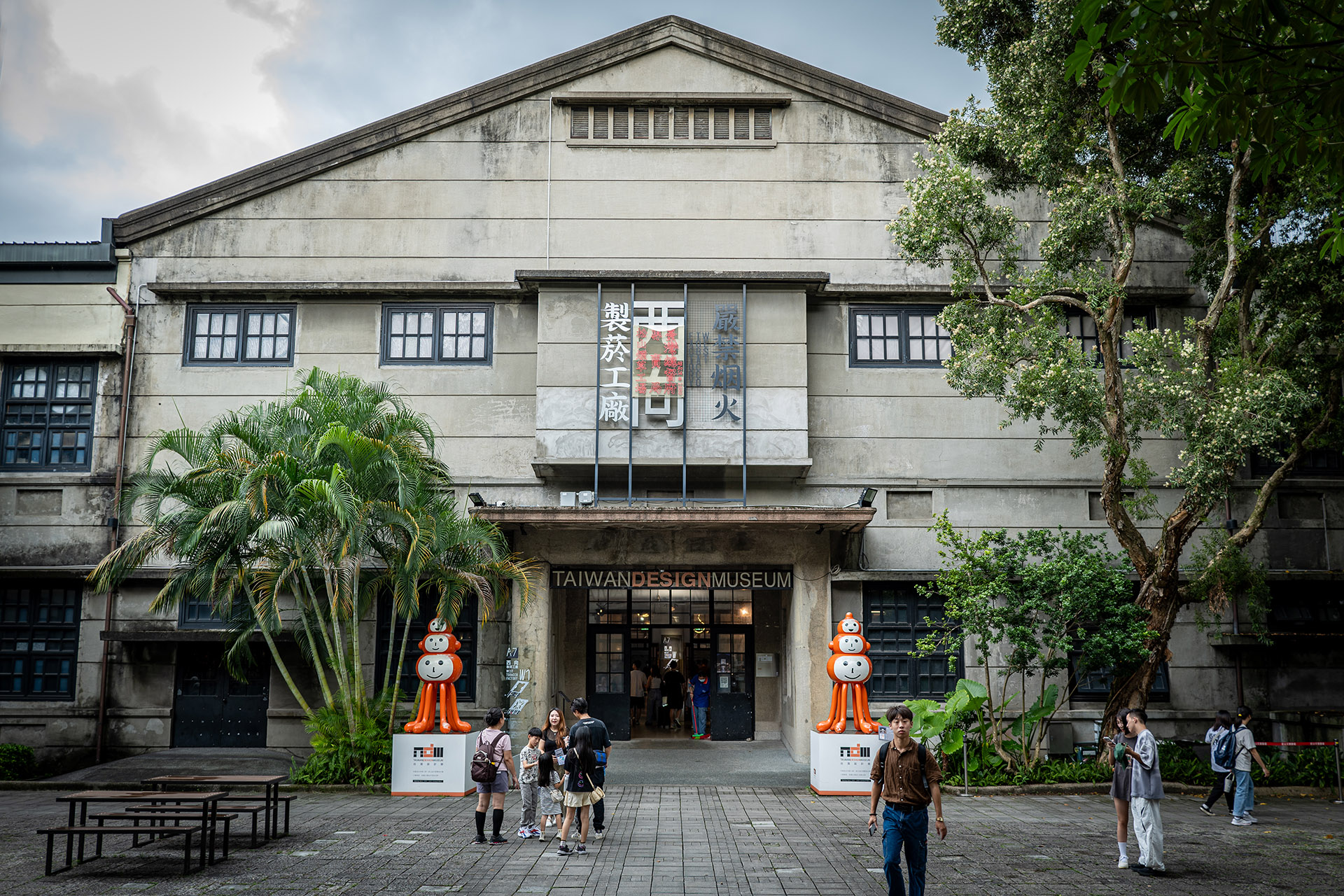
< Songshan Cultural & Creation Park in Xinyi District, Taipei >
Looking toward the future through sweeping curves: the radical transformation of the DDP. On March 21, 2014, the world’s largest three dimensional, nonstandard architectural structure emerged in Dongdaemun, Seoul. Designed by British architect Zaha Hadid, the Dongdaemun Design Plaza stands at the heart of the district like a monumental sculpture in its own right. Its fluid exterior, clad in 45,133 silver aluminum panels, was conceived to express an “architectural landscape encircling the Seoul City Wall.” In designing the DDP, Hadid focused on the relentless dynamism of Dongdaemun, which shifts continuously from early dawn until late at night. Through a distinctive architectural language composed of curves and curved surfaces, diagonals and slanted planes, she created a space in which natural and artificial forms flow seamlessly into one another. The building represents the extreme of nonstandard architecture, entirely free of horizontal lines or right angles.
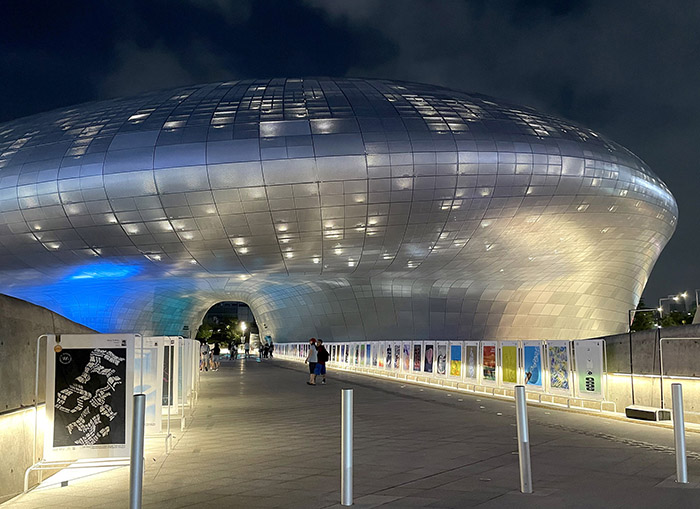
< Dongdaemun Design Plaza (DDP) by world-renowned architect Zaha Hadid >
The DDP was built on the former site of Dongdaemun Stadium. Constructed in 1925 during the Japanese colonial period, Gyeongseong Stadium was Korea’s first modern multipurpose sports complex. When the stadium was demolished in 2007, it sparked significant controversy in Korean society. The excavated Igansumun water gate and remains of the Seoul City Wall were preserved underground and developed into Dongdaemun History and Culture Park. As a result, a unique layering of time was created in which the Joseon Dynasty fortress, a colonial-era stadium, and a 21st-century design plaza coexist in a single location. However, the DDP rising above ground made a radical choice to completely sever visual continuity with the past and move decisively toward the future. At the time of its opening, the DDP faced harsh criticism, being labeled “a purposeless public building that cost 500 billion won.” Yet as time passed, perceptions began to change.
In 2015, The New York Times selected the DDP as one of the “52 Places to Go in the World,” and within just one year of its opening, sales in the surrounding commercial district increased by 15–25 percent. By the first half of 2025, cumulative visitor numbers surpassed 10 million, firmly establishing the DDP as one of Seoul’s leading tourist destinations. International events such as Seoul Fashion Week, MAMA, BTS-themed exhibitions, and the Seoul Biennale of Architecture and Urbanism have been held here, transforming the DDP into a platform representing Seoul’s creative industries rather than merely a singular architectural landmark. Following Zaha Hadid’s passing in 2016, the DDP gained even greater significance as her final completed work and architectural legacy.
Regeneration Embracing the Past: The Organic Evolution of Songshan Cultural & Creation Park
Located in Taipei’s Xinyi District, the Songshan Cultural & Creation Park was born from a philosophy entirely different from that of the DDP. Built in 1937 during the Japanese colonial period, the Songshan Tobacco Factory of the Taiwan Governor-General’s Monopoly Bureau was Taiwan’s first specialized tobacco manufacturing facility. Production ceased in 1998, and in 2001 the Taipei City Government designated the site as the city’s 99th cultural heritage zone, giving it new life. On November 15, 2011, the 6.6-hectare site officially opened as the Songshan Cultural & Creation Park. What is particularly notable is that the existing buildings were preserved intact rather than demolished, with only their functions transformed. Designed in an “early Japanese modernist” style, the architecture emphasizes horizontal lines, simple classical forms, and refined construction techniques. More than 80 years later, these structures remain solid and beautiful, repurposed as exhibition spaces, design studios, workshops, cafés, and bookstores, creating an environment where past and present coexist naturally.
The most defining characteristic of the Songshan Cultural & Creation Park is the concept of an “Industrial Village.” Originally implemented during its time as a tobacco factory, this concept was a pioneering design approach that placed workers’ amenities directly alongside production lines. Today, the expansive outdoor spaces and courtyards have been reborn as Baroque gardens, ecological ponds, and walking paths, serving as places of rest for the public. The Taiwan Design Center is located within the park, and in 2014 the region’s first American Innovation Center was established here. Eslite Spectrum Songyan is a multifaceted cultural complex combining a bookstore, shopping mall, and hotel, with an international art-house cinema and small art galleries located underground. Liuli Gongfang is a glass art gallery that reinterprets ancient Chinese glassmaking techniques through a contemporary lens, demonstrating the encounter between traditional craft and modern design. The park also retains a monument known as the “Songshan Tobacco Factory Inscription.” Inscribed in 1949 with lyrics written by songwriter He Zhihao, this monument illustrates that the Songshan Cultural & Creation Park preserves not only buildings, but also the memories and spirit of the people who once worked there.
Two Cities, Two Design Philosophies
A comparison between the DDP and the Songshan Cultural & Creation Park clearly reveals how East Asian cities seek balance between cultural heritage and modernization. Seoul chose a path of “radical rupture,” burying the past underground and constructing an entirely new future above ground. Taipei, by contrast, adopted a strategy of “conservative regeneration,” retaining the shell of the past while renewing its interior. Neither approach can be deemed inherently right or wrong. The radical nature of the DDP perfectly embodies the dynamism and future-oriented energy of Seoul as a city. Zaha Hadid’s curves translate the rapid change and constant innovation of Korean society into architectural language. The preservation-oriented approach of the Songshan Cultural & Creation Park reflects Taiwanese society’s respect for history and its values of organic growth. The old tobacco factory buildings themselves testify to Taiwan’s modernization, while the contemporary creative activities taking place within them generate an ongoing dialogue between past and present.
The contrast between the two spaces is also striking in their architectural appearance. From any angle, the DDP evokes the “future.” Its silver aluminum panels and fluid curves leave an intense, almost surreal impression, reminiscent of a scene from a science-fiction film. At night, through the Seoul Light Project, the DDP’s exterior transforms into a massive canvas showcasing diverse forms of media art. The Songshan Cultural & Creation Park, by contrast, conveys “history” from every perspective. Red brick buildings, rusted steel window frames, and mature trees vividly communicate Taipei’s past. Yet the contemporary art exhibitions, design markets, and fashion shows held within the site prove that it is far from a frozen relic of history. Interestingly, both spaces faced similar criticisms in their early stages, including “wasteful use of public funds,” “discord with surrounding commercial areas,” and “insufficient public consultation.” Over time, however, both have come to be recognized as successful cases of urban regeneration.
Design Changes Cities
Both the DDP and the Songshan Cultural & Creation Park demonstrate the power of design. Design does not merely beautify buildings; it redefines a city’s identity, stimulates its economy, and enhances the quality of life for its citizens. The curves of the DDP have imprinted Seoul as a global design city, while the preserved brick structures of the Songshan Cultural & Creation Park have shaped Taipei into a city where history and creativity coexist. As of 2025, many cities across East Asia are developing their own cultural and creation districts, such as Beijing’s 798 Art District, Shanghai’s M50 Creation Park, and Tokyo’s Roppongi Hills. Yet each city is finding its own balance between past and present, preservation and innovation.
If Seoul’s DDP represents a bold leap toward the future, Taipei’s Songshan Cultural & Creation Park embodies a slow evolution built upon the past. Both spaces have succeeded, but the meaning of that success differs. The DDP demonstrates the “courage to change,” while Songshan reveals the “wisdom of preservation.” Both values are essential for 21st-century cities. When you visit Seoul, stand beneath the sweeping curves of the DDP and imagine the future. When you visit Taipei, touch the aged bricks of the Songshan Cultural & Creation Park and reflect on the past. Both experiences will reveal how design can transform cities and enrich our lives.











#14057, 905 49, Beolmal-ro 102beon-gil,
Dongan-gu, Anyang-si, Gyeonggi-do, Korea
Business Registration Number: 454-86-01044
Online Sales License No.: 2021-Anyang Dongan-1081
Copyright © DESIGNSORI Co., Ltd.