
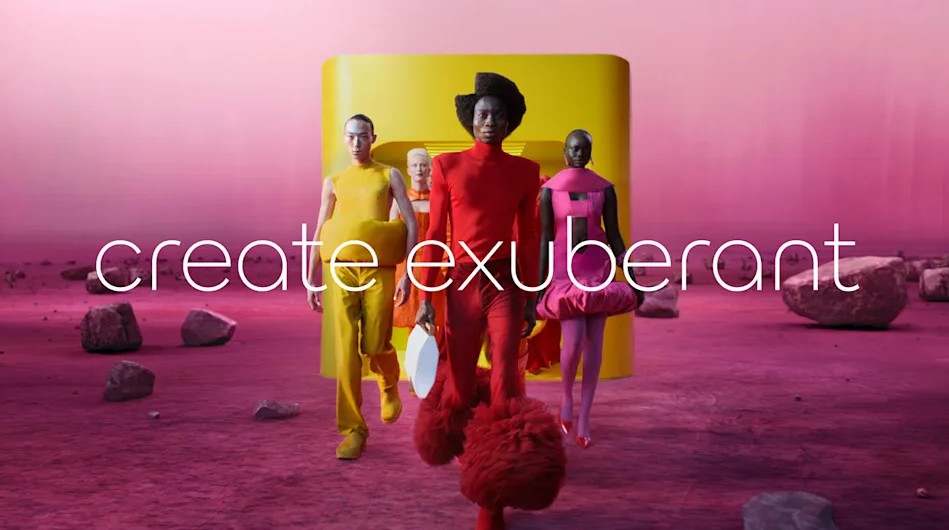
There is a moment that arrives in almost every rebranding meeting. Someone says, “This time, let’s really make a statement,” and the atmosphere in the room changes. Shoulders relax. People lean back in their chairs. I have sat in rooms like that myself and I have also seen how often the results born from that excitement miss the mark. Jaguar in November 2024 was, perhaps, the largest version of that room imaginable. The film was thirty seconds long. Models dressed in highly saturated colors walked through an abstract, almost placeless environment. Phrases like create exuberant, live vivid, and delete ordinary drifted across the screen, before finally revealing the new wordmark: “JaGUar.” Not once did a car appear. It was an advertisement for a car company.
That same day, Elon Musk posted four words on X: Do you sell cars? That single sentence followed Jaguar for months afterward. The next day, smartphone brand Nothing changed its social media bio to “Copy Jaguar,” and within days the campaign had become a meme. Some called it genius. Others called it the worst branding move of the year. Both sides were loud. And in the middle of all that noise, Jaguar kept taking hits. Nine months later, the CEO stepped down. The advertising agency left. The creative director departed as well. From launch to collapse, the entire cycle took less than a year.
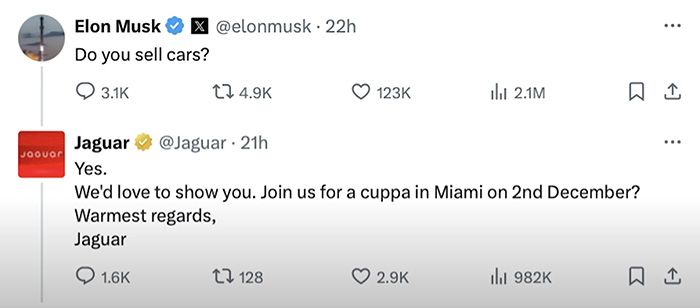
It is easy to mock Jaguar. But before doing that, there is something important to acknowledge: the strategy itself was not wrong. Even in its best years, Jaguar’s sales fell short of targets by nearly a third, and for more than a decade it chased BMW and Audi, let alone Mercedes, without ever truly catching up. It had to move toward electric vehicles. It had to sell at a higher price point. It had to attract a different kind of customer. All of these were reasonable decisions. What failed was the way those decisions were communicated to the outside world. More precisely, Jaguar became so immersed in its own desire for transformation that it forgot where the people watching that transformation actually were, and who they were.
When you spend months reviewing the same materials, repeating the same meetings, and redefining the same words over and over again, eventually an internal language begins to form. Inside that language, everything makes sense: the slogan, the colors, the typography, the model casting. Within the meeting room, the atmosphere flows naturally. The problem is that the moment this language leaves the room, almost nobody outside can hear it. That 30 second Jaguar film probably received applause inside the meeting room. The issue was simply that outside the room, there were almost no people left to applaud with them. And this distance becomes visible in three specific places.
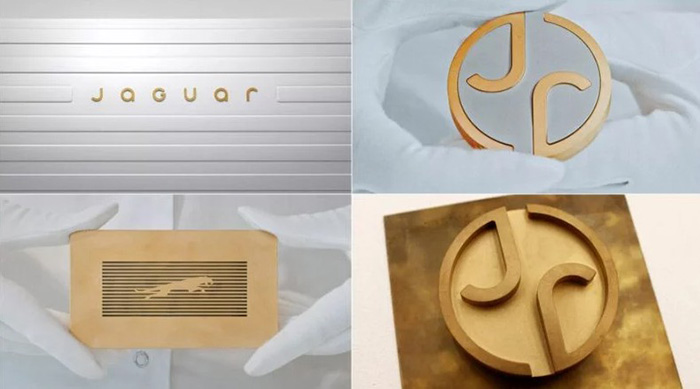
The first place is the output itself. The typography built around the phrase “copy nothing” was criticized almost immediately for resembling other brands’ logos, while the symmetrical “JR” monogram felt heavily borrowed from the visual language luxury fashion houses had used for decades. In trying to declare that it would imitate nothing, Jaguar ended up looking like it had imitated almost everything.
This usually means one thing: the copywriters and designers were sitting in the same meeting room, but listening to entirely different meanings. The copy team likely heard “copy nothing” as a commitment to creating something uniquely their own. The design team, meanwhile, probably interpreted the same phrase as an instruction to look radically different from existing car brands. The two interpretations sound similar, but they arrive at completely different outcomes. And inside meeting rooms, people often discover only at the very end that they were heading toward different destinations all along.
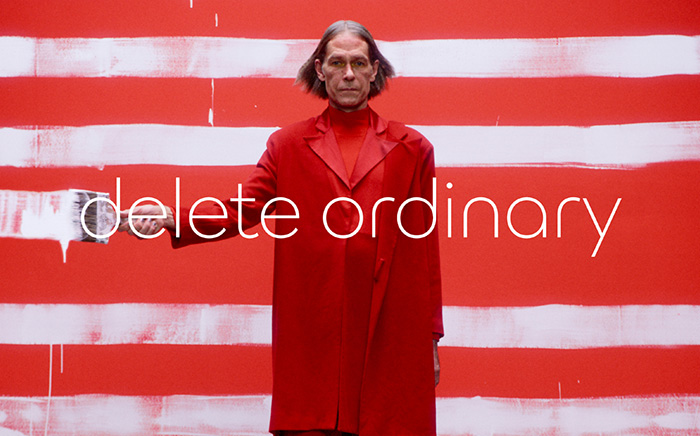
The second issue was sequence. Jaguar revealed the brand’s attitude first, and the car later. A commercial does not necessarily need to show the product, if the product has already been seen. But if you declare “we have changed” before showing what you have changed into, that declaration lands nowhere. People do not know what they are supposed to agree with, and the empty space is quickly filled with suspicion. Jaguar already knew the new car. It already understood the new tone, the new audience, the new vision. But people outside the meeting room had seen none of it when they encountered the film. The moment you assume that the people outside are looking at the same landscape you are, the order of presentation is almost always wrong. What feels familiar to those inside the process still feels entirely unfamiliar to everyone else.
The third issue was timing. The atmosphere at the end of 2024 was simply not one in which that campaign could survive easily. Public fatigue toward a certain kind of aesthetic and messaging had already reached its peak, and Jaguar’s film pressed nearly every button that fatigue was waiting to react against. Later, a Jaguar executive said that after Musk’s tweet, “it became difficult to control the narrative.” But I do not think the narrative became uncontrollable, I think it was never designed to be controllable in the first place. Inside the meeting room, the film’s confident tone probably felt like a declaration of a new era. Outside the room, however, the public no longer had the emotional capacity to receive declarations like that. No matter who speaks, or how confidently they speak, if the audience is not in a state to receive the tone, the message never truly arrives.
When these three points are combined, the only conclusion is that Jaguar became trapped in itself. And the truly frightening part is that this is not only Jaguar’s story. To varying degrees, almost every rebranding meeting carries the same shadow: the desire to believe “this time, we are truly different,” the hope that “after putting in this much effort, surely people will understand.” At some point, that feeling places us in the customer’s seat, and we begin viewing what we created as the version of ourselves we most wanted to see. Jaguar simply did it on the biggest stage, at the highest possible cost.
Placing attitude before product can work for brands in fashion or trend sensitive retail sectors, brands whose position allows mystery and anticipation to generate momentum. But Jaguar is not that kind of brand. A brand of Jaguar’s scale, when it begins with declarations, will be cross examined relentlessly until it produces evidence. And Jaguar did not yet have that evidence in its hands. Once explanations begin replacing proof, the confident tone that launched the campaign gradually transforms into a defensive one.
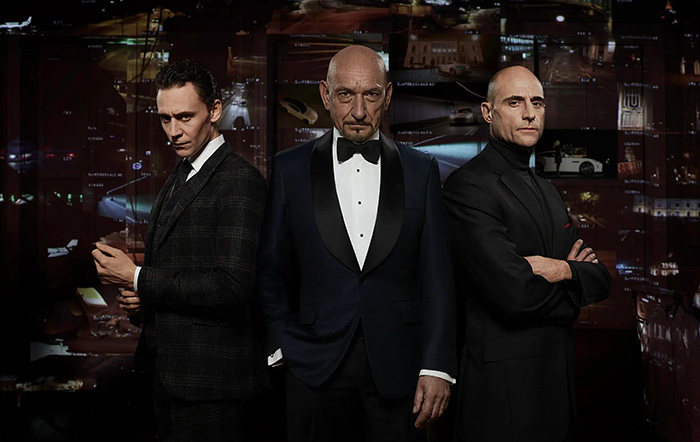
Jaguar “British Villains” Campaign - (2015 One Show Automobile Advertising of the Year Finalist)
We treat the word rebranding far too often as if it were merely a declaration. A new logo. A new slogan. A new key visual. But to people outside the company, rebranding is not a declaration, it is proof. If the proof is not yet ready, it is better to delay the declaration. More honestly, the gap between declaration and proof must be designed to be as small as possible. The longer that gap becomes, the more it is filled not with the brand’s intention, but with the world’s suspicion.
Jaguar was certainly bold. But boldness cannot become the goal itself. If there is a message you genuinely need to communicate, and the most accurate way to communicate it happens to be bold, that is meaningful. But when boldness itself becomes the objective, the declaration stops facing outward and begins facing inward. The language becomes increasingly elaborate, yet understandable only to the people speaking it. Jaguar was not speaking to customers. It was speaking to itself. So if we return once again to that meeting room, to the moment when someone says, “This time, let’s really show them who we are,” the hardest thing a designer can do in that charged atmosphere is not to be swept away by it. It is to step back half a pace and ask one question:
Is what we want to show aligned with what people actually want to see?















#14057, 905 49, Beolmal-ro 102beon-gil,
Dongan-gu, Anyang-si, Gyeonggi-do, Korea
Business Registration Number: 454-86-01044
Online Sales License No.: 2021-Anyang Dongan-1081
Copyright © DESIGNSORI Co., Ltd.