
Architecture appears as a single form when viewed from a distance. But as you move closer, it becomes clear that architecture is composed of countless connections. Structure is joined to material, technology is woven together with human perception, and lived experience meets spatial order within a single system. In the end, architecture is the result of connection. In timber architecture, one of the oldest and clearest expressions of this idea is joinery. Joinery refers to the craft of connecting pieces of wood to create a unified structure. Yet it should not be understood merely as a traditional construction technique. It is both a method of joining materials and an architectural way of thinking, one that begins by understanding the distinct properties of different elements and then brings them together into a coherent whole.
This way of thinking has become even more relevant today. We live in an era where design, architecture, technology, and artificial intelligence are rapidly converging. AI generates countless design possibilities, computational design calculates increasingly complex structures, and robotic fabrication and 3D printing transform forms once considered impossible into physical reality. Yet regardless of how advanced technology becomes, architecture ultimately returns to one fundamental question: How do we connect different elements, and what kind of spatial experience can those connections create?
Traditional timber joinery represented one of the earliest answers to that question. Wood is not a uniform material like steel or concrete. It has grain, direction, and a natural tendency to expand and contract with humidity and time. For that reason, traditional joinery was never about forcing materials into rigid submission. Instead, it was about understanding their nature and working with it. A well crafted joint was not simply a strong connection. It was an intelligent negotiation of different forces and directions, bringing them into balance within a single structural system.
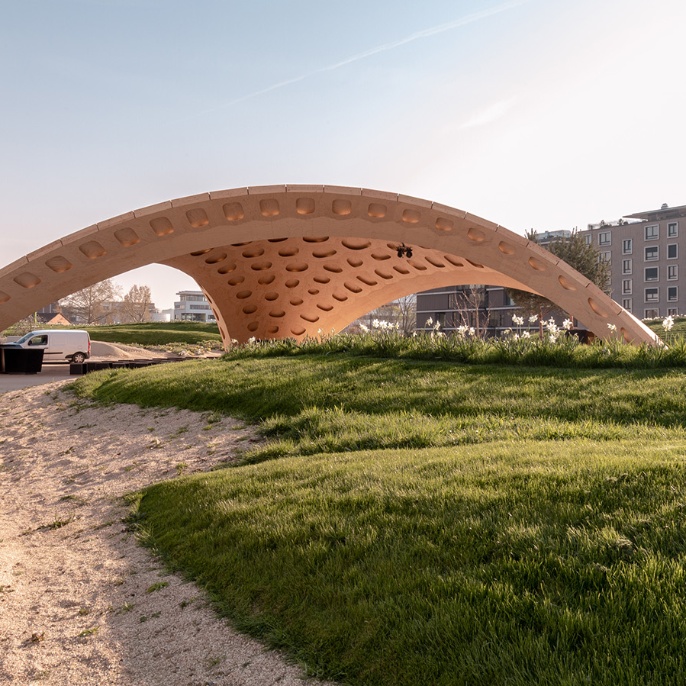
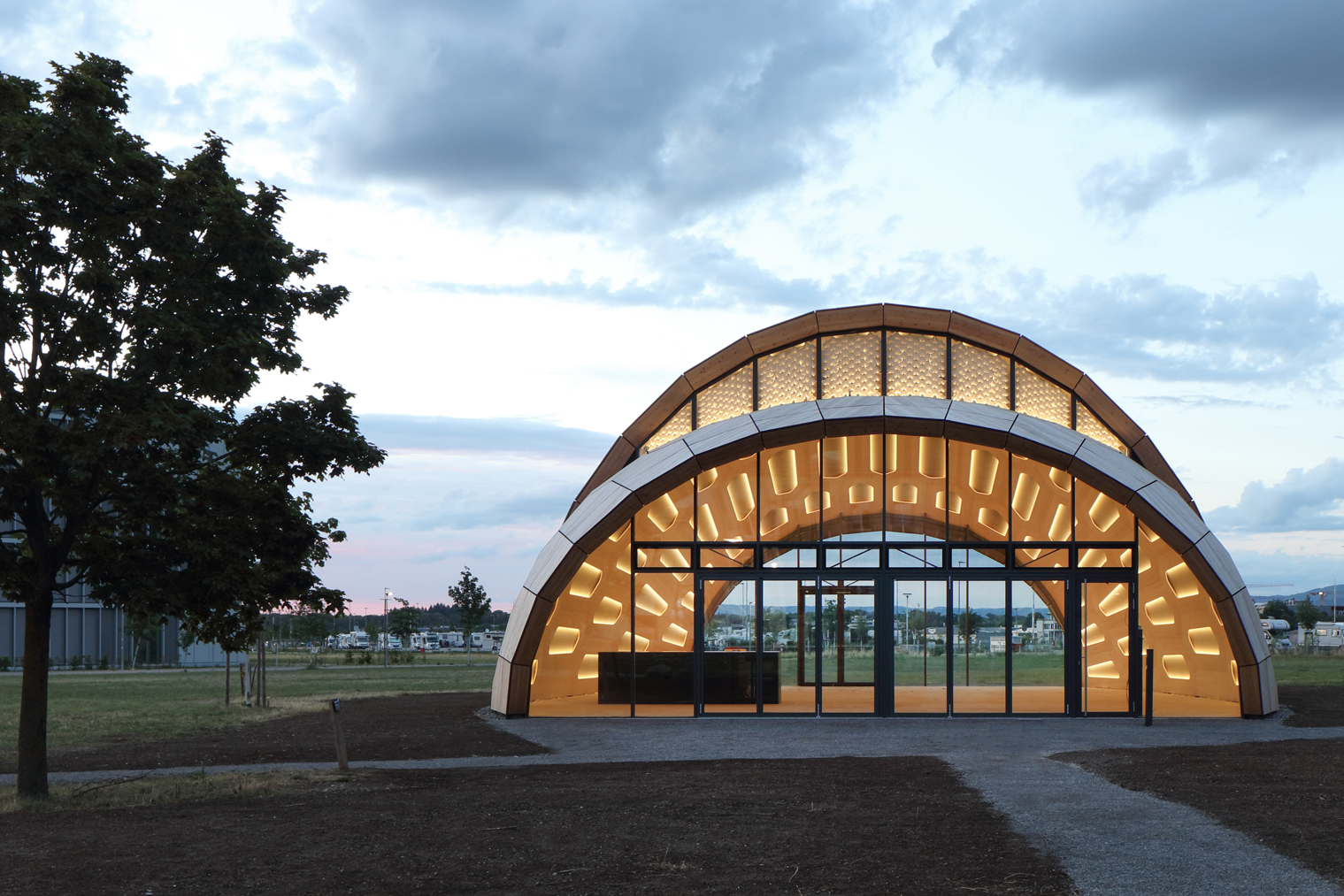
< BUGA Wood Pavilion / Image source: Oliver David Krieg >
The way designers and architects approach AI today is not so different. AI can generate forms with extraordinary speed, but determining why those forms are needed and how they can be realized through structure and material remains a fundamentally human responsibility. In the age of AI, what architects and designers need is not the ability to produce more images, but the ability to connect different bodies of knowledge and technologies in meaningful ways.
This shift is already evident in a number of experimental architectural projects. The BUGA Wood Pavilion, developed by the University of Stuttgart in Germany, is a representative example of the convergence of biological principles, computational design, robotic fabrication, and timber construction. The pavilion is based on a segmented timber shell system inspired by the skeletal structure of sea urchins. Here, wood is no longer treated solely as a traditional building material. It is analyzed through data, fabricated by robots, and assembled with remarkable precision into an entirely new spatial system. If traditional joinery relied on the craftsman's hands and accumulated experience to connect individual pieces of timber, the joinery embodied in the BUGA Wood Pavilion represents a new structural paradigm, in which digital information, computational intelligence, and advanced fabrication technologies come together to create architecture.
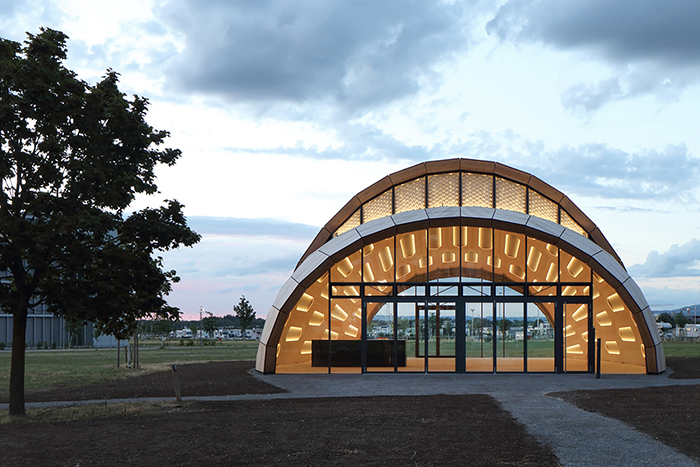
< livMatS Biomimetic Shell / Image source: University of Stuttgart >
Another compelling example is the livMatS Biomimetic Shell, which demonstrates just how far the idea of connection in architecture can be extended. The project integrates computational design, robotic prefabrication, automated construction, and collaboration between humans and machines into a single architectural system. Embedded within its timber shell is an energy autonomous 4D printed shading system, allowing the building to respond dynamically to changing environmental conditions. Architecture is no longer simply about creating form and structure. It has become the practice of orchestrating materials, climate, energy, methods of fabrication, and the collaboration between humans and machines within one coherent system.
This transformation extends well beyond timber architecture. Switzerland's DFAB House offers another important example, demonstrating how robotics, 3D printing, and digital fabrication can be applied to the construction of a real building. Developed by ETH Zurich, the project serves as an experimental residence that was digitally designed and constructed with the assistance of robotic systems and large scale 3D printing technologies. What makes DFAB House significant is not merely its futuristic appearance. Its true innovation lies in the seamless integration of design, structural engineering, fabrication, construction, and operation into a single digital workflow. This is where the real potential of AI and digital technology resides, not in generating forms more quickly, but in fundamentally reorganizing the entire process through which architecture is conceived, produced, and brought to life.
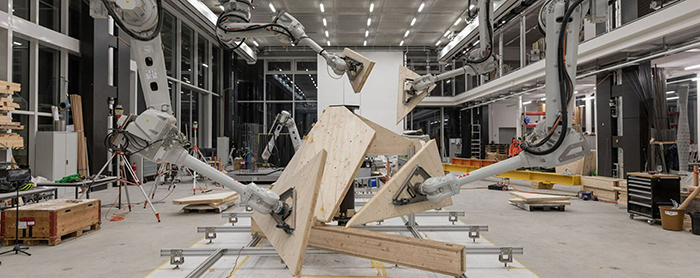
< Semiramis >
Semiramis offers another compelling vision of architectural connection in the age of AI. Developed with the support of artificial intelligence and robotic fabrication, this vertical garden structure exemplifies the synergy between computational design, machine learning, and digital manufacturing. Here, the architect is no longer the sole author of form. Instead, the architect becomes the designer of a system, one that enables human imagination, AI computation, and robotic precision to work together. These projects share a common principle. The architecture of the future will not be realized through any single technology alone. New possibilities emerge only when design imagination, architectural judgment, structural logic, material intelligence, AI driven analysis, and robotic fabrication are meaningfully connected.
This is precisely why the concept of joinery deserves renewed attention today. Joinery is no longer simply about connecting pieces of timber. It has become a broader way of thinking about architecture itself, a philosophy of connecting disciplines, technologies, and ways of knowing into a coherent whole. In that sense, the future of architecture is not defined by AI replacing architects, but by architects learning to design the connections through which human intelligence and artificial intelligence can create something neither could achieve alone.
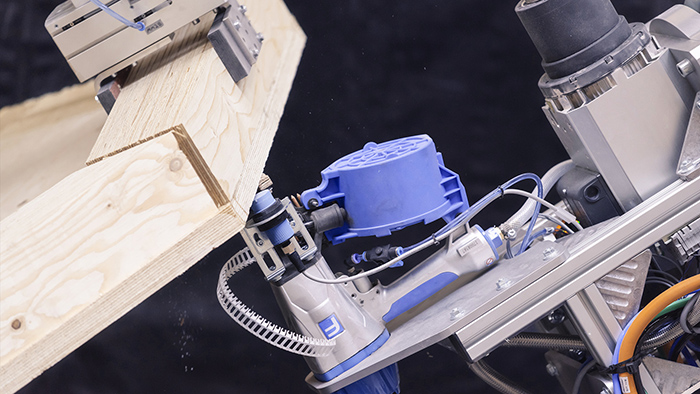
Of course, the idea of joinery discussed here extends far beyond the details of traditional timber construction. If traditional joinery connected columns and beams, eaves and brackets, today's joinery connects design and architecture, data and materials, humans and AI, technology and culture. Joinery is no longer simply a method of joining structural elements; it has become an architectural language for understanding convergence in the future. In the age of AI, the most important question is no longer, "How many new forms can we generate?" Rather, it is, "What knowledge, technologies, materials, and human experiences does this form connect?" Images can now be generated almost instantly, but great architecture cannot be achieved through the speed of image generation alone. It must be structurally convincing, materially feasible, and capable of creating meaningful experiences for the people who inhabit it.
In this context, the role of architects and designers becomes even more significant. Even in an era where AI proposes alternatives, robots fabricate components, and data evaluates performance, the final questions still belong to humans: What should be connected? Why should it be connected? And for whom should those connections ultimately create space? What, then, completes architecture? The answer does not lie solely in monumental forms or groundbreaking technologies. Architecture is realized when diverse elements come together with precision, and those connections evolve into a coherent structure and a meaningful spatial experience. Joinery was the original expression of this idea, and today its meaning is being reinterpreted within an era where design, architecture, technology, and AI converge.
Great architecture emerges when technology and materials, structure and perception, and humans and machines are brought together in meaningful ways. The future of architecture will undoubtedly become more complex. Precisely because of that complexity, it demands an even clearer design attitude. The ability to design connections may well become the most essential architectural imagination in the age of design, architecture, and AI integration.
















#14057, 905 49, Beolmal-ro 102beon-gil,
Dongan-gu, Anyang-si, Gyeonggi-do, Korea
Business Registration Number: 454-86-01044
Online Sales License No.: 2021-Anyang Dongan-1081
Copyright © DESIGNSORI Co., Ltd.