
Nipper the Dog in Front of the Phonograph and What It Teaches Us About the Essence and Importance of Brand Storytelling
I spent the final week of 2025 in Gangneung. Amid the slower rhythm of the year’s end and a family trip with my children, we happened to visit the Chamsori Gramophone and Edison Science Museum. To be honest, I did not have high expectations. I assumed it would simply be a quiet museum displaying old inventions. However, once the docent tour began, the atmosphere of the space changed completely. I had expected explanations focused on machines and technology, but the narrative unfolded in an entirely different way. “Now, let me introduce the protagonist of a brand,” the guide said. And with that, the figure that appeared was a single dog named Nipper.
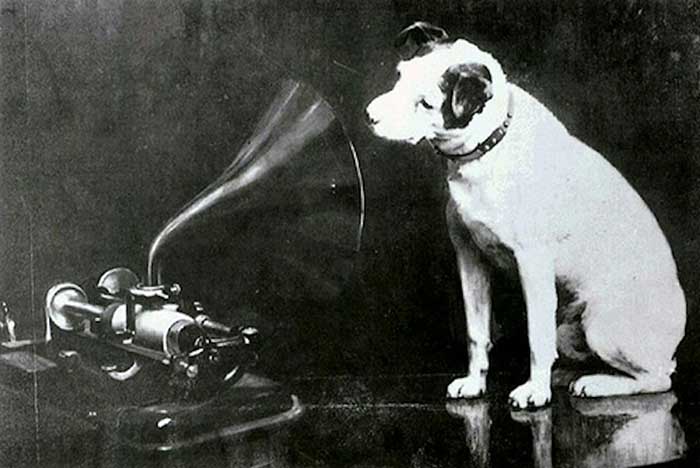
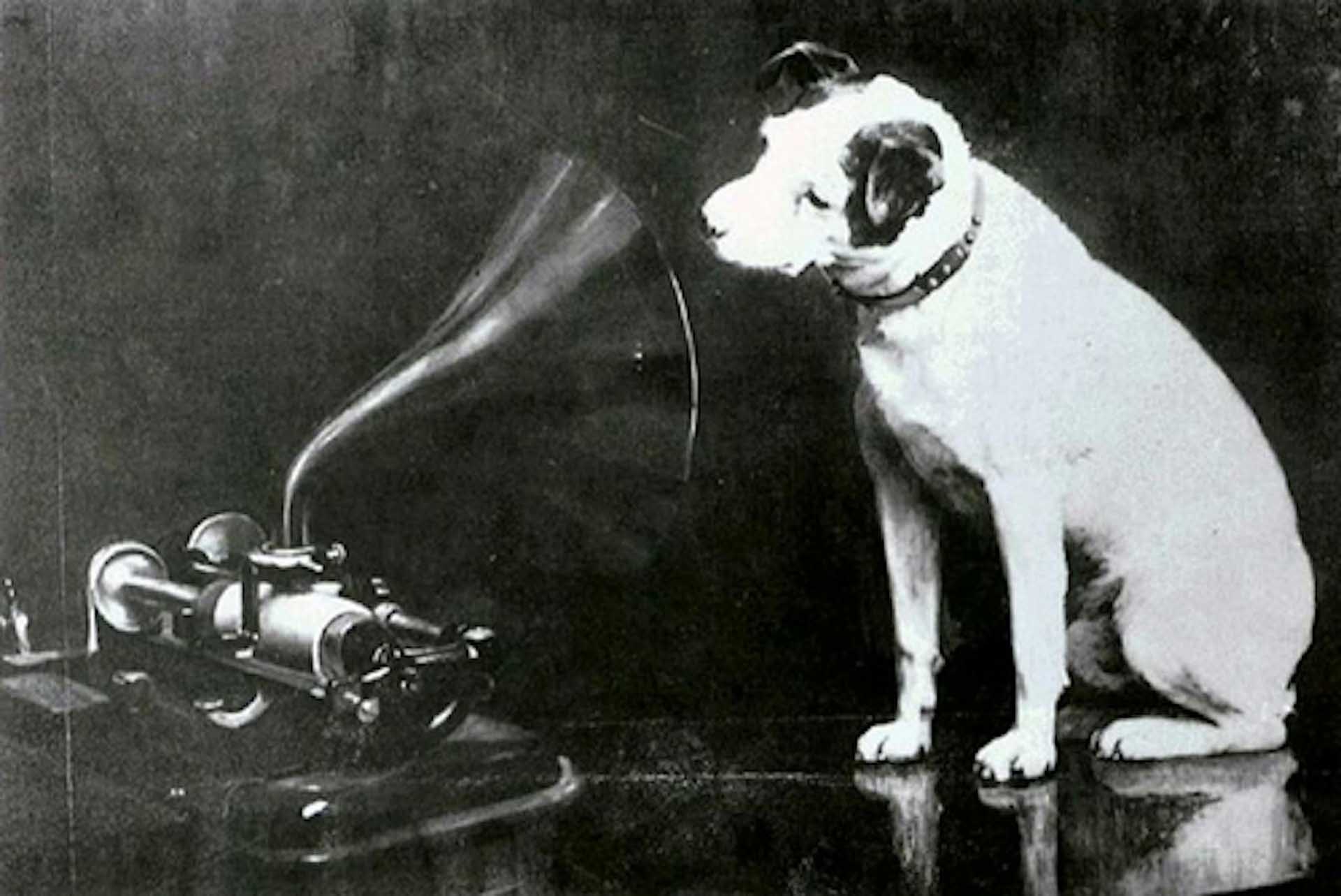
< Image source: His Master’s Voice (HMV) Official Archive >
A small dog sitting in front of a large horn shaped phonograph, tilting its head, and the phrase written beside it, His Master’s Voice. I already knew this image. Yet the story I heard that day, in that space, was not a simple explanation of a logo. It was not a history of technology, but a story about how a brand is born and how it remains in people’s memories. By the time I left the museum, a thought stayed with me. Perhaps that tour was not about seeing inventions at all, but about learning how a brand takes root in the human heart.
The story of Nipper that the docent shared went like this. Nipper loved listening to music with his owner on the phonograph. But his owner passed away early, and they were not able to spend a long life together. One day, hearing music playing out on the street, Nipper approached the phonograph from which the sound was coming and sat quietly, ears perked. When the music ended, he waited for the voice of his owner, who always used to call him His Master’s Voice, hoping to hear it once again. On the surface, it is a tender and deeply moving story. But when one looks a little closer at the historical facts, this narrative is less a record of an actual event and more a story that was later added, quite literally a constructed tale. The origin of the image lies in the painter Francis Barraud, who depicted his own dog listening to a phonograph and then layered that image with emotional storytelling.
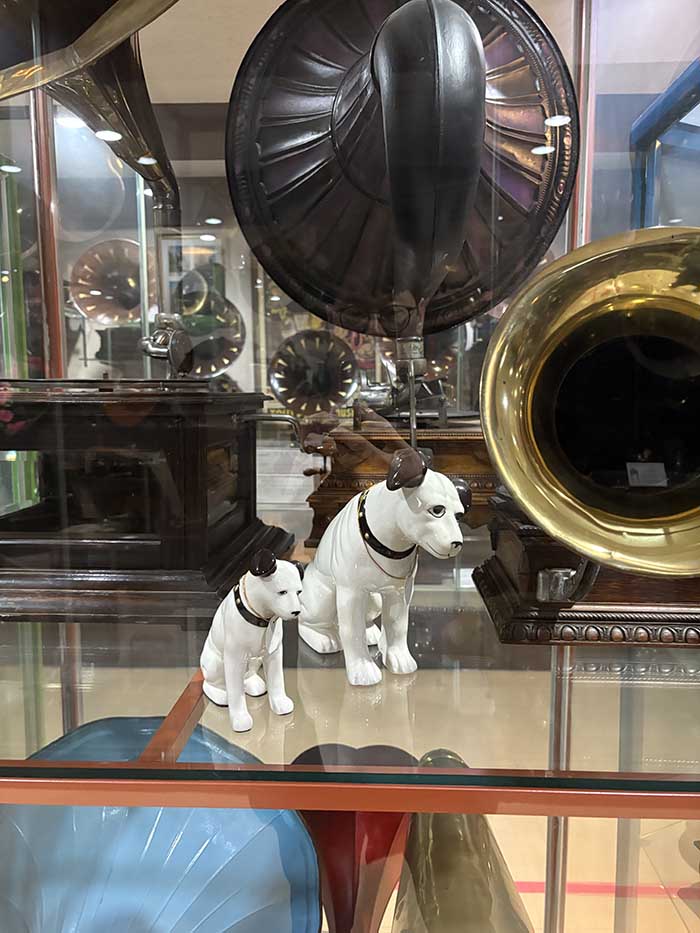
Nipper was a real dog that lived in Bristol, England, in the 1880s. After his brother passed away, Francis Barraud took in Nipper and later painted scenes of the dog reacting to the sound of a phonograph. This painting eventually became known as His Master’s Voice and went on to become one of the most iconic images in the history of the music industry. However, the story that Nipper was waiting to hear the voice of his deceased owner is less a historical fact and more an emotionally refined narrative completed as a brand story. Nipper had already passed away before the painting was made, and the scene depicted was an artistic reconstruction based on observation and memory. Even so, the image transcended its origins as a painting and became a powerful brand asset. Barraud initially attempted to sell the work to the Edison Bell Company, only to be rejected. Its fate changed when the Gramophone Company purchased the image.
One particularly interesting detail is that the original Edison-style cylinder phonograph in the painting was later redrawn as a disc-based gramophone at the company’s request. From the very beginning, Nipper was not a purely artistic subject, but a symbol redesigned to meet the needs of a brand. Through this process, Nipper became an icon representing the entire twentieth-century music industry, passing through Britain’s HMV, America’s Victor, and later RCA Victor. HMV eventually evolved into EMI and was later acquired by Warner Music, becoming part of an even larger history of the global music industry. Yet at the starting point of all these transformations was always the same image of a single dog sitting in front of a phonograph.
Specifications demand explanation, but stories demand empathy. This leads to an important question. Why do people remember Nipper rather than the structure of the phonograph. Why does the story of a single dog linger longer than hundreds of technical explanations. The answer is simple. Humans are not beings who remember information, but beings who remember stories. Technology stays in the mind, but narrative stays in the heart. Whether the story of Nipper is entirely factual is therefore not the most important issue. What matters is that the story translated a complex technology into human meaning. Instead of explaining that sound can be recorded, it presented the image of hearing the voice of a loved one again. In that moment, the machine ceased to be a cold device and became a medium of emotion. Nipper did not explain a product’s function. He revealed the relationship that function made possible. That was the moment a brand was born.
Today’s brands operate on the same principle. Nike does not explain the materials of its shoes, but tells stories of challenge and perseverance. Coca-Cola does not focus on ingredients, but on moments shared together. Apple does not emphasize chip performance, but speaks about a creative way of life. Successful brands never talk about functions themselves, but about the changes those functions bring to life. This does not mean that storytelling allows for arbitrary fabrication. As the case of Nipper shows, storytelling is not about inventing falsehoods, but about translating technology and products into human language. Storage capacity becomes the ability to preserve a child’s first voice. Frequency response turns into the experience of hearing even the softest breath of someone you love. Only then does a product become a brand. Especially in an era where AI proliferates and sentences and copy can be easily replicated, brand depth is created not through artificial phrases, but through authentic narratives.
That brief tour in Gangneung left me with one clear realization. For a brand, storytelling is not decoration, but structure. No matter how excellent a product may be, without a story that connects it to human life, the brand remains a flat name. A well-designed narrative, on the other hand, transforms technology into memory and expands function into meaning. The story of Nipper is one of the most symbolic examples of this process. As I left the museum, I found myself thinking again. What language is the brand we are creating speaking today. Is it the language of numbers and specifications, or the language of stories that understand human life. In the end, brand depth is not created by technology. It is created in the human heart. And there is only one path that leads there. The path of storytelling.















#14057, 905 49, Beolmal-ro 102beon-gil,
Dongan-gu, Anyang-si, Gyeonggi-do, Korea
Business Registration Number: 454-86-01044
Online Sales License No.: 2021-Anyang Dongan-1081
Copyright © DESIGNSORI Co., Ltd.