
“When it is minus thirty degrees, would you go outside?” When the Harbin Ice and Snow Festival comes up, people usually tilt their heads first, revealing their fear of the cold. In winter, most people want to stay indoors where it is warm. So why do millions of people head toward a winter festival, pushing through extreme cold? The answer lies in design. It overturns the natural obstacle of cold through human creativity and transforms winter from something to fear into a stage for experience. This is the power of design embedded in winter festivals.
< Image source: Harbin International Ice and Snow Festival >
Christmas Eve at Minus Thirty Degrees in Harbin
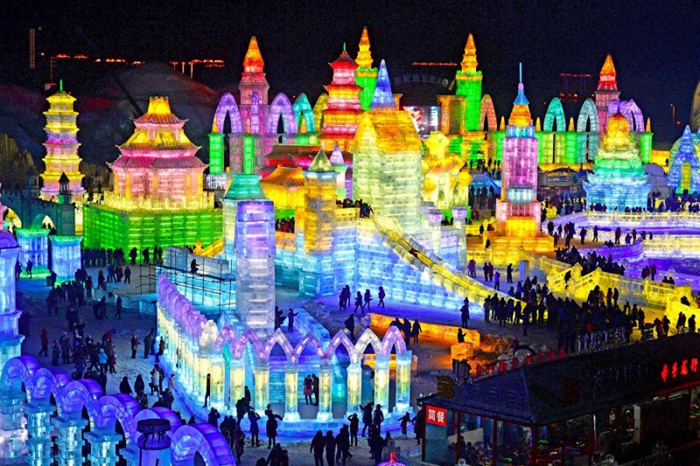
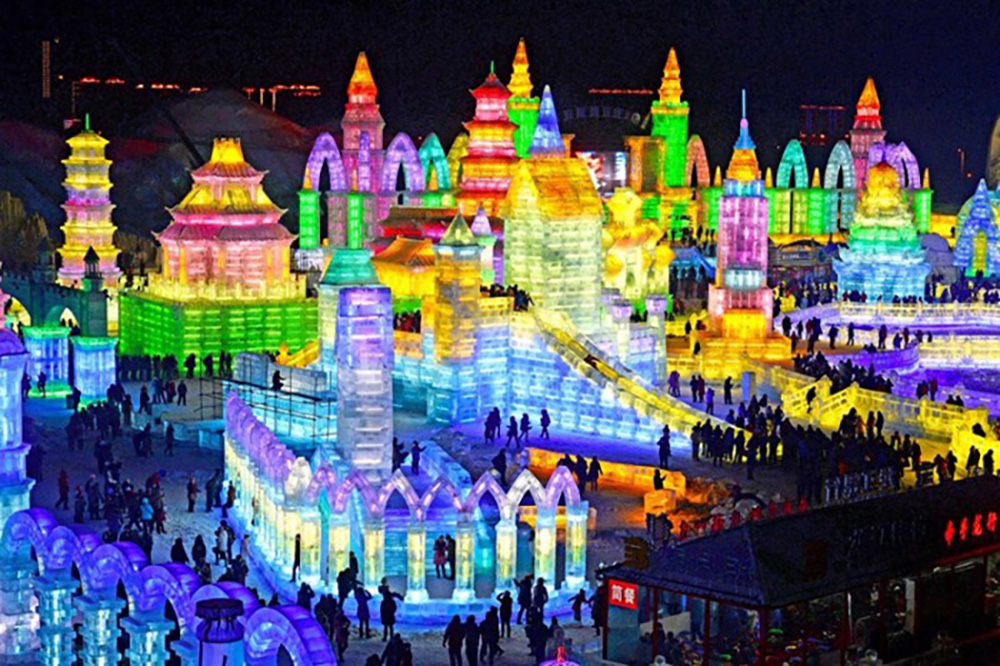
December 24, 2025. Christmas Eve. I visited the Harbin International Ice and Snow Festival, one of the world’s three major ice and snow festivals. Anticipation and concern coexisted. What could there possibly be to see in temperatures as low as minus thirty degrees? Yet the moment I arrived at the festival site, I realized those worries were unfounded. What unfolded before my eyes was not a simple exhibition of ice sculptures, but a fully designed world of winter experiences. Launched in 1985, the Harbin International Ice and Snow Festival is held every year from around January 5 through the end of February. Although the official opening takes place in January, visitors can already tour the site from late December. During the festival period, ice sculptures are installed throughout the city of Harbin, with major themed areas including Sun Island Park, Zhaolin Park, and Ice and Snow World.
The first thing that caught my eye was a concert venue filled with young people. Performances were taking place outdoors in minus thirty degree temperatures, with crowds cheering enthusiastically. The Harbin Ice and Snow Festival has evolved from something merely to be seen into something to be actively participated in. Concert stages are scattered throughout the venue, alongside winter sports and citizen snow sculpture competitions. Particularly striking were the experiential sculptures made of snow. Large blocks of snow were carved with recessed silhouettes of various human poses, allowing visitors to step inside and take photographs. People lined up to capture images in their own poses, and in that moment, they became part of the ice art itself. This was participatory design, where the visitor becomes the subject of the work.
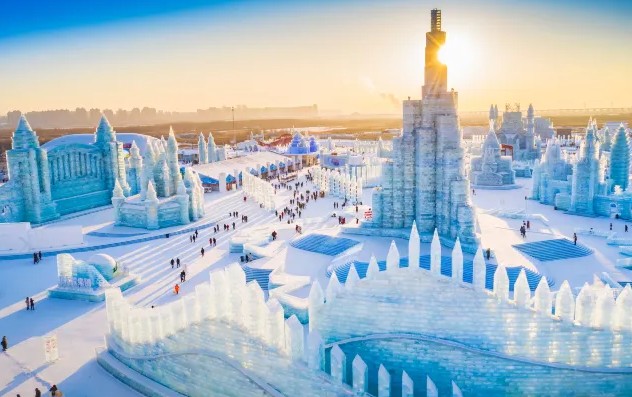
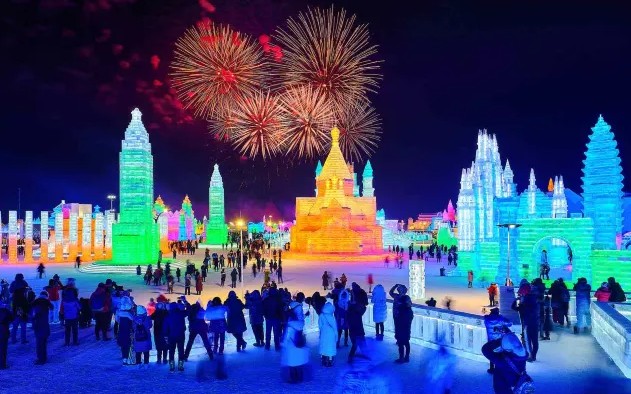
The ice sculptures went far beyond imagination. China’s Forbidden City and Great Wall, Russia’s Kremlin and architectural landmarks, the Egyptian pyramids, and even monumental Buddha figures were recreated entirely in ice. There were also numerous animal sculptures shaped like horses, and even the delicate patterns of traditional Chinese ceramics were intricately carved into the ice. This visual strategy clearly positioned the Harbin Ice and Snow Festival as an international cultural event. Ice and Snow World is located on the riverbanks of the Songhua River, where large scale architectural structures are displayed around a central tower rising to roughly forty meters. As night fell, the ice sculptures were illuminated with colorful fluorescent lighting and LEDs, glowing in vivid hues. It became a massive light show, and visitors walked through it immersed in the experience.
< Image source: Hwacheon Sancheoneo Ice Festival >
Korea’s Winter Festivals, Between Participation and Controversy
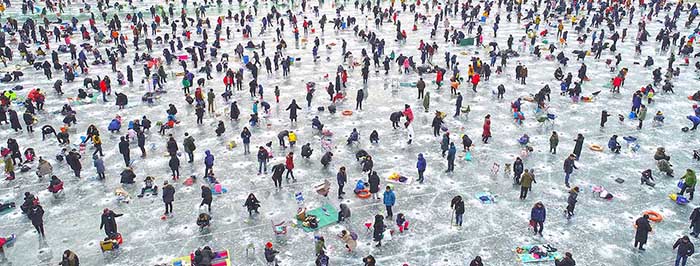
Korea’s representative winter festivals include the Hwacheon Sancheoneo Ice Festival in Gangwon Special Self-Governing Province and the Taebaeksan Snow Festival. Unlike the grandeur of Harbin, these festivals are designed around Korean sensibilities and hands-on experiences. First held in 2003, the Hwacheon Sancheoneo Ice Festival was selected by CNN in 2011 as one of the Seven Wonders of Winter, and in 2019 attracted 1.84 million visitors, establishing itself as one of Korea’s leading festivals. Under the slogan Warm Hearts That Never Freeze, Memories That Never Melt, it offers activities such as ice fishing for mountain trout, bare-hand catching, and sledding. A visit to the Hwacheon festival several years ago left me with lingering questions. To prepare for ice fishing, mountain trout are brought in from external sources each dawn and released beneath the frozen river, making the event closer to a managed experience space than a natural habitat. With 200 tons of fish and 90 percent of Korea’s farmed mountain trout used for the festival, animal rights groups have raised concerns about sustainability.
When compared with Harbin, the characteristics of Korean winter festivals become clearer. Harbin emphasizes visual overwhelm through its forty-meter ice towers, meticulously crafted landmark replicas from around the world, and integrated lighting systems. Hwacheon, by contrast, features ice sculpture plazas, mountain trout made of hanji paper, and ice slides, but places greater emphasis on direct participation than on scale or visual impact. If a more unified visual language were strengthened across the entire festival, experience and design could coexist more harmoniously. The Taebaeksan Snow Festival, which began in 1994, presents yet another direction. Each year it introduces a new theme for its snow sculptures, taking a different approach from Harbin’s monumental structures. The small to mid-scale snow sculptures set against the natural winter scenery of Mount Taebaek embody a philosophy of harmony with nature. If Harbin represents the maximization of the artificial, Taebaek chooses coexistence with the natural environment.
Korean winter festivals are particularly strong in participatory experiences. Their programs are diverse and accessible, yet there remains room for growth in terms of visual spectacle. While visitors to Harbin marvel at overwhelming ice palaces, visitors to Hwacheon find satisfaction in the hands-on experience of catching mountain trout themselves. Both approaches have value. However, for Korean festivals to take the next step forward, it may be time to reconsider the balance between experience and visual design.
< Image source: ArchDaily >
Festivals as the Crystallization of Design
In my view, a regional festival is a crystallization of design. Every festival is shaped by design from the very first planning stage. Design begins with the process of promotion. In building the overall identity of a festival, everything from simple banners and street signs to logos, colors, and typography comes together to form a unified visual language. The identity of the Harbin Ice and Snow Festival is built around ice and light. Its posters and promotional materials are based on shades of blue and white, graphically expressing the shimmering texture of ice. The signage system throughout the festival grounds follows a consistent design language, allowing visitors to feel that they are fully immersed in the world of the Harbin Ice and Snow Festival no matter where they stand.
The Hwacheon Sancheoneo Ice Festival emphasizes warmth and jeong, a uniquely Korean sense of affection and human connection. Its mascot, Eolgomi, is a friendly and playful character that appeals to families. The dominant use of orange and yellow reflects an intention to add warmth to the cold winter environment. Compared to Harbin’s integrated lighting and unified signage systems, however, Korean festivals tend to operate programs more independently, leaving room to strengthen overall cohesion. The Taebaeksan Snow Festival presents itself under the concept of a winter kingdom, selecting a new theme each year. Snow sculptures set against natural winter landscapes pursue a different direction from Harbin’s global landmark replicas or intricate ceramic patterns carved in ice. Rather than scale, they prioritize harmony with nature, and instead of technical precision, they seek a more modest and understated beauty. That said, to grow into a more international festival, there is still a need to further develop the level of craftsmanship and the depth of storytelling.
Designing Memories Through Goods
Festival goods are more than simple souvenirs. They are designs of memory that translate the festival experience into a physical form. At the Harbin Ice and Snow Festival, goods shops sell ice crystal shaped keyrings, tumblers printed with the Bingdeng Festival logo, and miniature ice sculptures. Long after returning home, these items recall the cold winter nights of Harbin. Goods from the Hwacheon Sancheoneo Ice Festival are even more diverse. Plush mountain trout dolls, mugs and tumblers printed with trout graphics, rice cakes and cookies shaped like trout, and T shirts and eco bags printed with the slogan Warm Hearts That Never Freeze, Memories That Never Melt are particularly popular. Products featuring the Eolgomi mascot are also produced in a variety of poses. At the Taebaeksan Snow Festival, goods often use snow crystal motifs. Snowflake shaped accessories, winter kingdom themed snow globes, and postcards and calendars printed with Taebaek’s snowy scenery are among the favorites. Each time people see a mountain trout doll on their desk or drink coffee from a Bingdeng Festival mug taken from the cupboard, they are reminded of that day once again. Memories are replayed through objects. This is the power of goods design.
< Image source: travelandleisure >
The Essence of Festival Design, the Totality of Experience
Comparing the Harbin Ice and Snow Festival with Korea’s winter festivals leads to one clear realization. A festival is not a question of what it shows, but of what kind of experience it designs. Harbin designs an experience of overwhelm. Forty meter high ice towers, massive architectural structures filling the riverbanks of the Songhua River, and ice sculptures recreating landmarks from around the world. Visitors stand in awe before the monumental scale created by human imagination, capturing striking images to share on social media. China’s continental temperament and its confidence tied to the idea of national rise are expressed through ice and snow. Concerts, film screenings, winter sports, and citizen snow sculpture competitions add further layers to the festival, giving it depth and dimensionality. Korea, by contrast, pursues an experience of participation, revealing a different direction. Dropping fishing lines into holes cut through ice, catching mountain trout with bare hands, and riding snow sleds place emphasis on direct, physical engagement. These experiences attempt to embody distinctly Korean cultural values such as jeong, emotional warmth and connection, and heung, collective excitement and joy.
Visitors to Harbin experience visual awe in front of colossal ice palaces, while visitors to Hwacheon remember the tactile thrill of ice fishing and the warmth of time spent with family. Each festival possesses its own strengths. However, for Korean winter festivals to strengthen their international competitiveness, they must go beyond excellent experiential programs and further enhance overall visual completeness and a unified brand identity across the entire festival. At the same time, issues of sustainability and animal welfare must also be addressed as part of the broader social conversation.
Design Overcomes the Cold
Winter is a cold season. Yet a well designed festival transforms cold into an asset. Ice and snow are materials that can only be used in winter, a seasonal privilege unavailable at any other time of year. Harbin elevates them into monumental architectural art, while Korea translates them into participatory experiences. These are different approaches, but both are meaningful. Harbin creates spectacles that astonish the world. Hwacheon secures mass appeal by attracting 1.84 million visitors. Taebaek builds tradition through more than three decades of continuity. As demonstrated by the title Seven Wonders of Winter selected by CNN, Korean winter festivals have also earned global recognition.
Still, for Korea’s winter festivals to advance to the next stage, several considerations are necessary. Beyond strong experiential programs, they must strengthen visual spectacle, establish a unified visual language that encompasses the entire festival, and explore sustainable operational models. What should be learned from Harbin is not its scale, but its consistent brand identity and its design of experience. The future of Korean winter festivals depends on the harmony between participation and design. When enjoyment and visual impact, regional economic vitality and environmental ethics, mass appeal and artistic value are brought into balance, these festivals can truly grow into world class cultural events.















#14057, 905 49, Beolmal-ro 102beon-gil,
Dongan-gu, Anyang-si, Gyeonggi-do, Korea
Business Registration Number: 454-86-01044
Online Sales License No.: 2021-Anyang Dongan-1081
Copyright © DESIGNSORI Co., Ltd.