
Industrial design has long been about creating objects that carry out human intentions. Press a button and they respond; hold them and they perform a function. Judgment belonged to humans, and objects existed to execute the result. For this reason, the questions of design were relatively clear: How can it be used more comfortably? How can it be made more efficiently? Form, function, and usability stood at the center of design. But recently, the object of design has begun to change. Entities are emerging that can make decisions on their own, move autonomously, and spend time alongside humans in the same space. A humanoid is closer to a responsive presence that reacts to its environment and forms relationships than to being a simple machine. This shift forces industrial design to rewrite its fundamental questions.
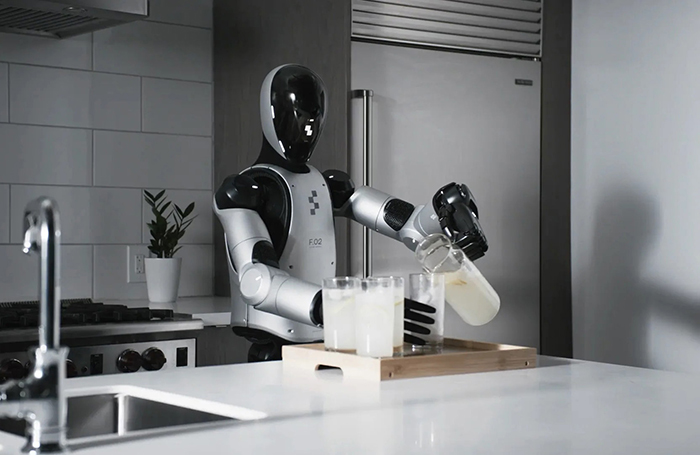
< Image: Figure Humanoid Robot @figure / figure.ai >
As artificial intelligence increasingly assumes responsibility for a machine’s intelligence, the role of the designer becomes even clearer. What kind of body should house that intelligence? What kind of attitude should a robot standing before a human possess? Design is no longer about creating an attractive exterior; it is about shaping how humans and machines coexist within the same space. From a purely engineering perspective, the humanoid form is not the most efficient. Wheels are simpler and more stable than legs, and specialized structures designed for specific tasks are often faster and more precise. Yet there is a clear reason why many companies are focusing on humanoids: the environments we live in were built around the human body. The height of door handles, the rise of stairs, the size of worktables, the grip of tools are all designed according to the length of human arms, the height of human sightlines, and the rhythm of human walking. The humanoid is almost the only form that can use this vast infrastructure without requiring it to be rebuilt.
It is here that the role of the industrial designer becomes evident. The task is not to reinvent robots from scratch, but to connect them seamlessly to environments already designed for humans. It is about designing the physical interface that reduces friction between machines and space. This work demands a sensitivity not only to function, but also to proportion, posture, and movement. One of the most frequently discussed concepts in humanoid design is the uncanny valley. The theory suggests that as robots become more human-like, the sense of discomfort can actually increase. It serves as a warning about the dangers of imitating humans too closely. For this reason, many recent humanoids choose deliberately abstract forms rather than attempting to replicate the human face with complete realism.
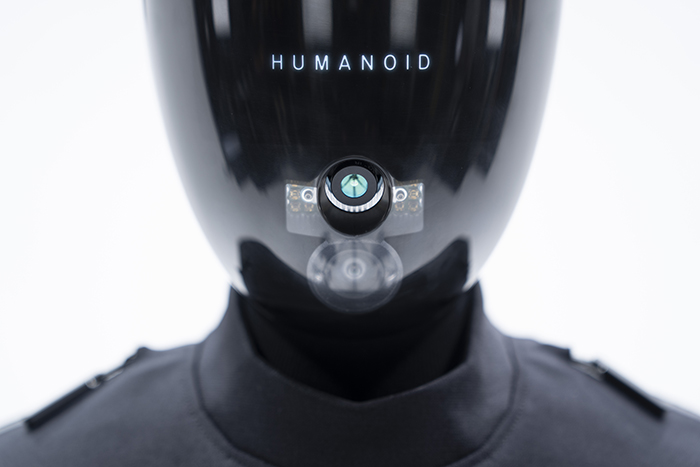
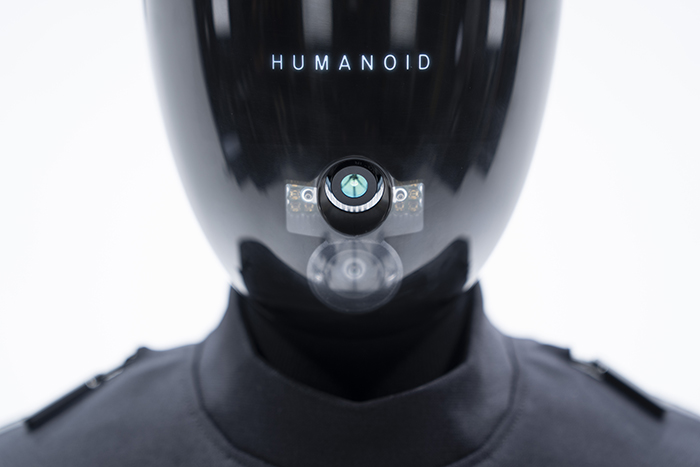
< Image: Humanoid Robot @humanoid / thehumanoid.ai >
Smooth surfaces or simple displays convey a clear message: “I am not human.” This is not because the robot lacks emotion, but because this is a deliberate design decision meant to define the boundaries of the relationship. Designers may no longer be asking how closely a robot should resemble a human, but rather how far it should intentionally avoid that resemblance. Details such as body proportions, exposed joints, and the segmentation of surfaces all shape the character of a robot. Maintaining a human-like silhouette while refining the details in a distinctly mechanical way is a delicate balance that cannot be solved by calculation alone. It belongs to a domain that requires experience, sensitivity, and careful observation of human beings.
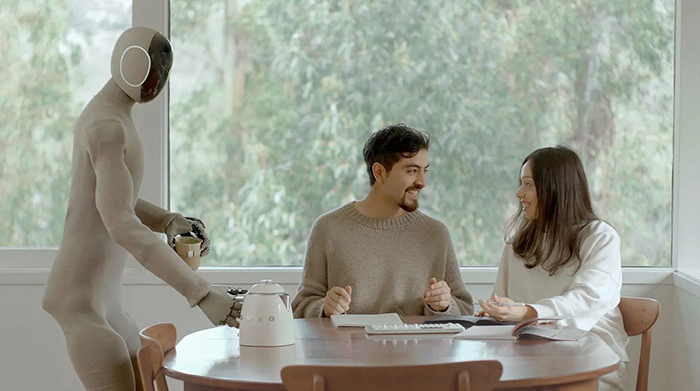
< Image: 1x Humanoid Robot @1x / 1x.tech >
A humanoid communicates far more when it moves than when it stands still. The speed at which it extends an arm, the timing of a head turn, and the rhythm of its walk determine whether the robot feels trustworthy. Even with the same form, different movements create entirely different impressions. Movements that are too fast can feel threatening, while movements that are too slow can make the robot appear unintelligent. A brief pause before approaching a person or a gesture of yielding the way establishes a relationship before any language is exchanged. Movement thus becomes not merely a function, but a form of communication. Sound is part of this as well. The operating noise of motors and the friction of joints shape the robot’s presence. When these sounds are perceived not as irritating noise but as signals of a precisely operating machine, users feel reassured. Designers are therefore no longer simply drawing forms; they are designing time and rhythm.
Ultimately, the core of humanoid design lies in relationships. Will this robot be perceived as a simple tool, accepted as a partner that works alongside humans, or regarded as a companion capable of emotional connection? The answer to this question fundamentally changes the direction of design. Even the choice of material alters relationships. Cold metal emphasizes professionalism and strength, while soft fabrics reduce psychological distance. The robot’s height and eye level function similarly: a height lower than a human creates a sense of comfort, while equal eye level suggests a relationship of equality. Small design decisions like these shape how people respond to robots.
Should we design robots as objects that can be treated carelessly, or as entities worthy of respect? This question reveals how industrial design is expanding beyond technology into the realms of society and ethics. As humanoids enter everyday life, they pose a new challenge to industrial designers: how much humanity should we allow machines to embody, and what place should robots occupy within human environments? As the title “Product Designer” began replacing “Industrial Designer,” and as UX and UI became the dominant language of design, industrial design gradually drifted away from its traditional focus on form. While the digital domain expanded, the discipline responsible for shaping the physical world may have quietly receded.
Yet humanoids call designers back to the physical world once again. Designing entities that move alongside humans within shared environments remains fundamentally a question of form, proportion, sensibility, and attitude. If the future of mobility design once seemed like the next horizon, perhaps it is now time to imagine robots entering everyday life. A humanoid resembles a human, yet it is not human. How to maintain that difference, and how to connect across it—answering that question may become one of the most important roles for industrial designers in the years ahead. For many designers, this shift may even feel like a long-awaited blessing.















#14057, 905 49, Beolmal-ro 102beon-gil,
Dongan-gu, Anyang-si, Gyeonggi-do, Korea
Business Registration Number: 454-86-01044
Online Sales License No.: 2021-Anyang Dongan-1081
Copyright © DESIGNSORI Co., Ltd.