
Every morning during rush hour, millions of people take the subway. They squeeze into narrow spaces, lean against strangers’ shoulders, and at times endure discomfort and unease. Yet even within the same subway system, some countries design with greater consideration, while others do less. What creates that difference is the presence or absence of considerate design.
In Nagoya, Japan, the municipal transportation bureau has operated women-only cars since the early 2000s. During peak commuting hours, typically between 7 and 9 a.m., certain train cars are designated exclusively for women to protect them from sexual harassment. In fact, women-only cars were first introduced in Japan as early as 1912 and expanded widely beginning in 2000. Today, in major cities such as Nagoya, Tokyo, and Osaka, they have become a normalized part of daily life. Pink markings on platform floors indicate waiting lines, and platform screen doors display clear ‘Women Only’ stickers. In Japanese society, women-only cars are broadly recognized as a necessary safety measure and have been firmly established for over two decades.
From a design perspective, Japan’s women-only cars go beyond merely separating compartments. The pink waiting lines on the platform, the clear signage indicating car locations, and the consistent markings both outside and inside the train are all systematically designed. The system is visually clear, intuitively understandable, and consistently applied. This is the level of completion that defines thoughtful design.
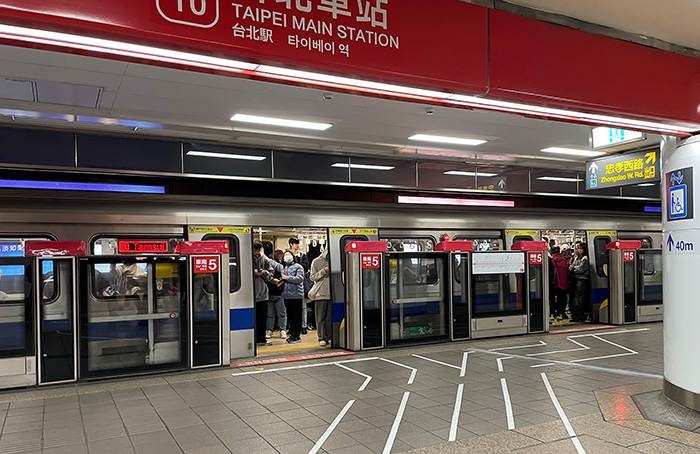
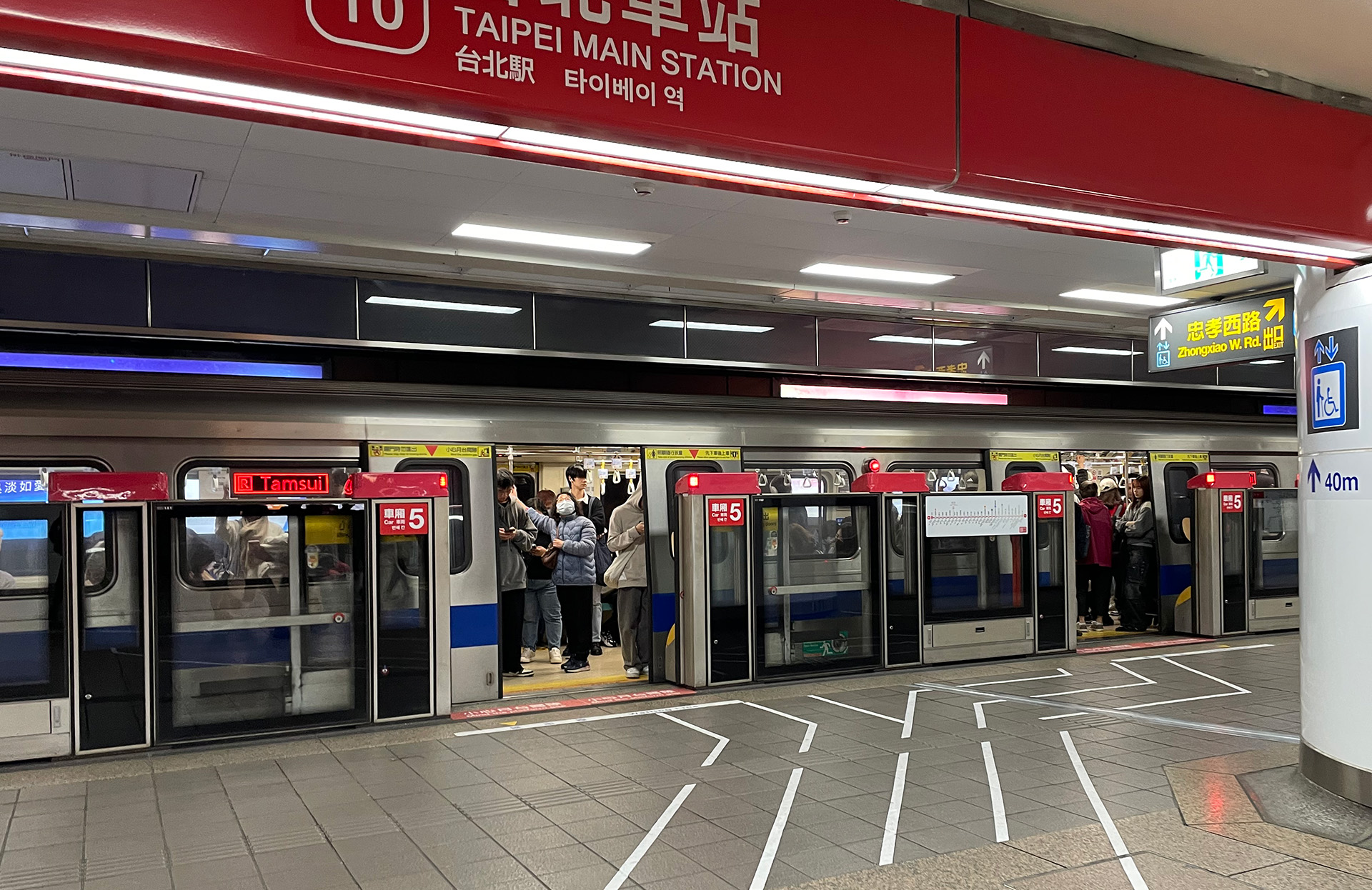
Taipei Metro: Boarding Lines That Create Order
One of the most striking features of the Taipei MRT is its boarding line system. The lines drawn on the platform floor are not merely markings. They function as a design mechanism that produces order. Spaces for alighting passengers and lines for boarding passengers are clearly separated. On Taipei platforms, arrow marked waiting lines align precisely with the positions where train doors open. Passengers queue accordingly, step aside to allow others to exit first, and then board in sequence. These behaviors occur naturally because the design guides them. The boarding line system is simple yet effective. Clear color contrasts, intuitive arrows, and well calibrated spacing work together to maintain order even during peak commuting hours. The Taipei Metro is widely regarded as clean, quiet, and orderly. Much of that reputation can be attributed to its well designed boarding system.
Korea: The Failed Introduction of Women-Only Cars
Korea has attempted to introduce women only cars several times. In 1992, a women and elderly only car was introduced on Seoul Metropolitan Subway Line 1. However, due to insufficient promotion and rush hour congestion, it was not properly enforced. About 40 percent of passengers in the designated car were men. After more than a decade of nominal operation that was reduced essentially to signage, it was quietly discontinued. Subsequent attempts followed in 2007 and 2011 by Seoul Metro and Seoul Metropolitan Rapid Transit Corporation, in 2013 by Daegu Metro, and in 2016 by Busan Metro Line 1, which piloted a ‘Women Consideration Car’ during rush hours. However, all faced public backlash and were eventually abandoned.
The core of the opposition centered on claims of reverse discrimination. Critics argued that the policy treated men as potential criminals, that women riding in general cars would remain unprotected, and that segregating women under the pretext of protection was outdated. Even the Korea Sexual Violence Relief Center submitted opposition to the proposal. In Busan’s case, the official Korean name was ‘Consideration Car,’ yet the English signage read ‘Women Only.’ The inconsistency created confusion, and enforcement was virtually nonexistent. By mid 2017, many male passengers continued to use the car without consequence. The initiative had devolved into a purely symbolic measure marked only by signage.
Why Japan Succeeded and Korea Failed
Why has the same concept of women only cars been sustained for over 20 years in Japan but repeatedly failed in Korea. The difference lies in design. Japan approached the policy systematically from the outset. Pink waiting lines on platforms, clear positional markers, consistent signage, and strict implementation were introduced together. Most importantly, social consensus preceded execution, and the design embodied that consensus. The purpose of protecting women from sexual harassment was clearly defined, and the design supported that purpose.
In Korea, implementation was rushed and largely formalistic. Signage was installed without sufficient promotion or enforcement. More critically, the policy was introduced without adequate social consensus. Between the objective of protecting women and the broader value of gender equality, the necessary public deliberation was lacking. The design could not resolve that tension. In Busan’s case, even the terminology was unclear. Was it a ‘consideration’ car or an exclusive car. The mismatch between Korean and English labels reflected uncertainty about the policy’s identity. Ambiguous policy leads to ambiguous design, and ambiguous design fails.
The Core of Considerate Design Is Clarity
The essence of considerate subway design is clarity. Clarity about what is being considered, for whom, and how it operates. Taipei’s boarding lines are clear. Stand here, leave space for exiting passengers, board in order. No complex explanation is needed. The lines and arrows communicate the expected behavior. Japan’s women only cars are similarly clear. Pink lines, ‘Women Only’ signage, and designated time frames immediately convey the intent. Debate may persist, but the purpose is unmistakable. Korea’s subway system, by contrast, often lacks such clarity. In Busan, the distinction between ‘consideration’ and ‘exclusive’ was blurred. In Seoul, priority seats for the elderly are marked in pink, yet frequently occupied by younger passengers. Pregnancy priority seats face similar challenges. The signage exists, but effectiveness does not. The design is present. The consideration is not.
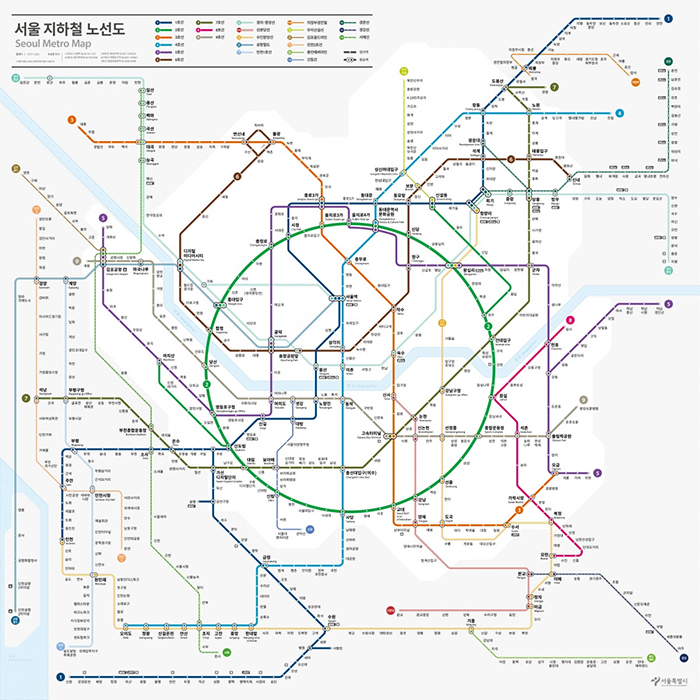
< Image Source: Seoul Metropolitan Government >
Seoul Subway Map: The First Major Redesign in 40 Years
In 2025, the Seoul Metropolitan Government carried out a comprehensive redesign of the subway map for the first time in four decades. The new design focuses on readability and inclusivity, particularly for the visually impaired and foreign visitors. It adopts an octolinear layout, a traffic light style transfer station indication system, enhanced geographic references, and more distinguishable colors and patterns. According to eye tracking experiments, the time required to locate stations was reduced by up to 55 percent, and the time needed to navigate transfers decreased by up to 69 percent. Notably, the reduction in wayfinding time for foreign passengers was 21.5 percent greater than that of local users. This is the measurable impact of considerate design.
Yet it is still not enough. The map has changed, but platform congestion remains the same. Designs that guide orderly boarding and alighting are still insufficient. Unlike Taipei, there are no clearly defined boarding lines. Unlike Japan, there is no systematic waiting structure. Passengers continue to crowd in front of doors, and boarding and alighting flows remain tangled.
Consideration Begins with Design
The subway is a public good. Everyone uses it, everyone endures its discomforts, and everyone requires consideration. Design translates that consideration into reality. From the debate over women only cars, the key question is not whether they are necessary. The real question is how to build social consensus and translate it into effective design. Japan has operated women only cars for over 20 years and found its answer. Korea has attempted and failed for more than three decades and continues to struggle. From Taipei’s boarding lines, the lesson is not merely that drawing lines creates order. Clear design induces clear behavior. Drawing a line on the floor is easy. Giving that line meaning so that it changes behavior requires a coherent system. The subway map redesign in Seoul demonstrates that design saves time. A 55 percent or 69 percent reduction is not just a statistic. In a system used daily by millions, saving one or two minutes per person represents enormous collective value. Fewer people get lost. Less stress accumulates. Movement becomes slightly more comfortable.
Good design considers the most vulnerable. Tactile paving for the visually impaired, elevators for wheelchair users, priority seats for pregnant passengers are all forms of considerate design. Women only cars also fall within this category as a measure intended to protect those who may not feel safe. Japanese society accepted this framing. Korean society resisted it. That divergence explains why one system endured for decades while the other faded within years. The same logic applies to boarding lines. The elderly who cannot move quickly, passengers carrying heavy luggage, foreigners navigating the subway for the first time. Designing for them creates order for everyone. The subway is a microcosm of society. Diverse individuals gather in a confined space, collide, accommodate, or neglect one another. Making that space slightly more comfortable is the role of design.
Clear boarding lines like Taipei’s, systematic safety measures like Japan’s, readable maps like Seoul’s. When these elements converge, we can begin to build a subway rooted in consideration. Subways need considerate design. It is not optional. It is essential.

















#14057, 905 49, Beolmal-ro 102beon-gil,
Dongan-gu, Anyang-si, Gyeonggi-do, Korea
Business Registration Number: 454-86-01044
Online Sales License No.: 2021-Anyang Dongan-1081
Copyright © DESIGNSORI Co., Ltd.