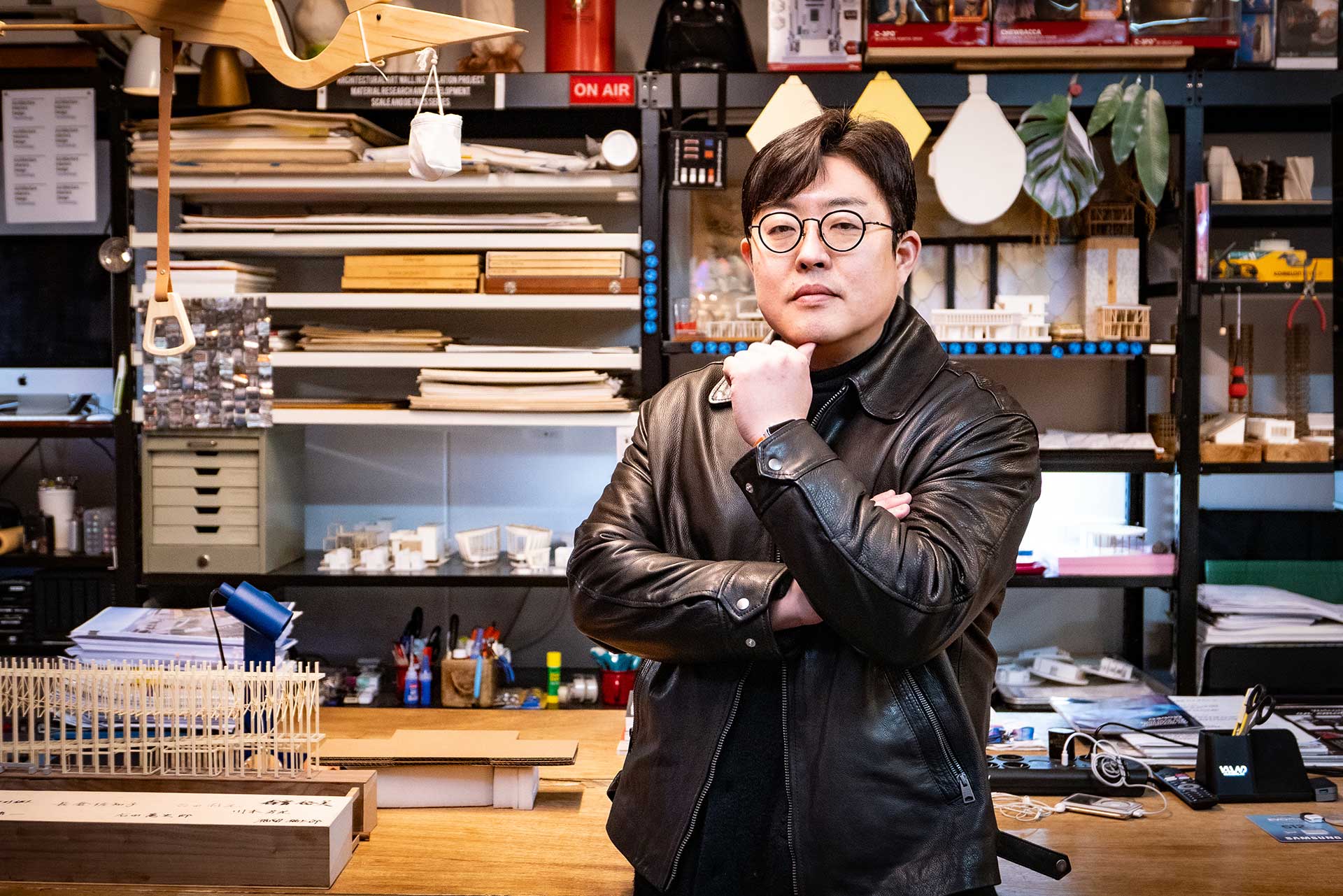
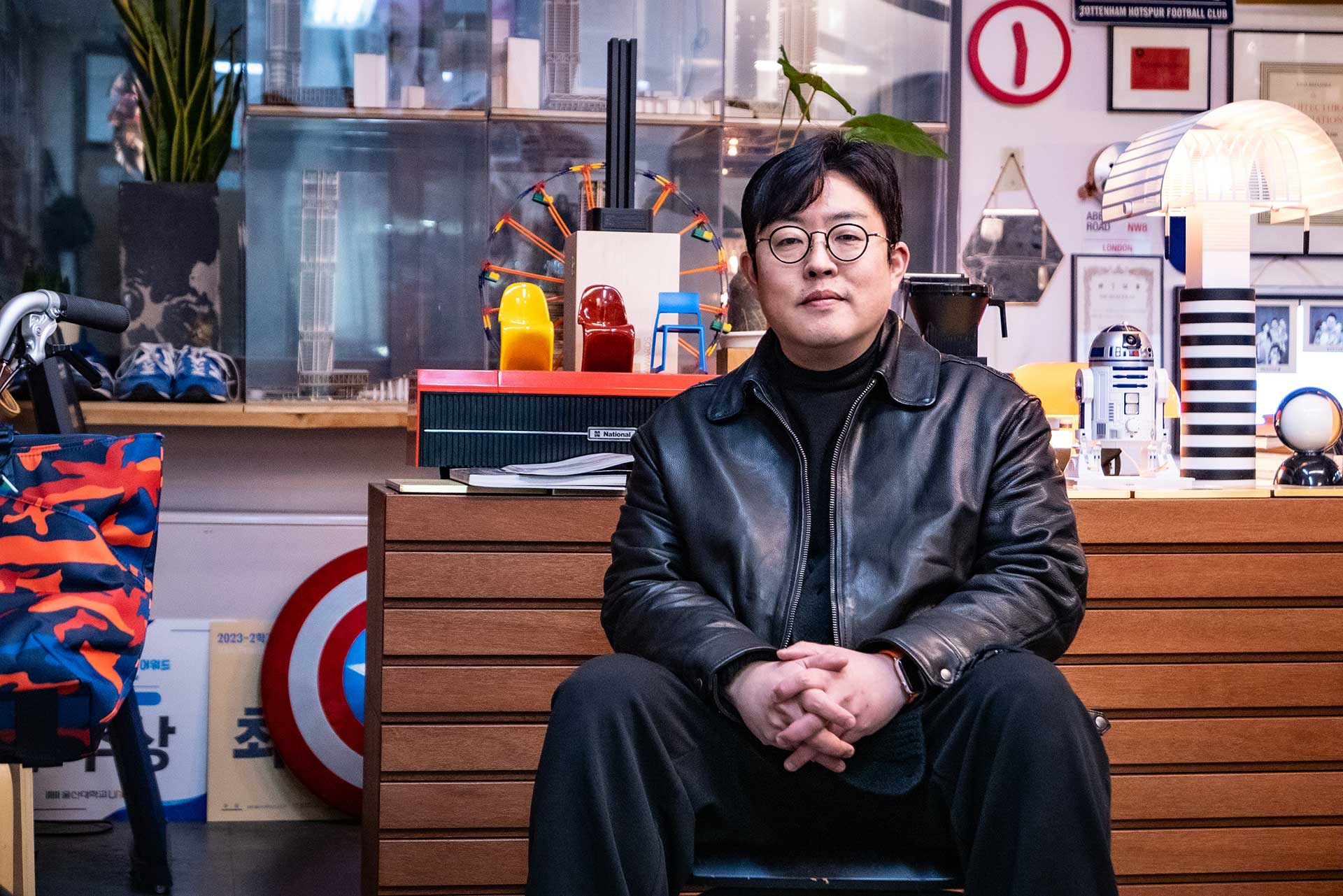
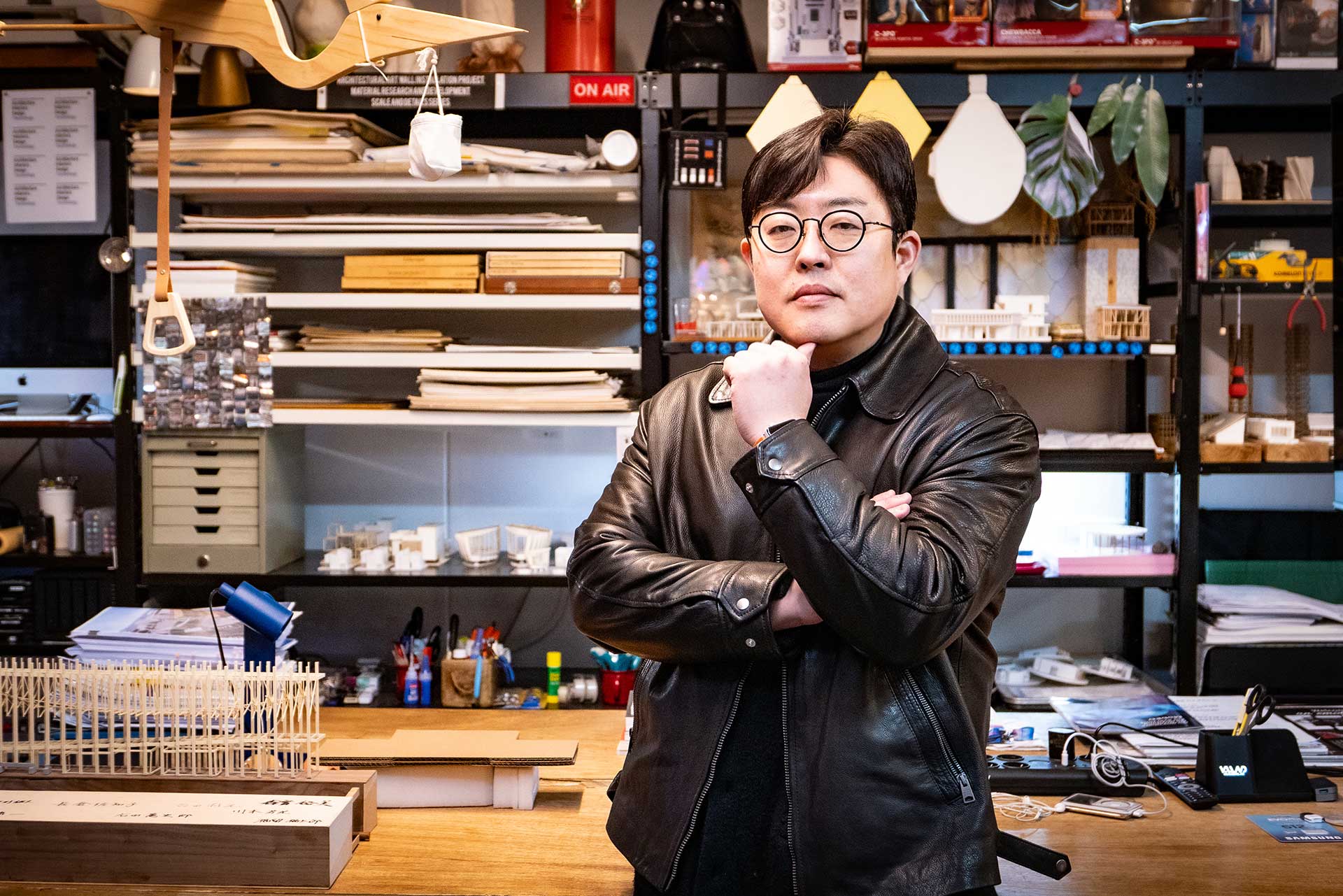
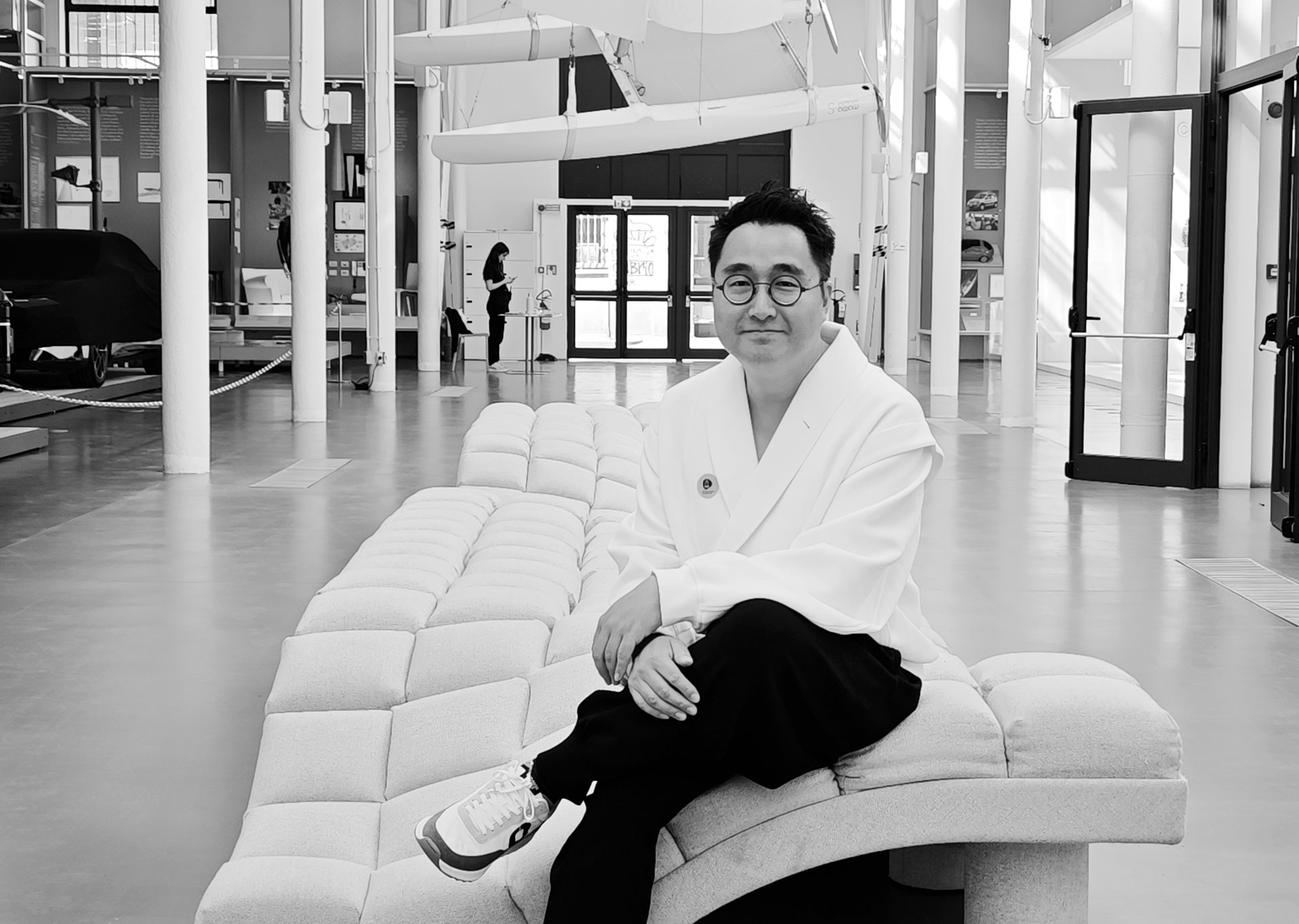
Beom Kwan Kim Professor, University of Ulsan
“Professor Beom Kwan Kim is an architect and researcher whose work connects ways of thinking across different scales. After studying industrial design, he went on to study architecture at the Architectural Association in London, further developing his approach to integrating design thinking with architectural practice. His work has consistently explored how ideas developed at the scale of objects can expand into the spatial, structural, and social dimensions of architecture. In this interview, he reflects on how timber architecture can be expanded within the discourse of future architecture, what essential qualities of an architect should remain unchanged despite rapid technological advancement, and how structural thinking can connect local identity with global challenges. Viewing architecture as a functioning ecosystem of materials, energy, culture, and human activity, he invites us to reconsider the direction architecture must take in an era defined by sustainability and energy transition.”
To begin, could you briefly introduce yourself? Please tell us about your career as an architect and educator, as well as your main research interests at the University of Ulsan.
My name is Beom Kwan Kim, and I conduct research and teach architecture and design at the University of Ulsan. I first studied industrial design and later pursued architecture at the Architectural Association AA in London. My journey from industrial design to architecture was not simply a shift in academic discipline but rather an expansion of the scale of thinking and an ongoing effort to connect different fields. While industrial design deals with dense relationships between objects and users, architecture addresses complex relationships where people, structures, environments, and cities overlap. I have always understood these two fields not as separate disciplines but as a continuous system of thinking that organizes relationships across different scales. I hold several titles. I am a researcher and educator, and at the same time an architect and designer. However, if I were to describe myself most accurately today, I would say that I am a pioneering researcher who explores and verifies new possibilities for architecture and design. I formulate theoretical and structural hypotheses and conduct research to test them.
In order to prove those ideas, I also design and build directly, and then share the results again within the educational environment. My work continues within a cycle where research, design, experimentation, and education continuously interact. Fortunately, these interdisciplinary approaches and projects have received meaningful recognition both domestically and internationally. My work has been honored at the Korea Timber Architecture Awards, and I became the first Korean to receive the Grand Prize at the Built Design Awards BLT in Switzerland. I have also received awards from Architecture Master Prize AMP, International Design Awards IDA, K Design Awards KDA, and Asia Design Prize ADP. I believe that receiving international recognition in both industrial design and architecture has been possible because my work does not remain within a single formal approach but instead attempts to integrate history, culture, structure, materials, environment, and technology into a unified way of thinking. I often compare my work to cooking. Just as a chef experiences food from different cultures, studies the properties of ingredients, and experiments with combinations to create new menus, I explore diverse environments and experiment with materials in order to develop new architectural recipes. However, what I consider most important in this process is not the visible form but the details that truly integrate and operate within the structure. Architecture often begins with large concepts and scales, but it is ultimately completed through detail.
A structural joint, the thickness and grain of materials, the way light enters through a gap, or how panels connect with one another are small elements that determine how the building actually works and whether the entire system is convincing. During the design process, I constantly ask myself a simple question. Does this detail actually work? No matter how beautiful the concept may be, architecture loses its persuasive power if the details fail to function. For this reason, I consider the process of discovering, experimenting with, and inventing new details to be one of the most important acts of design. Currently my research focuses on three main areas. The first is timber architecture and hybrid structural systems. Rather than viewing timber only through a traditional lens, I reinterpret it as a structural alternative and explore new structural possibilities by combining engineered wood with metal and digital fabrication technologies. The second area is energy producing building envelopes BIPV. My research aims to transform architecture from a passive consumer of energy into an active system that produces energy and interacts with the environment. The third area is the integrated design of digital fabrication technologies and sustainable materials.
Through AI based robotic fabrication, three dimensional printing, and parametric design, I explore design methodologies where structure, environment, and expression are not separated but integrated. Ultimately, I do not see architecture and design as finished images or final outcomes. Rather, I see them as complex systems that continuously operate, evolve, and transform through experimentation and verification. Discovering new structures, exploring new experiential forms of expression, and ensuring that they can be realized through concrete details in the real world is the direction I am currently focusing on in both research and design. Through this process, I hope architecture can move beyond simple form and become a structure that actively operates and continues to evolve within environmental and social contexts.
< Photo Courtesy of @yoon_joonhwan >
You have consistently presented Korean timber architecture not simply as a traditional style but as an important alternative for contemporary architecture. Could you share the decisive moment that led you to focus on timber architecture and the first time you truly sensed its architectural potential?
The decisive moment that led me to focus on timber architecture began when I returned to Korea after living in the United Kingdom for about ten years. Although I had an interest in traditional Korean architecture, the more fundamental reason came from a growing awareness of the need for environmental and structural transformation in response to the changing conditions of our time. Modern architecture has long developed around reinforced concrete. It was a powerful material that enabled rapid industrialization and the construction of modern cities, but it also assumes high carbon emissions and heavy structural systems. Facing the urgent demands of climate crisis and carbon neutrality, I began to feel that we needed to reconsider the very foundations of structural thinking in architecture. At that moment the material that I returned to was wood. Timber is not simply a warm natural material.
During its growth process it absorbs carbon, and when it is used as a building material it stores that carbon within the structure. At the same time it is lightweight, easy to process, and has strong potential to work together with modular construction and digital fabrication technologies. Most importantly it is a structural material that humanity has used and tested for the longest period of time in many different ways. At that point I began to see timber not as a symbol of tradition but as a compelling structural material for future architecture and design. The decisive turning point came shortly after I returned to Korea when I happened to encounter Japanese timber architecture in person. Japan is a country that experiences far more natural disasters such as earthquakes and typhoons than Korea. The fact that houses and public buildings were still being built with wood in such an environment came as a profound shock to me. At that moment my interest shifted from the material itself to the structural system. Timber structures are not systems that simply resist force through rigidity. Instead they absorb force, distribute it, and respond flexibly. The realization that timber structures could actually be a rational choice in environments with frequent natural disasters completely changed my previous perception of wood.
Timber was not a weak material but an intelligent structural system that responds to environmental forces. After that I traveled to Japan to study timber architecture directly. I visited sites to observe how engineered wood is processed and how structural components are combined. Rather than stopping at learning, I brought timber architectural models that I had designed and placed them inside a wooden box before traveling to Japan again to ask for guidance and support. Looking back it may have been a reckless attempt, but the sincerity behind it was recognized and it eventually led me to establish connections with Miyazaki Prefecture, which is one of the central regions of the timber structure industry in Japan. Through that connection I was able to begin more serious research. That experience gave me a meaning beyond technology itself. Timber architecture is not simply a choice of material but a system in which the forestry industry, processing technology, regional economies, and environmental strategies are organically connected. Since then I have continued to experiment with and apply these ideas within the specific conditions of Korea. I became convinced that timber is not a form belonging to the past but a structural strategy for the future, and that conviction became the starting point of my continuing research into timber architecture. For me timber architecture is not a reproduction of tradition but a structural alternative that responds to the demands of our time and a material that points toward the future.
< Photo Courtesy of @yoon_joonhwan >
Traditional timber architecture is often treated only as something to be preserved. You have expanded it into the language of contemporary architecture and design. By what criteria do you establish the balance between tradition and modernity?
I believe the most essential value of traditional timber architecture lies not in its form but in its structural thinking, its environmental response, and the cultural and technical ways it has evolved over time. Traditional timber construction is not merely architecture from the past built with natural materials. It is a complex structural system that has read local climate and material properties, organized loads, and formed spaces according to the conditions of each region. Techniques found in Hanok architecture and in the knowledge of master carpenters should not be regarded only as subjects of historical preservation. I see them as collections of principles that can still address the problems of today. For that reason the criteria I use to establish a balance between tradition and modernity can be summarized in three aspects. First, how can the structural principles of tradition operate within the conditions of contemporary technology, society, and environment through design. Second, can that operation be structurally and performatively verified. Third, through that process can new forms of expression and function create meaningful experiences.
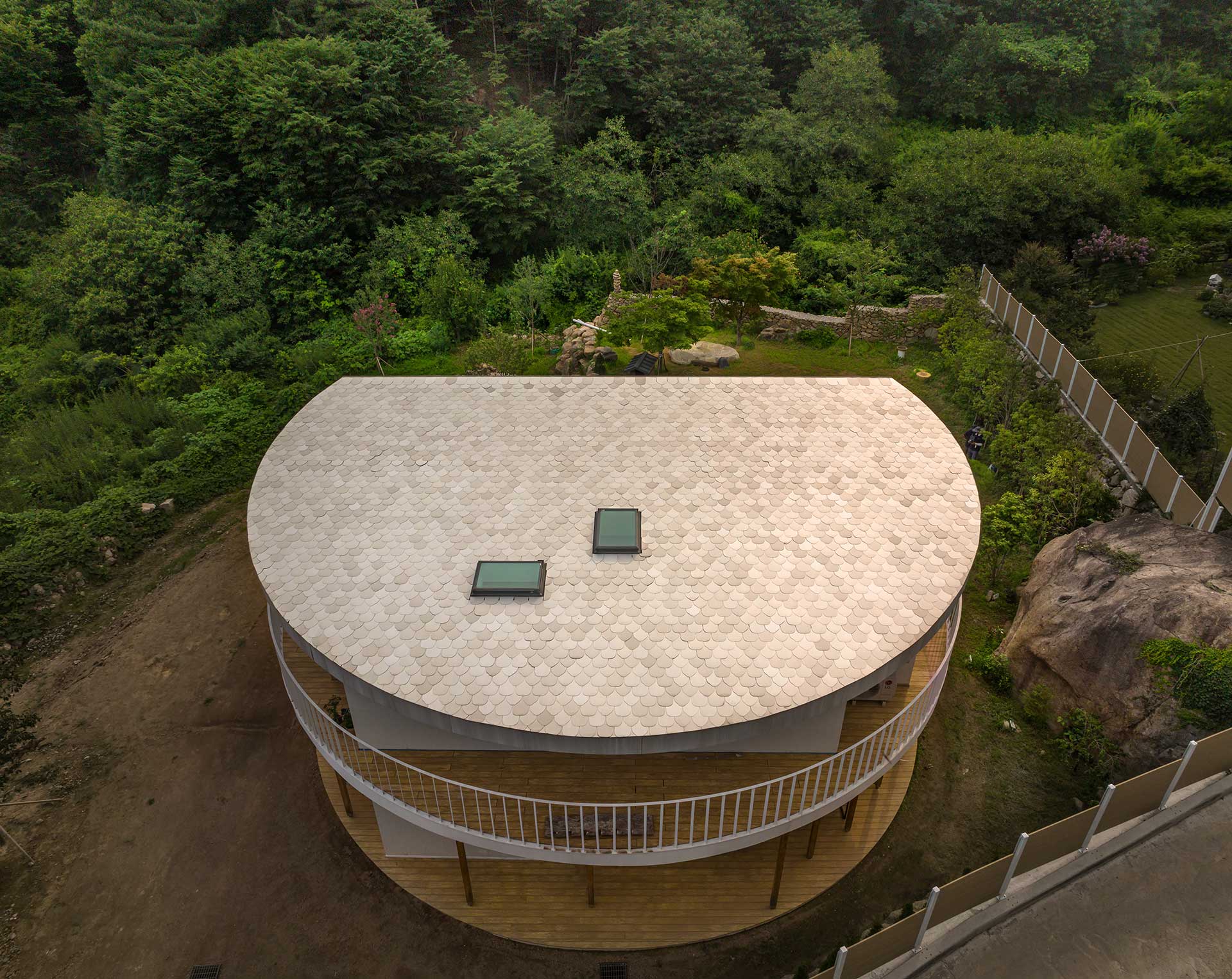
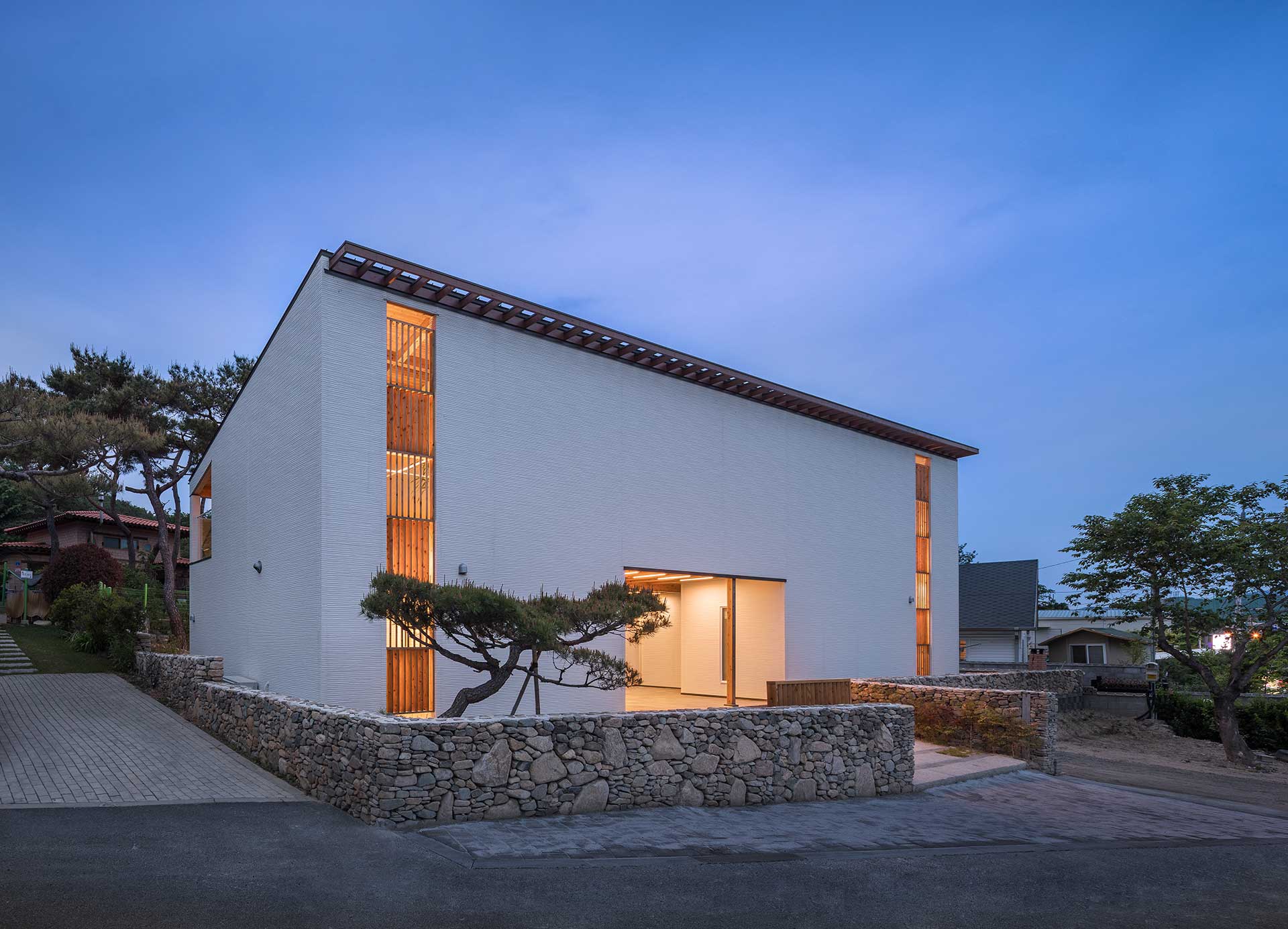
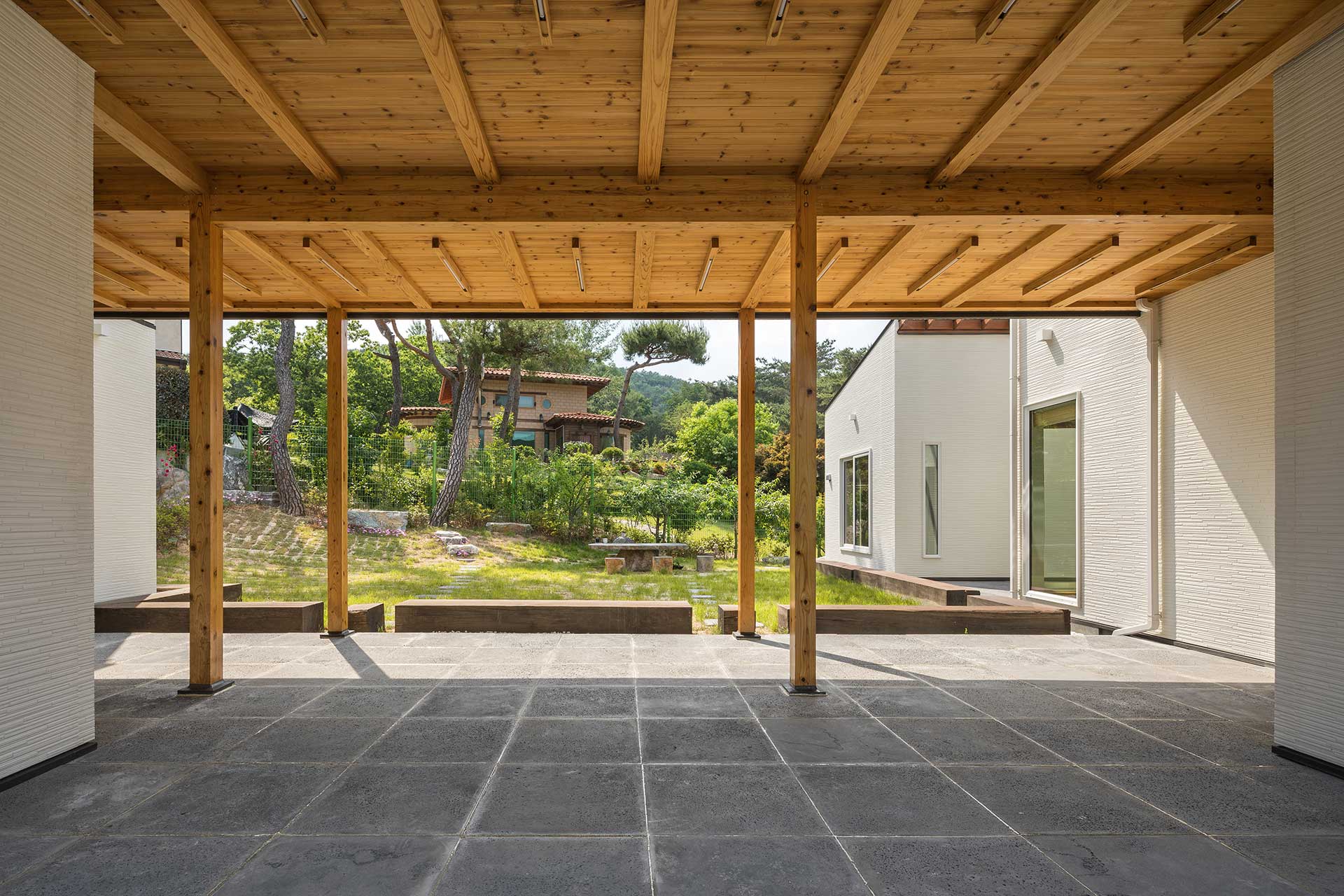
These criteria do not attempt to imitate old forms. Instead they focus on translating the structural logic of tradition into the conditions of the present and developing it into a new design language. The joinery methods of traditional timber architecture, the mechanisms of load transfer, and the strategies for responding to climate still provide valuable insights for contemporary issues such as energy efficiency and carbon reduction. I therefore understand tradition not as something to be restored but as something to be translated so that it can operate again within the present. In order to explore this balance I have conducted a range of experiments. In the project Wood Garden and House I reinterpreted the spatial structure of the traditional Hanok using engineered timber. In Arijujin I applied engineered wood to a commercial interior environment to test how the logic of traditional structural systems could function within a contemporary program. In Stone Nature and Wood House I experimented with creating a circular spatial structure using modular engineered timber that is typically based on linear systems, exploring a balance between organic spatial expression and structural efficiency. Through projects that range from residential architecture to commercial space I have repeatedly explored the points of connection between tradition and modernity across different scales. The culmination of this research and experimentation was the Ganjeolru project.
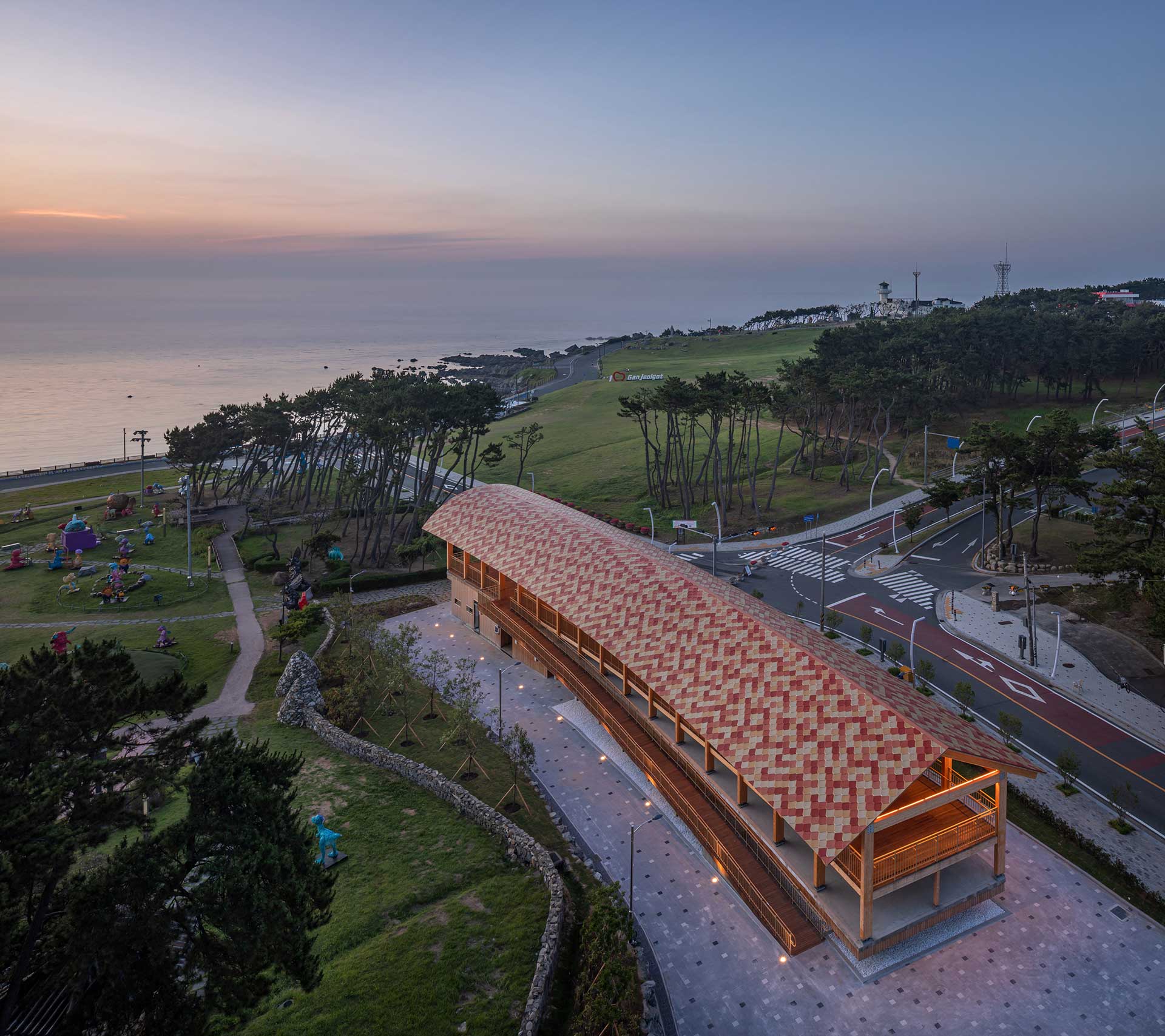
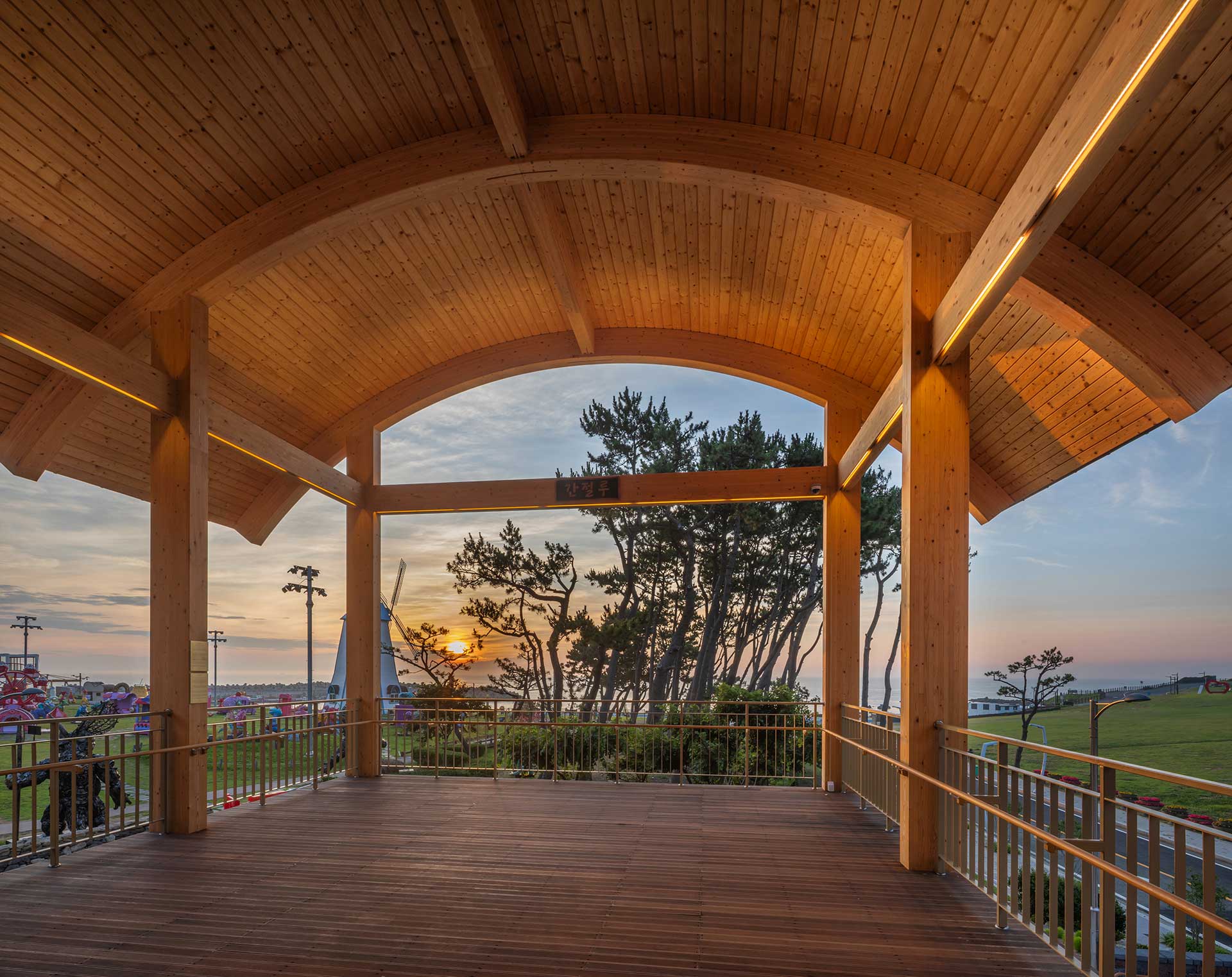
Ganjeolru is a public architectural project located at Ganjeolgot in Ulsan that interprets the local landscape and the sunrise through the contemporary reinterpretation of the traditional Korean spatial concept of the ru pavilion. The irregular roof structure is composed of seventeen different timber sections that rotate one degree at a time, transforming from angular geometry into a continuous curve. This system reinterprets the structural logic of traditional timber joinery through engineered timber and digital design technologies. It was also an attempt to structurally express the flow of the terrain that connects Bonghwasan Mountain to the sea and the direction of the sunrise. However expressing the landscape through structure alone was not sufficient. I also wanted the architecture to embody the experience of time and light at Ganjeolgot. Over an extended period I observed the sunrise and recorded data related to color temperature and seasonal change. Based on this research I collaborated with industry partners to develop the Ganjeolgot Sunrise Seven Color exterior system that could withstand strong sea winds and salt exposure. This system was not merely decorative but an architectural translation of the natural characteristics of the region into material form. Above all the most important aspect was structural verification. I had to ask whether this irregular roof structure would actually function in reality. How would timber elements at different angles distribute structural loads. Would the connection with metal connectors remain stable. How could construction tolerances be controlled on site. These were not conceptual questions but issues that required structural experimentation.
Through the precise design of engineered timber components and connection details and through repeated verification during construction I became convinced that timber architecture is not simply an emotional or nostalgic choice but can function as a fully contemporary structural system. Today timber has moved beyond the idea of a natural material and has become a modern structural language that reads the landscape, captures light, supports structural loads, forms space, and at the same time stores carbon. Ultimately the balance between tradition and modernity is not a compromise between historical images or a repetition of past forms. It is the process of rediscovering the fundamental principles of materials and allowing them to operate again through the technologies of the present while reorganizing them according to the environmental and social purposes of our time.
< Photo Courtesy of @yoon_joonhwan >
Timber architecture has recently received renewed attention in the field of public architecture, yet many institutional barriers still remain in the actual process of design and construction. From the perspective of an architect, what do you see as the most realistic limitations currently facing public timber architecture in Korea?
If I look at the situation broadly I believe there are two main issues. The first is that the forestry industry and the construction industry are not yet organically connected. The second is that accumulated experience and institutional foundations are still insufficient. The reason timber architecture is attracting attention in the public sector is clear. It is closely connected to the demands of our time, particularly carbon reduction and sustainability. Timber absorbs carbon during its growth process and stores it within the structural body when it is used as a building material. The fact that a building itself can function as a form of carbon storage is a significant value that distinguishes timber structures from other structural systems. However the reality is not as simple as the ideal.
The first limitation lies in the structural weakness of the forestry industry. At present forest policy in Korea is largely designed around preservation and management. This is certainly important. However industrial strategies that address how forests can be utilized as high value structural materials, expanded into engineered timber industries, and connected with regional economies are still insufficiently prepared. Without a stable timber supply system and production infrastructure for high performance engineered wood such as CLT and LVL, timber architecture will struggle to expand as a viable structural alternative. The second limitation related to the lack of experience and institutional systems appears in the field in several forms. Most importantly there is a lack of accumulated experience. Reinforced concrete and steel structures are supported by decades of design and construction experience as well as extensive technical data. In contrast large scale public timber buildings are still relatively rare and there are not yet enough accumulated cases. Designers, structural engineers, contractors, and supervisors are all in a stage where they must build experience simultaneously. As a result conservative judgments tend to be repeated, safety factors are often set excessively high, and this can lead to situations where both the design intention and economic feasibility are constrained.
This lack of experience is directly connected to issues of institutional coherence in design standards. Current building regulations have been developed primarily around reinforced concrete and steel structures. Detailed design guidelines and evaluation systems that properly reflect the characteristics of timber architecture remain relatively limited. For example in order to satisfy fire resistance requirements the cross sections of timber structural elements can sometimes become excessively large, which may simultaneously compromise structural efficiency and the intended design expression. The fragmented nature of the public procurement system also creates practical difficulties. Architectural, electrical, fire protection, and communication systems are often commissioned separately, which makes structural integration difficult and can lead to conflicts in construction processes and increases in cost. Timber architecture performs best when structure, building envelope, and mechanical systems are closely integrated, but the current system does not fully support this level of coordination.
Finally the evaluation system that focuses primarily on initial construction cost also needs to be reconsidered. Public buildings are still frequently evaluated based on initial construction costs alone. However the true value of timber architecture becomes visible through a more comprehensive perspective that includes long term carbon reduction effects, energy performance, and life cycle cost. Evaluation criteria that properly incorporate these aspects need to be developed with greater sophistication. Ultimately I believe this is not a problem of technology but rather a problem of institutional frameworks and industrial structure. Timber architecture already possesses sufficient structural potential. However unless forest policy, engineered timber infrastructure, design standards, integrated procurement systems, and long term evaluation frameworks operate together, it will be difficult for timber architecture to establish itself as a sustainable alternative. In order for timber architecture in public projects to move beyond being consumed simply as an environmentally friendly image and to become a genuine alternative supported by structural science, industrial systems, and institutional foundations, these broader transformations must occur together.
<VINE, Winner 2026, Photo Courtesy of @yoon_joonhwan >
In recent years environmentally responsible architecture, sustainability, and carbon reduction have become global priorities. Within this context timber architecture is attracting attention not simply as a traditional style but as a potential alternative for the future of architecture. What role do you believe timber architecture can play within the discourse of future architecture?
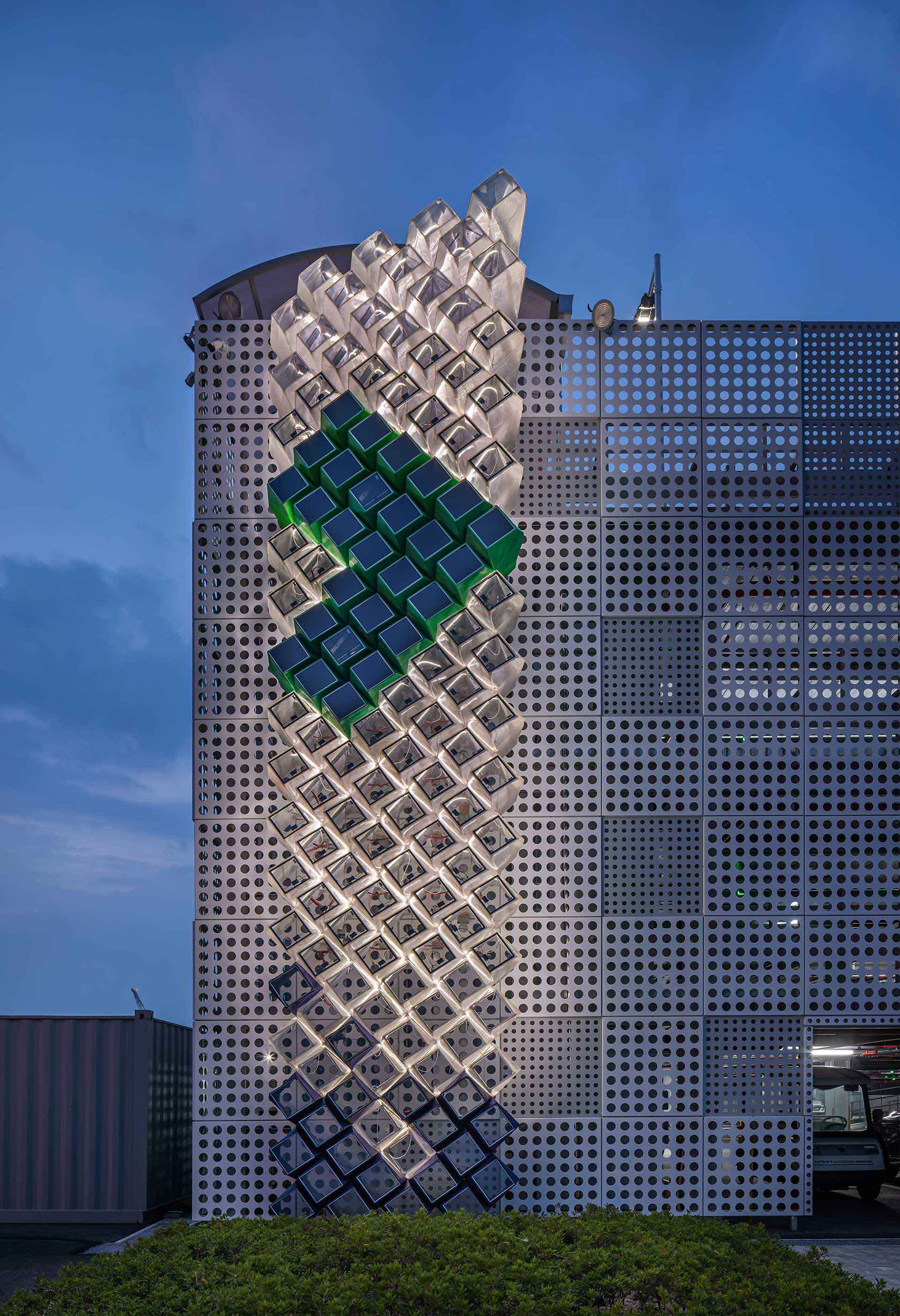
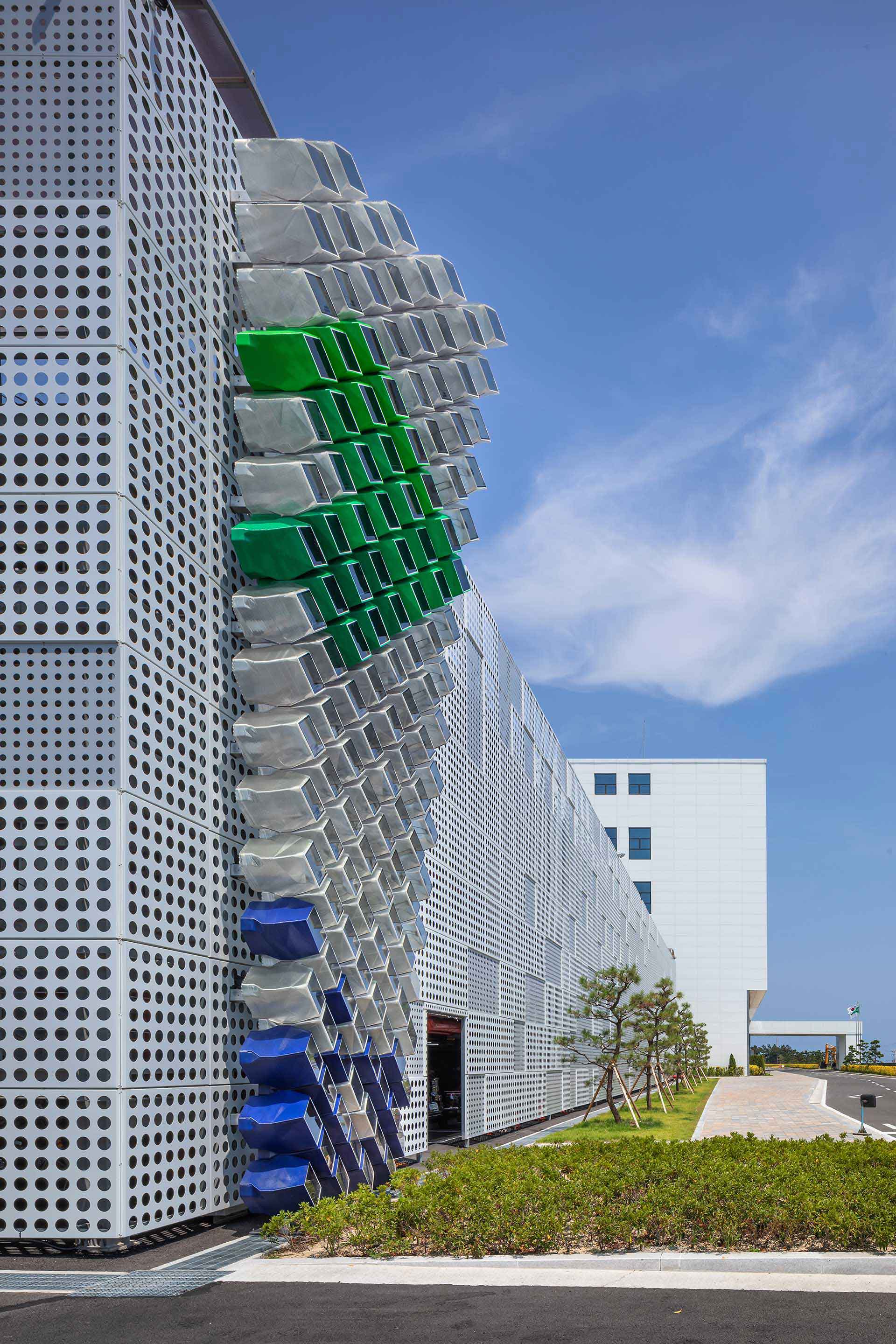
I believe that the most important issue in future architecture ultimately revolves around energy. We frequently discuss sustainability and environmental responsibility, yet most architecture still remains within the framework of consuming less energy rather than fundamentally rethinking the role of buildings within the energy system. Strategies such as improving insulation or increasing the efficiency of building equipment are certainly necessary, but they are essentially approaches that focus on reducing consumption. Because of this I began to change the question itself. I asked why architecture cannot produce energy. The experiment that began with this question eventually became the VINE project.
VINE was not simply a project that attached solar panels to a building. It was an attempt to redefine the building envelope itself as a structure capable of producing energy. Through AI based analysis of solar paths we designed conditions that would maximize solar exposure, and by using robotic three dimensional printing technologies we developed a spatial facade composed of curved and multi directional surfaces. This approach allowed us to maximize photovoltaic efficiency while evolving the envelope into an integrated system capable of both producing and storing energy. What was particularly important about this project was that it was not merely a technological experiment but a hybrid strategy that integrated structural systems with energy systems. I combined energy producing building envelopes with the lightweight and modular characteristics of timber structures. Timber functions as a structural body that stores carbon, while the energy producing envelope functions as a device that generates electricity.
When these two systems are integrated architecture can shift from being an energy consumer to becoming an energy producer. At the same time I am convinced that timber architecture alone cannot complete the discourse of future architecture. The fact that timber stores carbon within its structure is important, but it is not sufficient by itself. The transformations of our time demand broader changes that include energy transition, data based design, digital fabrication, and the restructuring of industrial systems. Timber architecture must also be experimented with, expanded, and redefined within these evolving conditions. In order for a traditional material to become a structural strategy for the future it must inevitably connect with contemporary technologies. In this sense the VINE project was not simply an experiment with solar technology but an example of how timber architecture can connect with the broader discourse of future architecture. When carbon storing structures, energy producing envelopes, and AI based optimization systems are integrated architecture can evolve into what might be described as an energy organism.
The VINE project attracted significant international attention including recognition at the Asia Design Prize as well as several other global design awards. I believe this response was not only because of the formal quality of the project but because it demonstrated the possibility that architecture could move from a system based on consumption toward a system based on production. I do not wish to confine timber architecture within the category of tradition. At the same time I do not claim that it is the ultimate solution. Timber architecture is an important starting point. When the structural foundation of carbon storage is combined with energy production systems and digital fabrication technologies we can finally begin to discuss a new paradigm for the architecture of the future. Architecture must move beyond simply using fewer resources and instead become something that actively generates value. In the future buildings will increasingly produce their own energy, store it, optimize their performance through data, and interact dynamically with their surrounding environments. Timber architecture must also continue to evolve through experimentation within this broader transformation.
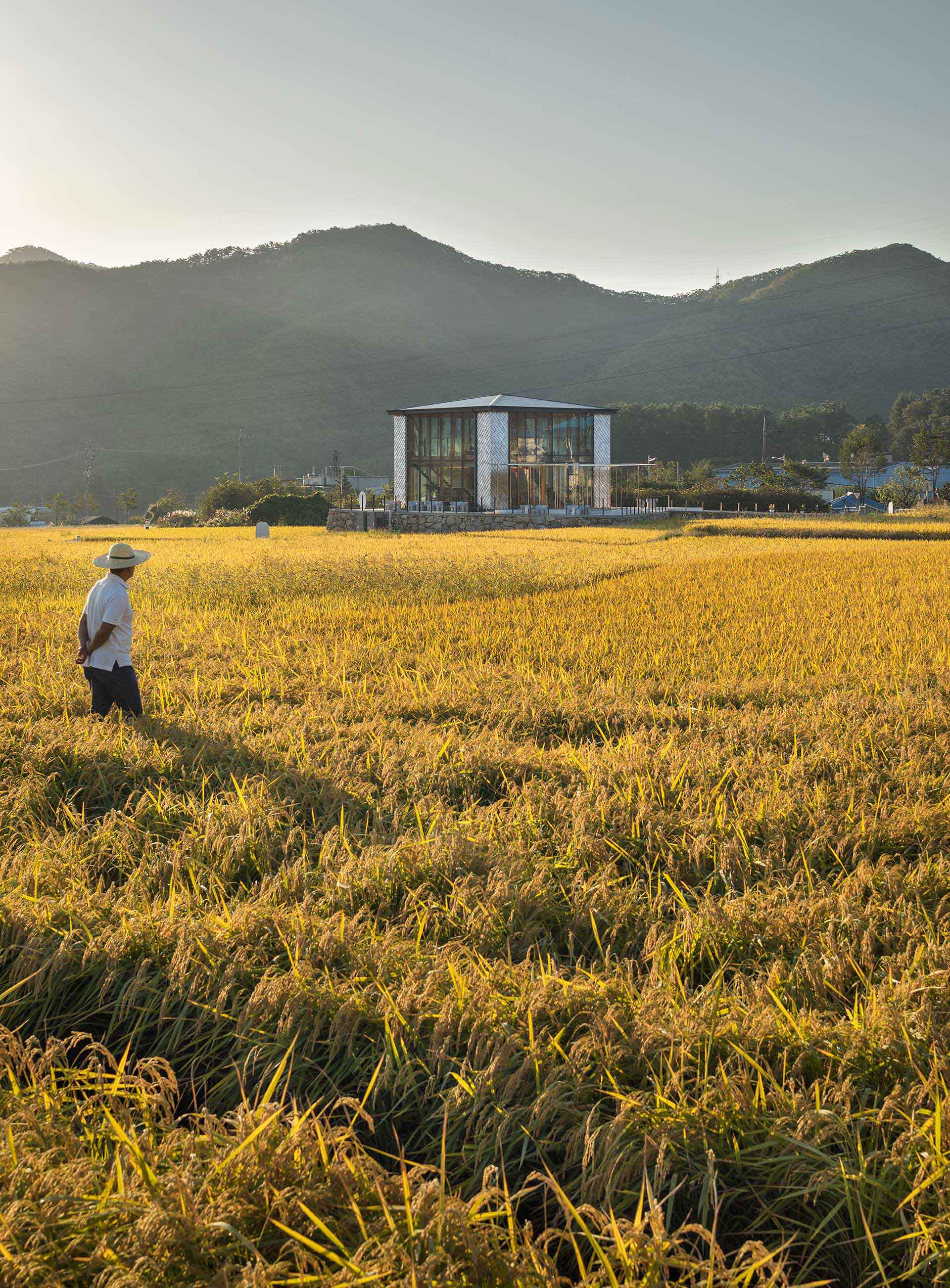
< Photo Courtesy of @yoon_joonhwan >
Your work and research extend beyond architecture and are deeply connected to design, spatial experience, and regional context. If you were to describe your personal design philosophy in a single sentence or concept, what would it be?
If I were to summarize my design philosophy in one sentence I would say that it is about creating sustainable structures and spaces that begin with the uniqueness of a place and then design and experiment with new experiential relationships discovered within that context. I always begin my questions from the place itself. What kind of landscape does this land have, what kind of climate and light does it contain, what kinds of industries and memories have accumulated here, and how have people experienced this space over time. My design process begins by reading the uniqueness and particular qualities of that specific place. However the question does not stop there. The issues of one region are inevitably connected to global challenges such as climate crisis, energy transition, transformations in industrial systems, and the expansion of digital technologies. I do not believe that local narratives and global changes exist separately. Rather I believe that architecture begins to find its true meaning when questions that originate in a specific place expand through encounters with broader changes of our time.
For me design is not the act of creating a particular form. It is the act of reading the relationships that exist between materials and structures, light and time, technology and industry, place and people, and designing how those relationships can be reorganized within both local context and global conditions. Architecture is not a fixed object but a system that continuously interacts with its environment and evolves through that interaction. Timber stores carbon, the building envelope produces energy, the structure distributes loads, and colors and surfaces carry the atmosphere and temporal qualities of a place. When these elements are organically connected architecture becomes a structure of experience that simultaneously carries the story of a place while responding to the demands of the present era. For this reason I always emphasize the importance of details that truly function. No matter how persuasive a concept may be architecture loses its strength if it does not work within real conditions. During the design process I continuously experiment and ask questions.
Does this structure function properly within the conditions of this place and does this space respond to the needs of our time. Design is ultimately tested in reality and verified through the experiences of people. The accumulation of small details eventually completes the structure of the whole. In the end architecture for me is not about presenting a finished form. It is about beginning with the uniqueness of a place, reinterpreting it within the flow of global issues and contemporary change, experimenting with it in sustainable ways, and realizing it as a structure that can be shared within society. Through this process architecture becomes not simply a physical object but a living cultural system that connects local context with the wider world.
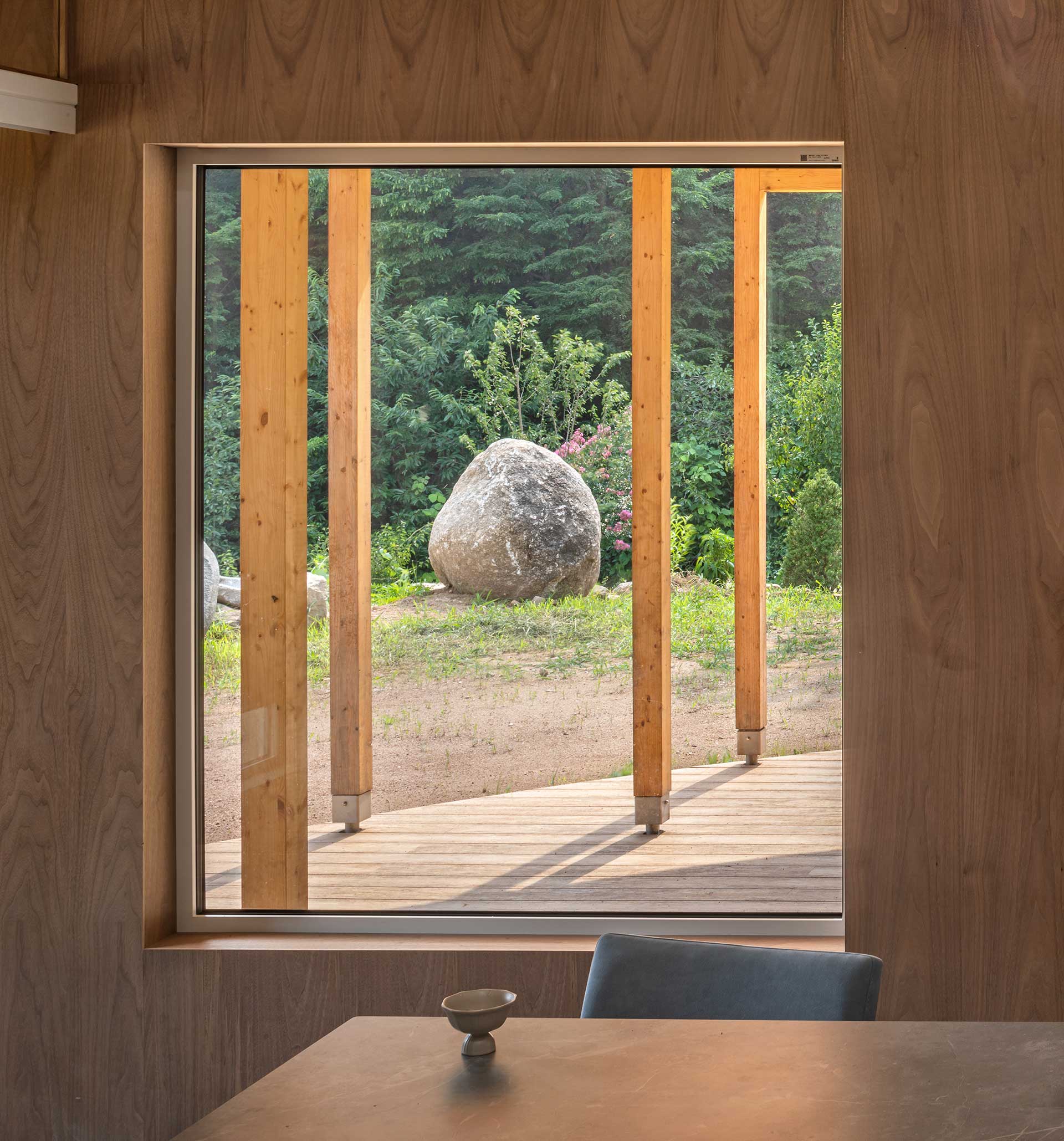
< Photo Courtesy of @yoon_joonhwan >
For a long time Asian design and architecture have often been perceived as peripheral within a discourse dominated by the West. From your perspective, where do you think Asian, particularly Korean, architecture and design stand today, and what direction should they move toward in the future?
Historically it is true that the West has often produced the dominant theories and discourses while Asia has largely been positioned as a place that receives or adapts them. For a long time we have also used expressions such as global architect or global designer quite naturally. Of course the influence and achievements of those figures deserve recognition. Their role in shaping global discourse and proposing new directions has been important within architectural history. At the same time however I believe it is necessary to ask another question. Have we perhaps relied too heavily on that standard of what is considered global. A globally recognized architect cannot fully understand every local context or solve the problems of every place in the most appropriate way. Architecture is ultimately a discipline of place. It operates within concrete conditions where landscape, climate, industry, culture, and collective memory accumulate over time.
I believe the situation is now changing. Issues such as climate crisis, energy transition, high density urbanization, and social transformations after rapid industrialization are challenges that many Asian societies have experienced more directly and often more intensely than others. Conditions characterized by rapid change, complex urban environments, and the coexistence of tradition and modernity have become fertile ground for experimenting with new models. Korea in particular occupies a very unique position. Through phenomena such as Korean popular music and Korean cuisine cultural influence has already reached a global level, while at the same time the country possesses strong manufacturing industries and advanced digital technological capacity. This combination of cultural sensitivity and industrial capability creates significant possibilities for architecture and design. The conditions are already present for local narratives and global technologies to meet and interact. Looking forward I believe the most important task is not to follow a single trend but to create an environment where diversity can be respected and encouraged.
As society becomes more complex the era in which one heroic architect could solve every problem has passed. Instead what is needed is an ecosystem where many designers and architects can experiment within their own contexts and fields. Above all it is essential that the people who understand a region most deeply are able to design what that region truly needs. Only those who deeply understand the climate, history, industry, ways of living, and cultural memory of a place can propose structures and spaces that are truly appropriate for it. When local experts are respected and their experiments are recognized a healthy architectural culture can grow. Originality cannot be artificially manufactured. It emerges from the unique culture and experiences of a place and develops gradually over time. When each region preserves its own characteristics and memory while connecting them with contemporary technologies genuine originality can be sustained and expanded. For this reason I am convinced that Asian architecture is no longer peripheral. What matters now is not following external perspectives but creating structures in which we define and address our own problems. The future of Asia and of Korea already exists within their own regions. The key question is how deeply we understand it, how carefully we value it, and how we develop it further within the changing conditions of our time.
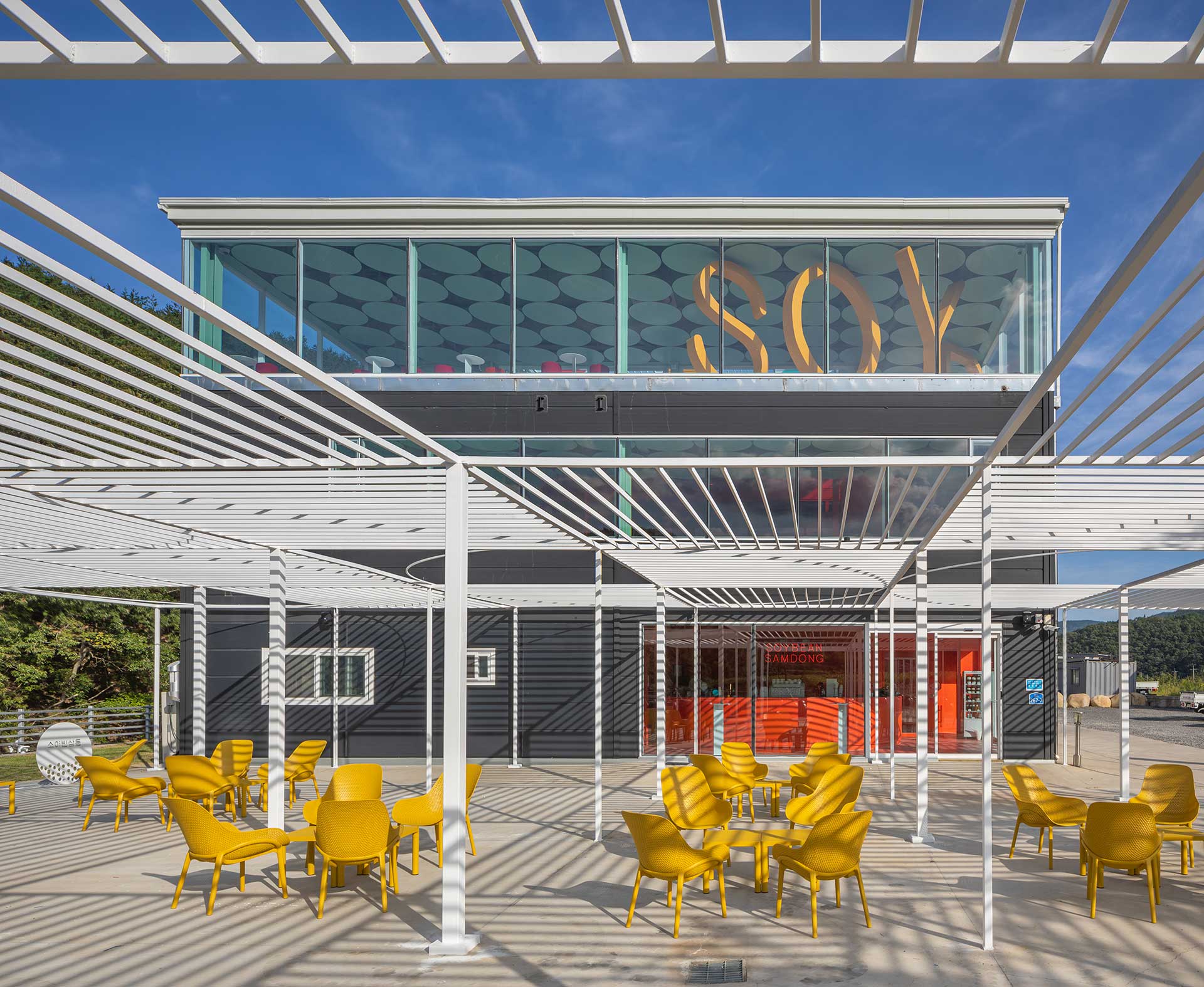
< Photo Courtesy of @yoon_joonhwan >
As an educator you have worked with many students over the years. In what ways do students of design and architecture today appear most different from previous generations, and what abilities do you believe they must not overlook?
Students today belong to a generation that has grown up within a digital environment. They handle artificial intelligence, parametric design, and simulation tools with natural familiarity and they accept new technologies without hesitation. Their ability to visualize ideas is also remarkably fast compared to previous generations. This is clearly a significant advantage and an important capability within the contemporary architectural environment. However I often tell my students that proficiency with tools does not necessarily mean depth of thinking. The ability to produce something quickly and the ability to question something deeply exist on entirely different levels. Technology opens possibilities, but the judgment of what should be created and why it should be created still belongs to human beings. There are three points that I emphasize most strongly to my students.
The first is the ability to define problems and communicate them clearly. Before thinking about what to design it is essential to understand precisely what the problem is. Students must be able to understand social context, environmental conditions, and user experience and then articulate those issues through clear language. The second is the ability to think about structure, environment, and energy in an integrated way. Form is only the result. Designers must also consider what structural system supports that form, how energy is produced and consumed, and how the building interacts with its surrounding environment. Architecture ultimately operates as a system. The third is the attitude of verifying ideas within real conditions. Anyone can produce a rendering today. However fewer students ask whether the structure could actually stand in reality, how loads are transferred, how materials are joined, or how efficiently energy is used. I often ask my students a simple question. Does this actually work. In the end I believe the most important ability for future designers and architects is the strength to continue asking why until the very end. The ability to produce something quickly is less important than the attitude of questioning, experimenting, and verifying ideas persistently. Technology will become increasingly powerful. As that happens deep thinking and responsible judgment will become even more valuable.
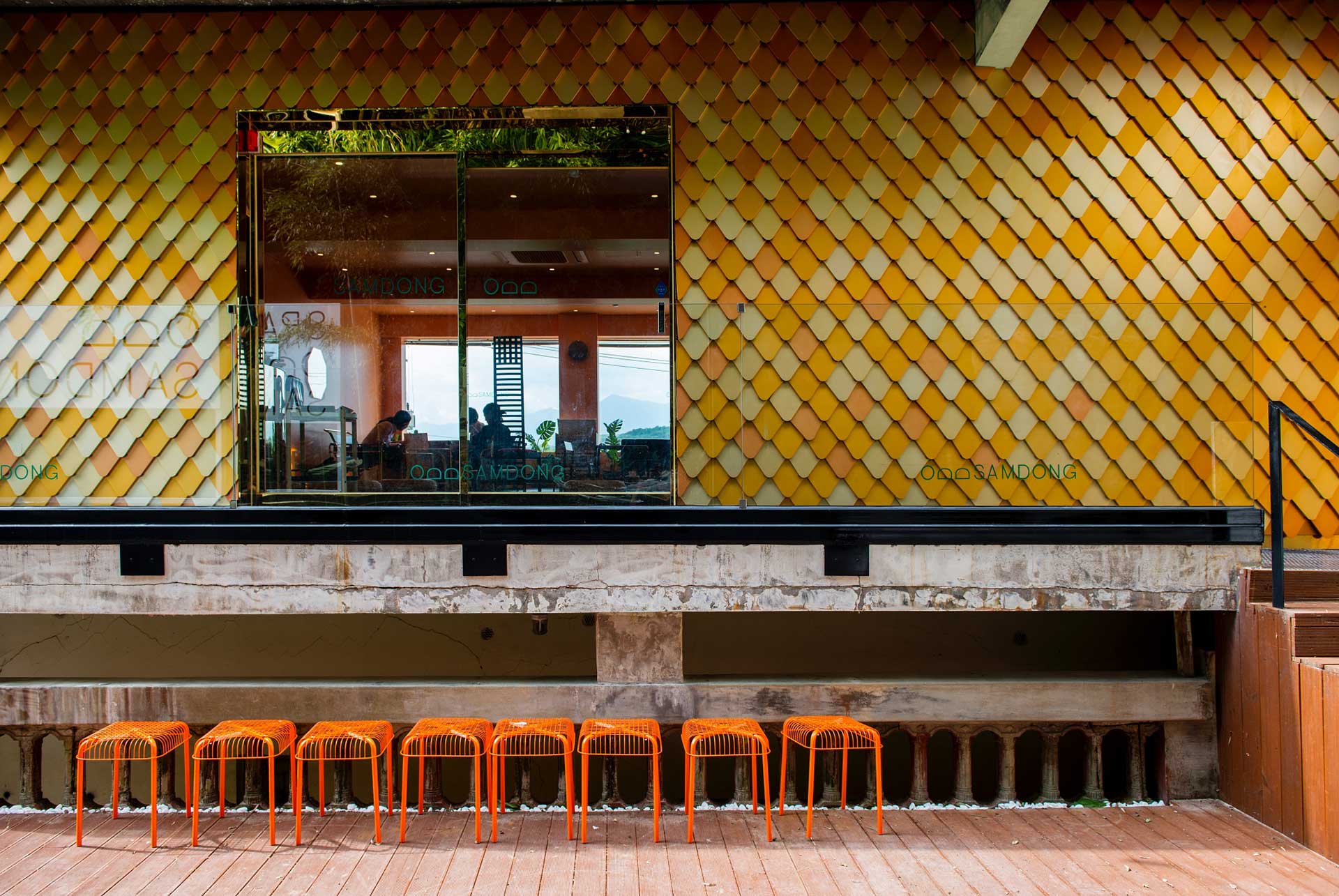
< The Perpetual Golden Leaf, Winner 2020, Photo Courtesy of @yoon_joonhwan >
Digital technologies, artificial intelligence, and simulation tools are rapidly transforming the entire process of architecture and design. Within these changes what do you believe must remain unchanged as the essential role of architects and designers?
Artificial intelligence can generate forms rapidly. Simulation tools calculate structural behavior and data can precisely predict energy efficiency and environmental performance. The process of design is becoming increasingly automated and the speed of production is accelerating dramatically. We now live in a time when even highly complex forms and structures can be generated almost instantly through algorithms. Yet I believe that within these transformations the essence of the architect and designer becomes even clearer. The moment we ask who we are designing for and what we should design the fundamental role of the architect and designer becomes more defined. Technology is only a tool. The decision about what should be created and why it should be created still belongs to human beings. Architecture is ultimately a social act. It organizes the lives of people, influences the environment, and has the power to reshape the structure of cities.
For that reason I believe the essence of architecture and design begins with understanding human beings. Everything we design should exist for people, for society, and for a better future. As technology advances I believe understanding human experience becomes even more important. Algorithms may suggest forms, but they cannot judge human emotion, collective memory, community context, or social responsibility. Data can calculate efficiency, but it cannot determine what a space will mean to the people who inhabit it. At the same time as technology becomes more sophisticated we are becoming increasingly accustomed to working alone. With a single computer and software program a large portion of the design process can now be completed independently. However architecture is never the work of a single individual. It is a collaborative act that is completed through dialogue between people. Architecture gains social meaning only through communication with structural engineers, builders, users, and local communities.
For this reason I believe the most important abilities for future architects and designers are empathy and communication. The ability to understand human experience, respect society, and connect different perspectives is essential. The willingness to engage in dialogue, share ideas, collaborate, and move toward better solutions together is something that technology cannot replace. The essence of architecture and design does not lie in producing forms. It lies in understanding people, respecting society, imagining a better future, and realizing it responsibly. As speed increases the direction must become clearer. As technology becomes more precise our understanding of humanity must become deeper. In the end architects and designers are not simply people who construct buildings. We are people who design the future of society and human life.
Finally, looking ahead, are there any new areas you hope to challenge in your future work or research, and what message would you like to share with the next generation of designers and architects?
In the future I would like to focus on hybrid architectural systems in which timber architecture and energy design are organically integrated. My goal is to build an advanced architectural model that combines timber structures which function as carbon storage bodies with energy producing building envelopes while integrating AI based design and digital fabrication technologies. Until now these kinds of experiments have mainly been conducted at the scale of individual buildings, but moving forward I would like to expand them into energy and structural systems at the scale of the city. Rather than focusing on isolated buildings my research aims to explore urban ecosystems in which structures are connected, share data, and continuously optimize themselves.
I believe that the architecture of the future will no longer remain limited to creating beautiful spaces. Instead it will involve designing living ecosystems where structure, energy, and technology are organically connected. Architecture must transform from a consumer into a producer and from a fixed object into a continuously evolving system. I would like to continue experimenting with and verifying this process of transformation. The message I would like to share with the next generation is clear. Seek out difficult challenges and engage with problems that are more complex and demanding. We now live in a time when shortcuts to clear answers are disappearing. The world is becoming more complex and relatively simple tasks are increasingly being replaced by artificial intelligence and automated technologies. Today it is possible to create convincing images and results even from simple ideas. This is certainly a positive change. More people are able to engage with design and architecture and culture continues to expand. However the people who will remain meaningful within this expanding culture are those who can continue to ask new questions and construct new systems within it. I often tell my students to actively use new technologies, tools, and artificial intelligence, but never to stop at rendering images.
Human beings must go further by designing new structures and experiences based on human thinking, sensitivity, and responsibility and by proving their ideas through real conditions. Technology is a powerful tool, but once we become dependent on tools our thinking can easily become shallow. The important task is to use technology while maintaining independent judgment and a thoughtful attitude that does not become subordinate to it. At the same time the goal should not be to become an expert who works well alone. What matters more is the ability to share ideas, engage in dialogue with others, learn together, and expand culture collectively. Architecture is ultimately a collaborative act. In the end the architects and designers of the future should not simply be people who operate technology. They should be people who can understand and take responsibility for human beings, society, and the environment beyond technology itself. Above all they should be individuals who continue to question, continue to experiment, and continue to challenge themselves until the very end.
















#14057, 905 49, Beolmal-ro 102beon-gil,
Dongan-gu, Anyang-si, Gyeonggi-do, Korea
Business Registration Number: 454-86-01044
Online Sales License No.: 2021-Anyang Dongan-1081
Copyright © DESIGNSORI Co., Ltd.