
One of the questions I hear most often while teaching students is, “How can I develop a better design sense?” It is a concern that almost every design student has likely wrestled with at some point. What is particularly interesting is that this question appears far more frequently today than it did in the past. Ironically, today’s students are studying within the richest visual environment in history. Pinterest offers an endless archive of references, Instagram delivers the latest global trends in real time, and generative AI can produce professional quality mood boards and concept images within seconds. In terms of access to visual information alone, students today begin from a position that is overwhelmingly more advantageous than any previous generation. But this raises an important question: Are we actually becoming designers with better judgment and stronger aesthetic sensibilities than those who came before us?
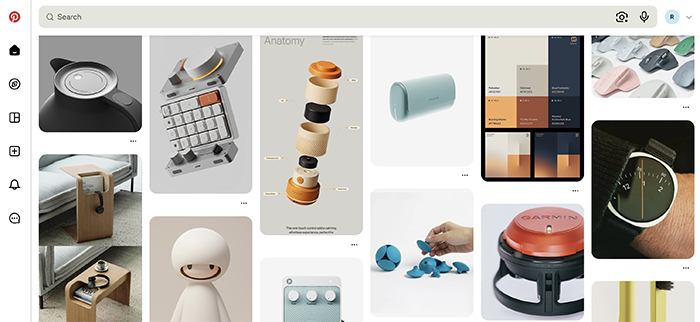
Design judgment is not developed through the collection of images, but through the interpretation of them.
< Image courtesy of Pinterest >
I do not view AI or Pinterest negatively. On the contrary, I believe they are powerful tools available to designers. Information that once required hunting down international design magazines or traveling to exhibitions can now appear instantly with just a few taps. As a practicing designer, I frequently used Pinterest myself. Through these platforms, students can compare hundreds of references in a short period of time and use AI to rapidly visualize their ideas. In many ways, they enjoy a level of accessibility and efficiency that designers of previous generations could hardly have imagined. Yet this is precisely where I often encounter a strange dilemma. Despite being exposed to an enormous volume of visual references, students’ outcomes frequently share similar moods, similar aesthetics, and similar visual languages. They appear polished and sophisticated, yet somehow familiar. At times, the results feel like carefully calculated averages of countless references rather than genuinely original expressions.
Perhaps the issue is not a lack of information, but our attitude toward information itself. We live in an age of excessive visual consumption. But seeing and observing are entirely different things. Many students mistake the act of collecting references for the act of learning, yet design judgment is not proportional to the number of saved images. The best designers do not simply consume finished work; they deconstruct it. When they encounter a beautiful product, they do not stop at saying, “This looks nice.” Instead, they ask why a particular proportion was chosen, why a specific material was used, why users feel comfortable interacting with it, and what manufacturing processes or engineering structures made such a form possible. Design judgment does not begin with admiration. It begins with questions.

Even the subway handrail we hold every day becomes a subject of inquiry for a designer.
The moment we ask why it had to be this size and this shape, observation begins.
< Image courtesy of Unsplash’s Pradamas Gifarry >
What is interesting is that many students unconsciously search for the “right answer” when working on design projects. By following the most saved images on Pinterest, award winning projects from prestigious design competitions, or the most polished results suggested by AI, it can begin to feel as though there is a formula for good design. Studying excellent precedents is certainly important. But design is not a mathematics problem. It is not a process of converging toward a single correct answer, but rather one of creating your own interpretation among countless possibilities. Sometimes, entirely new perspectives emerge the moment we begin questioning what has long been accepted as the correct answer. In the end, design judgment is less about knowing many good answers and more about discovering meaningful questions.
But this raises another question. Can a designer’s eye truly develop by looking only at design? I would argue the opposite. A refined sense of proportion can often be learned more effectively from classical architecture than from product design case studies. The beauty of negative space may reveal itself more clearly on a museum canvas than within a user interface. The tension between function and form can become far more apparent in the intricate mechanisms of aircraft engines or robotics than in furniture design. Ultimately, design is not learned solely from design itself. New perspectives emerge through the observation and connection of different disciplines. Curiosity about diverse fields, a willingness to embrace unfamiliar experiences, and the courage to question perspectives that feel familiar are what truly cultivate a designer’s eye.

The Beauty of Function Created by Complex Structures and Sophisticated Mechanisms.
Design inspiration is often discovered beyond the boundaries of design itself.
< Image courtesy of Unsplash’s Luka Slapnicar >
This is why I often encourage students to live as designers even outside the classroom. The alleyways of Seongsu dong explored on a weekend, the typography of a shop sign casually passed on the street, the lighting and circulation of a café, the thickness and material of a subway handrail, or even the interface of a kiosk that elderly people struggle to use, every scene in the world is a vast field of design research. What matters is not how much you have seen, but how deeply you have questioned what you see. Hidden within the ordinary moments we often overlook are countless design intentions, compromises, and insights into human behavior. The process of discovering these layers and interpreting them through your own perspective is perhaps the most practical and effective way to develop a designer’s eye.
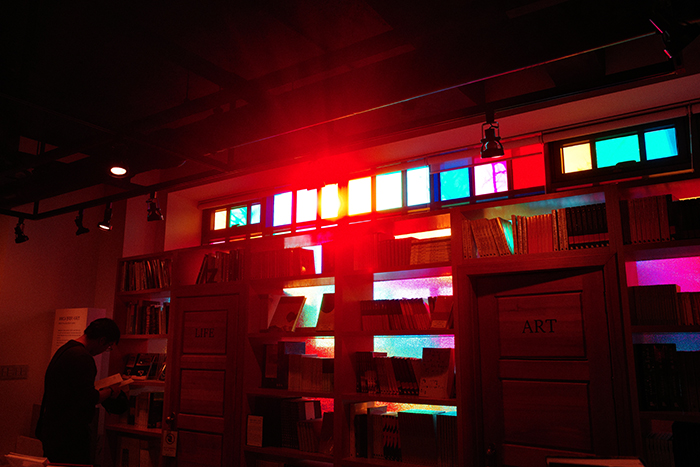
A Serendipitous Discovery of Light and Space at the MMCA Seoul Museum Shop.
Design inspiration often emerges from the most unexpected moments of everyday life.
< Photograph by the Author >
There is one more element that must be added to this process: the ability to accept criticism. While conducting design critiques, I often encounter students who are comfortable explaining their own work but struggle to embrace perspectives different from their own. Of course, the ability to articulate ideas logically is important. Yet what matters even more is the willingness to acknowledge that someone else’s viewpoint may differ from your own. Designers are not only interpreters of the world; they are also constantly being interpreted by others. The flexibility to accept diverse perspectives and revise one’s own thinking is not merely a skill, as it is one of the most powerful assets for developing design judgment. The best designers are not those who stubbornly defend their ideas, but those who remain open to discovering better perspectives.
AI will continue to become more intelligent. Pinterest will continue to accumulate endless images. Yet deciding what to observe, what to be curious about, and how to translate lived experiences into a personal design language will remain the responsibility of human designers. Ultimately, design judgment is not a special talent that suddenly appears one day. It begins not with saving thousands of images, but with the habit of observing a single object deeply. It grows not from searching for answers, but from cultivating the habit of asking questions. When references from screens meet experiences from the real world, and when observation, inquiry, criticism, and acceptance are repeated and accumulated over time, a truly personal perspective begins to emerge. I hope students can live as learners within school and as interpreters of the world beyond it. After all, a designer’s eye is not fully formed inside the classroom. It truly begins to grow the moment one steps outside its doors.
Anyone can learn design software. Anyone can use AI to generate impressive images. But becoming a designer with genuine judgment and a distinctive point of view is an entirely different matter. It is not achieved by following predefined answers, nor is it completed overnight. It is built through curiosity about the world, a willingness to ask questions, and countless hours of careful observation. Perhaps that is why design is both easy and difficult at the same time, being difficult, yet endlessly fascinating.



















#14057, 905 49, Beolmal-ro 102beon-gil,
Dongan-gu, Anyang-si, Gyeonggi-do, Korea
Business Registration Number: 454-86-01044
Online Sales License No.: 2021-Anyang Dongan-1081
Copyright © DESIGNSORI Co., Ltd.